Arsenal Reaches Champions League Final After Thrilling Semi-Final Victory
Arsenal’s night of reckoning ended with a roar, not a whimper. All the months of control, of structure, of carefully plotted progress under Mikel Arteta came down to 90 frantic minutes, a single goal and a final whistle that seemed to release a decade of tension in north London.
This was not about respectability. Not about plaudits for a brave effort. This was about breaking through a ceiling that has hovered over the club since 2006. Arsenal are back in a Champions League final – and this time they arrive looking like they belong.
A semi-final that felt like a reckoning
The stakes were clear even before a ball was kicked. Manchester City’s slip at Everton on Monday had pushed the Premier League door ajar. Arsenal could almost feel the trophy. But this was something different. This was the gateway to the game’s biggest stage, with Paris Saint-Germain or Bayern Munich waiting in Budapest on 30 May.
The Emirates responded with a crackle rather than a cauldron. Red flares greeted the team buses, fireworks had rattled Atlético Madrid’s sleep over Shoreditch the previous night, and “North London forever” rolled around the stands. It wasn’t intimidating in the old-fashioned sense. It was anxious. Hopeful. Heavy with memory.
Arteta leaned into it. He picked a team to attack the moment, not tiptoe through it. Riccardo Calafiori, more playmaker than full-back, started on the left. Myles Lewis-Skelly was thrown into a driving central role. Declan Rice sat deeper, the fulcrum and fire blanket. Ben White stepped infield from right-back, turning Arsenal’s back line into a launchpad.
Diego Simeone, dressed in his familiar black, went the other way. Two banks of four. Lines tight. Space rationed. His Atlético have been too porous this season, too unlike the snarling units of his prime years, and he demanded something closer to the old steel here.
Arsenal’s pressure, Saka’s punch
The early exchanges were exactly what a Simeone semi-final promises: attrition. Antoine Griezmann drifted wide to the right, looking to drag Calafiori into awkward places. Giuliano Simeone twice found pockets, first crossing low for Julián Álvarez to drag wide under pressure, then seeing a half-chance smothered by a fierce Rice challenge.
But it was Arsenal who carried the weight of the game. They played high, on the front foot, punching at the Atlético block, probing for those tiny seams that open only for a heartbeat. Three times they slipped in behind during the first half, three times the Spanish side scrambled, cleared, or clogged the central lanes.
The fourth time, they broke.
On 44 minutes, William Saliba stepped in and threaded a pass up the inside-right channel. Viktor Gyökeres darted on to it, Oblak charged, then hesitated and retreated. That blink was all Arsenal needed. Gyökeres whipped the ball across the box, Atlético’s shape shuddered, and it reached Leandro Trossard on the far side.
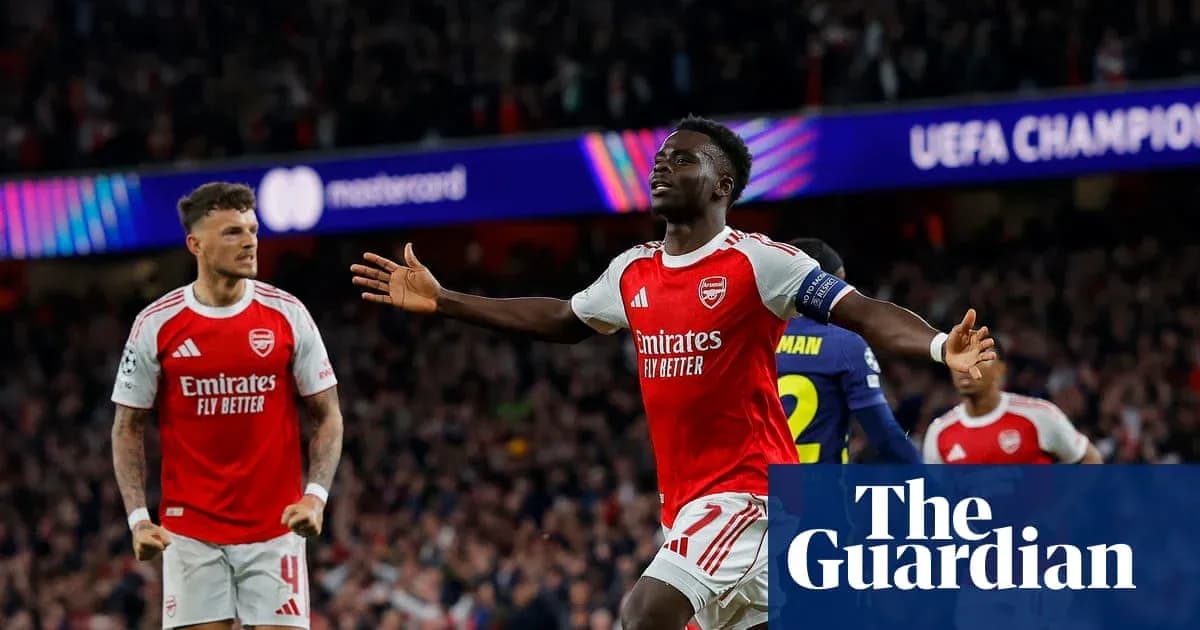
Trossard paused, jinked inside, and let fly. Oblak, peering through a thicket of bodies, spilled the shot. One man reacted faster than everyone else. Bukayo Saka. Close range. No fuss. Arsenal had their lead, and suddenly the whole stadium felt as if it had taken a step closer to Budapest.
Simeone’s surge and Arsenal’s resolve
The second half flipped the script. Atlético pushed up. Arsenal dropped a few yards, content to absorb and counter. Simeone prowled his technical area, every decision a performance, every contact in the box a cause.
He exploded when his son almost turned the tie. Giuliano Simeone latched on to a poor back header from Saliba, rounded David Raya with a perfect first touch and went down as Gabriel Magalhães chased. The contact, if there was any, lived in the margins. No penalty. No finish. No lifeline.
The game opened up. Rice led a break that ended with a Gyökeres shot blocked. At the other end, Griezmann stung Raya’s palms and, as the rebound spilled, Marc Pubill was penalised for a foul on Gabriel. A huge call, and a necessary one for Arsenal, because in the very next phase Calafiori clipped Griezmann in the box. The whistle had already gone. The danger passed.
Now the tie felt stretched, brittle. One goal either way would define it. Arsenal hunted the knockout blow and nearly found it. Substitute Piero Hincapié swung in a cross and Gyökeres met it first time in front of goal, only to lean back and send his effort rising over the bar. A huge chance, wasted.
Pubill then flirted with disaster in the 81st minute, hauling down Gyökeres as the last man and somehow escaping a red card. It barely registered with Arsenal’s players. The only priority now was survival.
Hearts in mouths, eyes on Budapest
The suffering was inevitable. Nights like this demand it. With four minutes of normal time left, it arrived in the form of Alexander Sørloth. A low cross fizzed through the Arsenal box, the substitute stepped into its path and swung. He missed. The entire stadium exhaled.
Atlético would not come closer. Their final push dissolved into hopeful balls and weary runs. Arsenal’s defence, so often questioned in previous European campaigns, stood firm. Saliba and Gabriel attacked everything. Rice closed lanes and smothered counters. Saka ran until his legs emptied.
When the whistle came, Arteta lost himself in the noise. He punched the air, embraced his staff, and soaked in a scene that felt like a personal vindication as much as a club milestone. This was the boldest step yet under his watch: a second Champions League final in Arsenal’s history, the first in 18 long years.
The party in north London will rage deep into the night. But somewhere beyond the music and the relief sits the bigger question: with a title race alive at home and a giant waiting in Budapest, just how far can this Arsenal side push the limits of its own story?