Arsenal's Tactical Mastery Sees Off Liverpool at Anfield
Anfield under the lights, Premier League leaders Arsenal walking out to face a Liverpool side still discovering its new identity under Andoni Iraola. The fixture may be in the books as a 0–1 defeat for the hosts, but the squads and season arcs tell a deeper story about where these teams stand and how this clash was always going to be decided on fine tactical margins.
I. The Big Picture – Contrasting trajectories
Heading into this game, Liverpool sat 5th with 15 points from 9 matches, their overall goal difference a slender +2 (11 scored, 9 conceded). The numbers underline a split personality: on their travels they had been ruthless, winning 3 of 4 and scoring 7, but at Anfield they had only 1 win from 5, with just 4 goals scored and 6 conceded. An overall attacking average of 1.2 goals per game drops to 0.8 at home, a stark figure for a club used to turning this stadium into a scoring machine.
Arsenal arrived as league leaders, 1st with 24 points from 9 games, built on an overall goal difference of +9 (14 for, 5 against). Their balance is striking: 4 wins from 4 at home and 4 wins from 5 away, with 5 away goals scored and only 3 conceded. Their overall scoring rate sits at 1.6 goals per match, but the defining statistic is defensive – just 0.6 goals conceded per game, with 6 clean sheets in total, including 4 away. This is a side comfortable suffering without the ball, then punishing mistakes with clinical precision.
Both coaches doubled down on their preferred shape: a 4‑2‑3‑1 for Liverpool and the same structure mirrored by Mikel Arteta. That symmetry made individual matchups, pressing triggers and small structural tweaks decisive.
II. Tactical Voids – Who was missing and what it meant
Liverpool’s absentee list was long and targeted key roles. Conor Bradley (knee), H. Ekitike (Achilles), J. Frimpong (muscle), G. Leoni (knee) and A. Nallo (leg) all missed out. The headline absence in tactical terms was Frimpong: without his vertical thrust from wide areas, Iraola leaned heavily on Miloš Kerkez at left-back and the creativity of Florian Wirtz and B. Barcola between the lines to generate width and overloads.
For Arsenal, the absences were even more symbolic. Bukayo Saka (thigh) and William Saliba (back) were out, while M. Dowman was suspended after a red card. Removing Saka and Saliba from a league‑leading side would usually feel like ripping out spine and soul, yet Arsenal’s squad depth allowed Arteta to reconfigure without abandoning his principles. J. Timber and R. Calafiori formed the full-back pair, while E. Konsa and Gabriel Magalhães anchored the back line, with David Raya behind them.
Discipline also shaped the risk profile. Liverpool’s season-long yellow-card distribution shows a clear spike between 46–60 minutes, with 43.48% of their bookings arriving just after half-time, and a single red card this campaign coming in the 61–75 window. That pattern encourages a narrative of aggressive, sometimes overzealous second‑half pressing – a double‑edged sword against an Arsenal side that thrives on exploiting rushed decisions. Arsenal’s yellows, by contrast, have been spread more thinly, with a late-game swell: 28.57% between 46–60 and a notable 35.71% in added time (91–105), suggesting they are prepared to suffer and foul smartly to protect leads.
III. Key Matchups – Hunter vs Shield, and the engine room duel
The headline battle was always going to be Alexander Isak versus Arsenal’s makeshift but disciplined central defence. Isak came into the round as one of the league’s most efficient forwards: 6 goals in 8 appearances, from 18 shots (9 on target), and a rating of 7.21. His duel numbers – 44 contested, 21 won – and 6 successful dribbles from 11 attempts paint a picture of a forward comfortable receiving under pressure, rolling markers and attacking the half-spaces.
Yet he was up against a defensive unit backed by elite collective numbers. Arsenal had allowed only 5 goals in 9 matches overall, with an away average of 0.6 goals conceded and 4 clean sheets on their travels. Konsa’s reading of danger and Gabriel’s aerial dominance gave Raya a secure platform, and the structure in front of them was reinforced by Declan Rice and Bruno Guimarães as a double pivot.
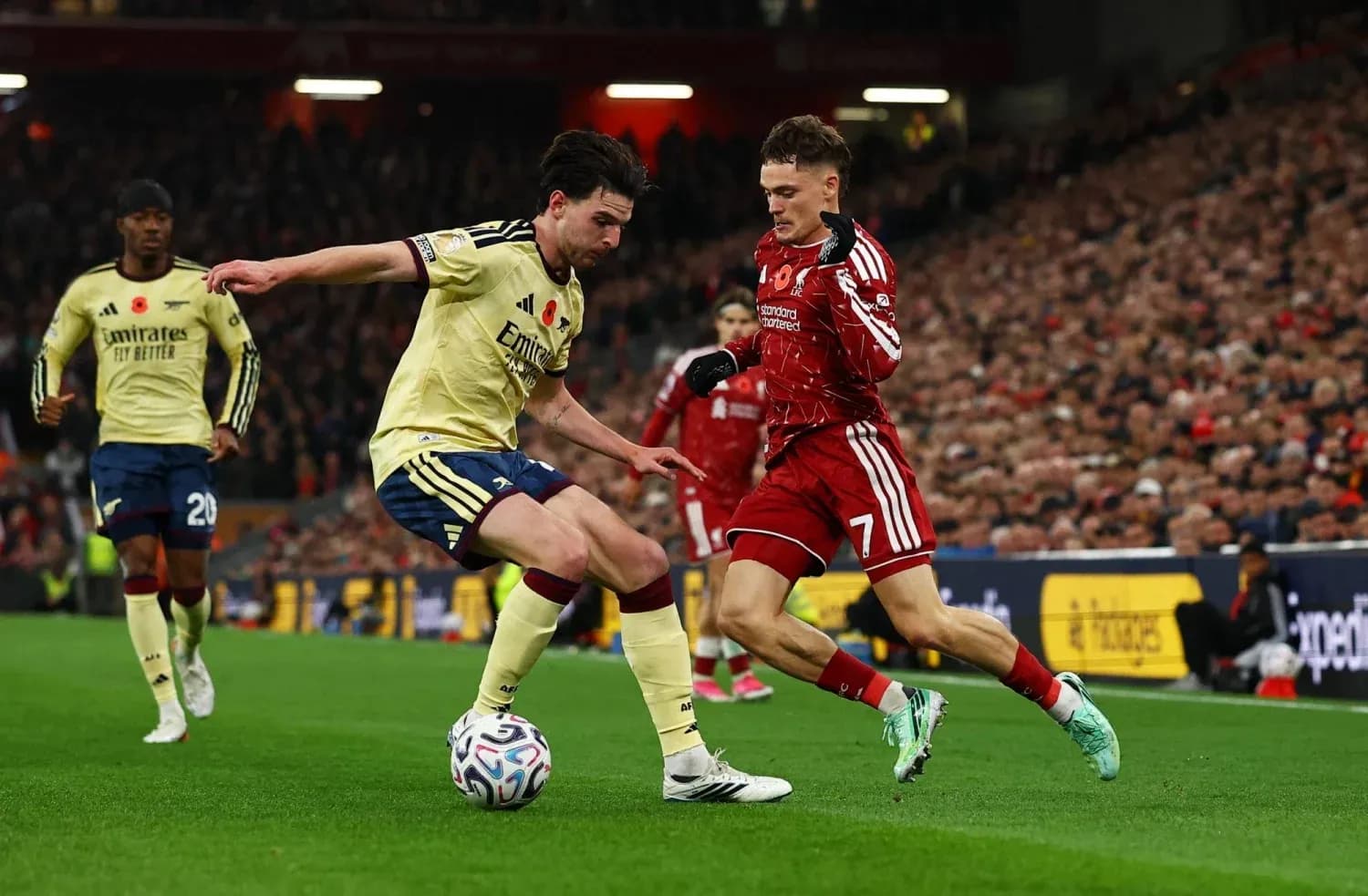
Rice, in particular, was the fulcrum of the “Engine Room” storyline. He entered this fixture as the league’s top assist provider with 5, underlining a dual role: destroyer and deep-lying playmaker. His 618 completed passes at 91% accuracy, 17 key passes, 13 tackles and 5 blocks show a midfielder who both sets the tempo and snuffs out transitions. Against him, Alexis Mac Allister had to be Liverpool’s metronome and disruptor. Mac Allister’s 408 passes at 85% accuracy, 18 tackles and 3 yellow cards tell of a player constantly on the edge of the contest, walking the disciplinary tightrope while trying to progress play.
Ahead of them, Cody Gakpo’s creative influence was crucial to Liverpool’s plan. With 3 assists already, 14 key passes and strong defensive work (9 tackles, 9 interceptions), he is Iraola’s hybrid: a pressing ten and a playmaker. His job was to find pockets around Martin Ødegaard and Rice, link with Wirtz and Barcola, and feed Isak early before Arsenal’s block could settle.
On the Arsenal side, Kai Havertz offered a different kind of threat. With 3 goals in 9 appearances and 82 duels contested (36 won), he operates as a pressing forward and aerial outlet. His movement between Virgil van Dijk and J. Jacquet, dragging R. Araújo and Kerkez out of line, was designed to open lanes for Ødegaard’s late surges and Noni Madueke’s runs from the right.
IV. Statistical Prognosis – Why the margins favoured Arsenal
From a season-long statistical lens, Arsenal’s narrow away win fits the pattern. Liverpool’s home attack, at just 0.8 goals per match, ran into an away defence that concedes 0.6 and has already delivered 4 clean sheets on the road. Iraola’s side had failed to score in 3 home fixtures overall; Arsenal had failed to score only once away.
In xG terms – even without explicit values – the profiles are clear. Liverpool’s overall scoring rate of 1.2 per game, combined with Arsenal’s defensive stinginess and control in midfield, suggests a game where the hosts would need efficiency rather than volume. Arsenal, with 1.0 away goals per match and a penchant for controlled, lower‑event football on their travels, were always likely to be content with a single decisive moment.
Defensively, Liverpool’s overall concession rate of 1.0 goals per match is solid, but at home it rises to 1.2. Arsenal’s varied attacking cast – Rice as provider, Ødegaard as orchestrator, Havertz as finisher and reference point – was well‑suited to exploiting that slight softening, particularly once Liverpool pushed higher in search of a breakthrough.
Ultimately, the 0–1 scoreline reflects the season-long balance of power: Arsenal’s mature, defensively secure league leaders edging a Liverpool side still caught between high-intensity ambition and a fragile home cutting edge. The squads, their absences and their statistical fingerprints all pointed in the same direction: a tight, tactical contest in which Arsenal’s shield held firm just long enough for their hunters to strike.