Arsenal Secures 1–0 Victory Over Newcastle in Premier League
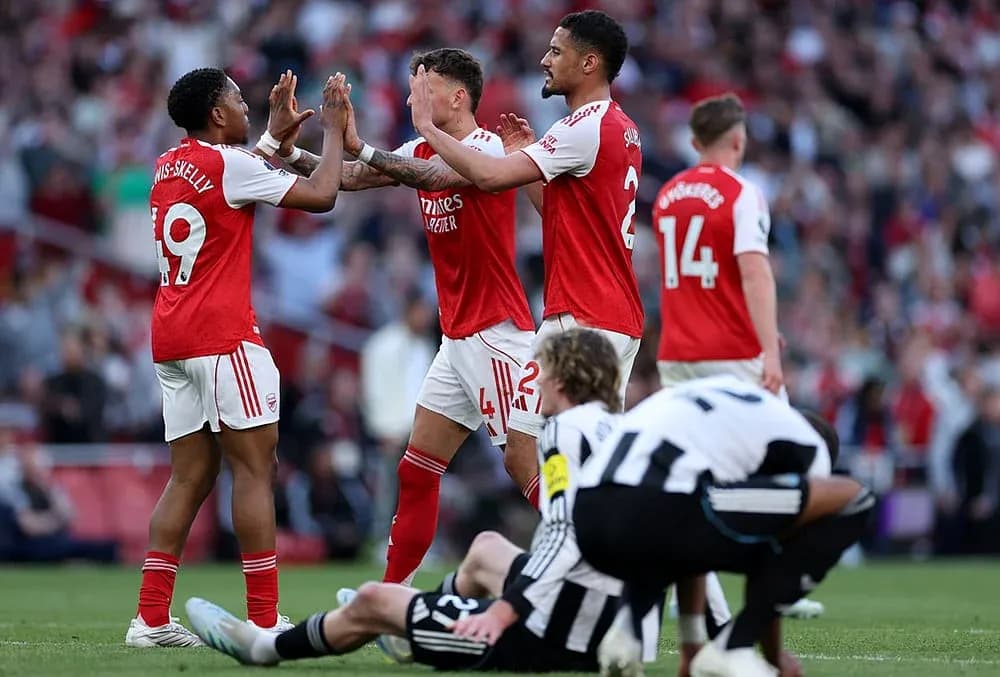
Arsenal edged a narrow 1–0 win over Newcastle at the Emirates Stadium in Premier League Regular Season Round 34, a contest defined more by structure and control than by volume of chances. Eberechi Eze’s ninth‑minute strike, assisted by Kai Havertz, established a game state that suited Mikel Arteta’s side: they were content to concede territory and possession while protecting the central lane. Newcastle, under Eddie Howe, saw more of the ball and marginally higher xG, but were repeatedly funnelled into lower‑value shooting zones. Across 90 minutes, the match became a test of Arsenal’s compact 4‑3‑3 block against Newcastle’s 4‑1‑4‑1 possession framework, with both goalkeepers making three saves and the hosts managing the lead with calculated substitutions and disciplined, if occasionally cynical, fouling.
Arsenal’s decisive moment arrived early. In the 9th minute, E. Eze finished a flowing move, with K. Havertz providing the assist. The goal immediately allowed Arsenal to shift from an aggressive 4‑3‑3 press into a more measured mid‑block, with Declan Rice and M. Zubimendi screening central access to Bruno Guimaraes.
Arteta’s first adjustment came on 34', when V. Gyökeres (IN) came on for K. Havertz (OUT). This did not change the nominal 4‑3‑3 shape but altered the reference points up front: Gyökeres offered more vertical threat and pressing depth, allowing Arsenal to threaten the space behind Newcastle’s high defensive line.
At 53', G. Martinelli (IN) replaced E. Eze (OUT), moving Arsenal towards a more transition‑oriented front line. Martinelli’s entry added direct running on the left, reinforcing the idea that Arsenal were now playing primarily to protect and counter rather than to build long possession phases.
The first card arrived on 57', when Dan Burn was booked for a foul, emblematic of Newcastle’s need to disrupt Arsenal’s counters once the hosts began sitting deeper. Howe responded with a double attacking change on 66': Y. Wissa (IN) came on for W. Osula (OUT), and H. Barnes (IN) came on for J. Murphy (OUT). This maintained the 4‑1‑4‑1 structure but significantly increased individual dribbling and box‑entry threat from wide areas.
On 71', Gabriel Martinelli received a yellow card for a foul, a tactical infringement as Arsenal increasingly used fouls to reset their block. Three minutes later, on 74', Nick Pope was booked for a foul, likely arising from a late or reckless intervention as Newcastle pushed higher and risked defensive exposure in transition.
Newcastle’s final central tweak came on 75', with N. Woltemade (IN) replacing Bruno Guimaraes (OUT). That move traded some control in deep build‑up for an extra presence between the lines and in the box, nudging the shape towards a more aggressive 4‑2‑3‑1/4‑4‑2 in attacking phases.
Arteta’s closing substitutions on 81' were clearly game‑management oriented: B. Saka (IN) came on for N. Madueke (OUT), and M. Lewis‑Skelly (IN) replaced M. Zubimendi (OUT). Saka offered ball retention and foul‑winning on the right, while Lewis‑Skelly injected fresh legs and pressing energy in midfield. On 86', Declan Rice was booked for “Argument”, indicating a flashpoint as Newcastle increased pressure and emotions rose. In the same minute, A. Elanga (IN) came on for J. Willock (OUT), adding another direct runner and giving Newcastle more verticality from midfield. No further goals followed, and the match closed at 1–0, with Arsenal collecting all three points.
Structurally, Arsenal’s 4‑3‑3 was built on a stable back four of B. White, W. Saliba, Gabriel, and P. Hincapie, with D. Raya behind them. Raya’s three saves matched Pope’s total, but within a different tactical context: Arsenal allowed more shots (13 vs their own 11) but were generally successful in keeping them at lower quality, as reflected in Newcastle’s xG of 0.91. Raya’s workload was steady rather than spectacular, consistent with an xG‑against profile that did not demand high‑difficulty interventions.
In front of the defence, M. Zubimendi and Declan Rice formed a dual shield, with Rice’s late yellow underlining his role in contesting central duels and game tempo. M. Odegaard operated higher as the connective tissue between midfield and the front three, helping Arsenal to progress the ball despite having only 45% possession and a lower passing volume (397 passes at 81% accuracy versus Newcastle’s 480 at 85%).
The front line evolved as the match progressed. Initially, N. Madueke, Havertz, and Eze offered a mix of between‑the‑lines receiving and half‑space occupation. After the 34' and 53' changes, Gyökeres and Martinelli shifted the emphasis towards depth runs and wide isolation, especially as Arsenal increasingly played into space vacated by Newcastle’s advancing full‑backs. Saka’s late introduction at 81' further solidified Arsenal’s right flank as a ball‑retention and outlet zone.
Newcastle’s 4‑1‑4‑1, anchored by S. Tonali as the single pivot, aimed to dominate territory and ball circulation. With 55% possession and 480 passes, they largely succeeded territorially. The back four of L. Miley, M. Thiaw, S. Botman, and Dan Burn pushed high, compressing the pitch and allowing the advanced midfield line of J. Ramsey, J. Willock, Bruno Guimaraes, and J. Murphy to pin Arsenal back. However, the lone striker W. Osula, later replaced by Wissa, often found himself outnumbered by Saliba and Gabriel, forcing Newcastle to rely on shots from the edge of the box or wide cut‑backs.
Pope’s three saves and a goals‑prevented value of 0 indicate that, aside from Eze’s early finish, Arsenal did not generate a volume of high‑danger chances. Their own xG of 0.64 supports the view that this was a control‑and‑protect performance rather than an attacking onslaught.
Statistically, Newcastle shaded several key metrics: 55% possession, 13 total shots to Arsenal’s 11, and a higher xG (0.91 vs 0.64). They also completed more passes (480 vs 397) at a better accuracy (85% vs 81%). Yet Arsenal’s defensive organisation and game‑state management were decisive. Both sides recorded 5 blocked shots, underscoring the density of bodies in and around the box at both ends. Fouls were relatively balanced (Arsenal 13, Newcastle 10), but the disciplinary record shows a 2–2 split in yellow cards: Dan Burn and Nick Pope for Newcastle (both for fouls), Gabriel Martinelli for a foul, and Declan Rice for argument.
From an Overall Form perspective, Arsenal showed the hallmark of a mature side capable of winning without dominating the shot quality metrics, leaning on structure and situational management. Newcastle’s Defensive Index was solid in open play, with Pope’s three saves and zero goals prevented indicating they were not catastrophically exposed beyond the early goal. However, their inability to translate territorial control and a slight xG edge into actual goals reflects an attacking structure that lacked penalty‑area penetration against a compact 4‑3‑3 block.