Asofa-Solomona's Brutal Knockout of Gallen: A Controversial Moment
The replays told the story before anyone could find the words.
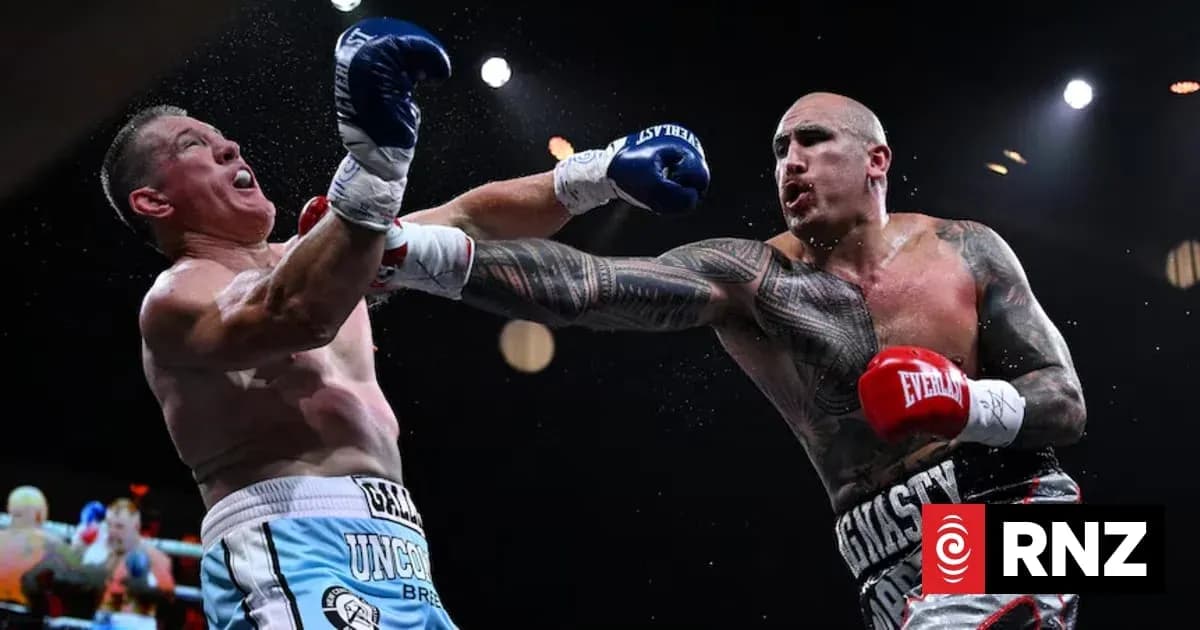
Nelson Asofa-Solomona’s right hand crashed through Paul Gallen’s guard with such violence that seasoned fighters and commentators recoiled. On the broadcast, Michael Ennis — a man who spent years beside Gallen in the trenches at Cronulla — looked rattled, admitting he struggled to watch. Tim Tszyu called it “frightening”.
In real time, it was worse.
“Oh jeez, oh no!” cried caller Ben Damon on Main Event as Asofa-Solomona’s fist detonated on Gallen’s blank, unresponsive face. Ringside, Danny Green’s instincts kicked in.
“The last one was the worst one, boys,” he said, almost over himself. “That was the one he didn’t need.”
“That’s no good,” Damon added, his voice tightening.
“The last one was a bad one,” Green repeated, as if trying to process what he’d just seen.
“That’s hard to watch,” Damon finally managed.
The fight lasted two minutes and 56 seconds. That was all. Less than three minutes for Asofa-Solomona to show he has the raw tools to keep climbing boxing’s unforgiving staircase — and, just as starkly, how ill-equipped he is in the sport’s darker, more complex corners.
It began with a steady feel-out. Then the mood changed.
A thunderous right hand from Asofa-Solomona sent the 45-year-old Gallen stumbling towards the ropes. A left-right combination followed, snapping his head back and pinning him there. Gallen’s arms flailed, his head lolled, and in that split-second Asofa-Solomona saw the gap for an uppercut.
He didn’t hesitate.
The first uppercut landed with hideous force, sending Gallen to the edge of unconsciousness. The second one pushed him over it, driving him fully into the void every fighter knows lurks behind their bravado.
It should have ended there.
Instead, as Gallen sagged, a third uppercut grazed his famously granite chin. His body folded, his legs tucked under him, and he slumped into a grotesque, puppet-like heap at the base of the ropes.
Still, Asofa-Solomona kept swinging.
Referee Chris Condon hurled himself between them, a black-shirted barrier finally arriving to halt the punishment Gallen had already worn for too long. As Condon dived in, Asofa-Solomona launched yet another blow toward the head of a man who was no longer a rival, just a stricken figure on the canvas.
This is where the night shifted from brutal spectacle to something more troubling.
Some will roll their eyes at moralising in the middle of a sport built on controlled violence. This is boxing, after all. Earlier on the same card, Paulo Aokuso had landed a perfectly timed left hand on Mobin Khahrazeh that had observers purring at its precision and finality.
Isn’t that the point? To knock a man out. To rattle his brain so violently that the lights go out and the crowd roars.
Yes. That is the deal everyone signs up for.
But even in a blood sport, there are lines. The rules are there not to sanitise the violence, but to stop it becoming something else entirely — a beating of the helpless rather than a contest between equals.
The Australian National Boxing Federation puts it plainly enough:
“Some fouls for which a referee may penalise or disqualify a boxer are:
(a) Hitting an opponent who is down or is rising from a knockdown.”
Reality is messier than any rule book. From the first of those savage uppercuts to Condon’s intervention, eight seconds passed. The four uppercuts that did the damage came in a blur — around two-and-a-half seconds of chaos. In that window, instinct and adrenaline often outrun thought.
But Gallen was clearly down. More than that, he was clearly out.
Across generations and continents, fighters have learned when to pull the last punch, when to recognise that the man in front of them is no longer a threat, just a body falling to the floor. That unspoken understanding is part of the strange brotherhood forged when two boxers touch gloves.
Hitting an unconscious opponent crosses that line. It always has.
On Thursday night, Asofa-Solomona barrelled straight through it. His celebration underlined how charged he was. Moments after the stoppage, he leapt into the crowd in a wild, ill-judged dash towards a spectator.
Later, in the press conference at the TikTok Entertainment Centre, he explained why.
“Someone was doing an ape gesture. I stood on the ropes and it looked like someone threw something at me,” he was reported as saying. “If I had my time back, I would, because that’s not on. But what that guy did to me, in terms of that gesture, is not on either.”
No one should ever have to absorb that kind of racist bile. No one has the right to tell a target of such abuse exactly how they should feel in that moment. The ugliness in the stands was real, and it matters.
So did what happened in the ring.
Asofa-Solomona showed power that can carry him a long way in this sport. He also showed how quickly that power can spill beyond the boundaries that keep boxing a contest instead of a mauling.
Next time he finds the knockout shot — and with his size and force there will be a next time — the measure of his progress won’t just be how hard he lands.
It will be whether he knows precisely when to stop.