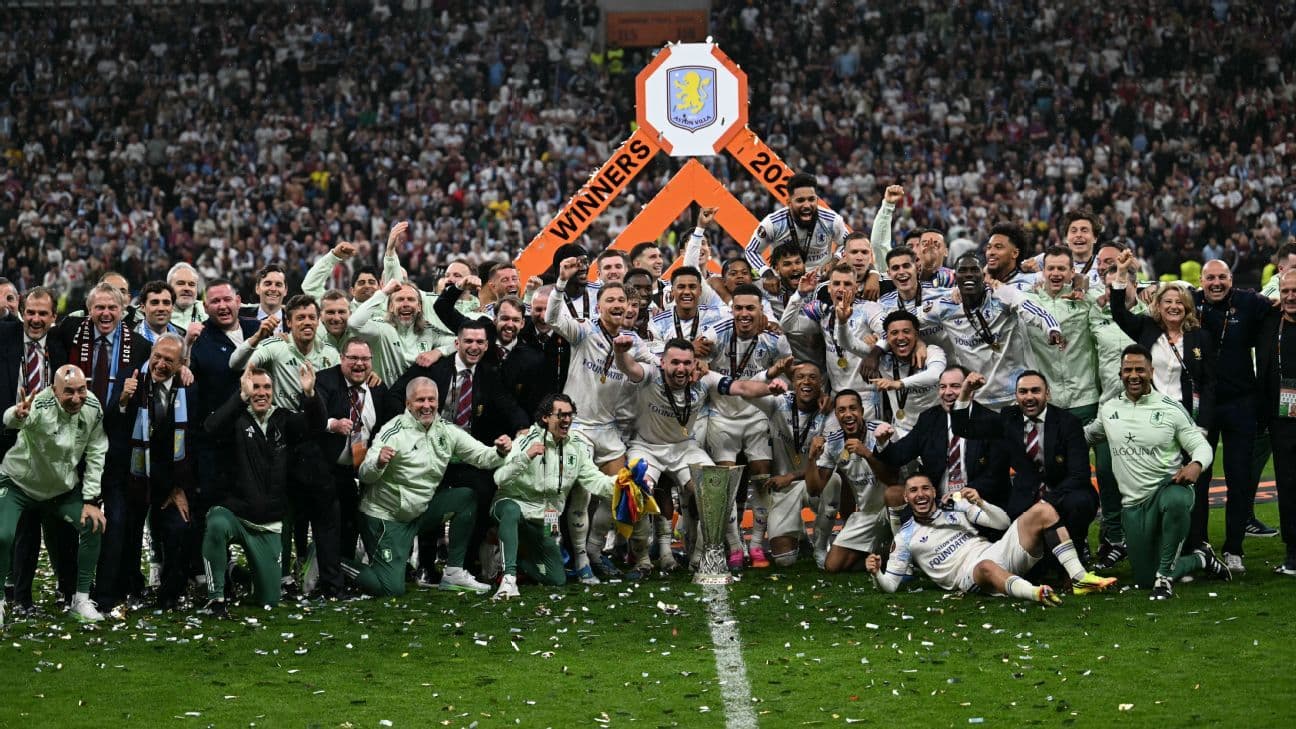
Aston Villa Triumphs in Europa League Final
Aston Villa’s long road back to Europe’s summit ended in Istanbul, under the glare of floodlights and a sense of history finally catching up.
Forty-four years after toppling Bayern Munich to win the European Cup, Villa lifted a major European trophy again, dismantling Freiburg 3-0 in a Europa League final that felt, at times, like a coronation. At the centre of it all stood Unai Emery, the man who has turned this competition into his own private domain.
Emery, the Europa League constant
Call it what you like, but at this point the Europa League might as well carry his initials. Emery, 54, has now won it five times with four different clubs. Sevilla, Villarreal, now Aston Villa added to his personal honours list, alongside a stint at Paris Saint-Germain and a turbulent spell at Arsenal that looks very different in hindsight.
Thomas Tuchel once joked UEFA could rename the trophy after him. Nights like this harden the argument. On the banks of the Bosphorus, Emery joined Carlo Ancelotti on five titles in major European competitions, but did something even Ancelotti has not: he lifted the same trophy with three different teams.
He tried to play it down before the game. He insisted past glories meant nothing here. Then he produced a gameplan that smothered Freiburg, showcased his team’s physical edge and technical clarity, and left the result feeling inevitable once Youri Tielemans ripped in the opener.
This is the same Villa who failed to win any of their first four matches of the season and waited until late September for a first goal. The same club Emery picked up in 17th place in the Premier League. Now they are Champions League qualifiers and Europa League winners. That is not a hot streak. That is a body of work.
From Preston midweeks to Istanbul nights
For Aston Villa, this was not just a trophy. It was a full stop at the end of a long, messy sentence.
Relegated in 2016, marooned in the Championship, they spent midweeks at Preston and the like, trying to remember what the big stage felt like. Their last major trophy had come in 1996, a League Cup win over Leeds United. An institution of English football had become a cautionary tale.
The climb back began in 2019 at Wembley, when Dean Smith’s Villa beat Derby County in the Championship playoff final. John McGinn scored that day. Seven years on, he stood in Besiktas Park as captain, hoisting a European trophy above his head, the first Scotsman to lead a side in a major European final since Barry Ferguson in 2008, and the first Scot to captain an English club in one since Graeme Souness in 1984.
The image of McGinn, beaming in claret and blue, surrounded by teammates who have walked this journey with him, will live with Villa fans for decades. Tyrone Mings and Tammy Abraham were there in 2019. Ezri Konsa, Emi Martínez, Ollie Watkins, Matty Cash arrived in the aftermath. Together they formed the spine of a side that kept threatening to break through, only to find the door slammed shut.
Conference League semifinal in 2024. Champions League quarterfinal last year, knocked out by eventual winners Paris Saint-Germain. Always close. Never quite over the line.
In Istanbul, they finally kicked it down.
Tielemans lights the fuse
The opening 40 minutes did not scream 3-0. They barely whispered it.
The game stuttered. Fouls broke the rhythm. Neither side could get a grip. Villa looked hesitant, almost flat, until Emery’s plan began to show itself. They stopped trying to knit their way through Freiburg’s press and simply went over it, hitting long balls towards Watkins, turning it into a battle the German side did not want.
Still, it was scrappy. Until Austin MacPhee’s fingerprints appeared.
Villa have built a reputation for inventive set pieces under their Scottish specialist, and again he delivered. Lucas Digne trotted over for a short corner that caught Freiburg napping. Morgan Rogers, given time to glance up, clipped a delicate ball to the edge of the area. Tielemans arrived with perfect timing and smashed a volley past Noah Atubolu, the ball screaming into the net as the goalkeeper froze.
One moment of clarity in a foggy half. One ruthless strike, and Emery’s team had the platform they craved.
Buendía’s masterpiece, Letexier’s whistle
The goal changed everything. Freiburg, already tentative, sagged. Villa, emboldened, began to punch through the lines.
Then came the second. Another reminder that this Villa side has a taste for the spectacular that outstrips the cold logic of expected goals.
Emi Buendía picked up the ball on the edge of the box. On his weaker left foot, no less. He shaped, curled, and sent a vicious shot arcing beyond Atubolu’s desperate reach and into the top corner. The ball kissed the side netting. The stadium gasped.
It was the kind of goal that silences even the opposition end for a heartbeat, just to take it in.
Referee François Letexier took one look, pointed to the centre circle, then almost immediately blew for half-time. No added drama. No extra seconds. Just a whistle that felt like a curtain dropping on Freiburg’s hopes.
The pattern held. The last three Europa League finals with a two-goal lead at half-time have all finished 3-0: Atlético Madrid in 2012, Atalanta in 2024, now Aston Villa in 2026. Once you fall that far behind in this competition’s showpiece, history says you stay there.
Rogers finishes the job
Freiburg ran. They covered 102.9km to Villa’s 100.4km. They chased, pressed, tried to summon a response. The numbers will show effort. The scoreboard shows the truth.
Villa managed the second half like a team who have learned the hard way. No panic, no wild openings offered to drag Freiburg back into it. Just control, angles, and the occasional burst to remind their opponents where the danger lived.
Rogers delivered the final blow. Not as spectacular as the first two, but sharp and decisive, the finish of a player who knew his night was already etched into the record books. At 23 years and 298 days, he became the youngest Englishman to score in a major UEFA final since Steven Gerrard in 2001.
By then, the claret and blue end had turned into a rolling celebration. Among them, Prince William, a lifelong Villa fan, watched a club he has followed through thin and thinner finally reclaim a piece of the European stage. On the touchline, Emery remained typically restrained, but he knew. Everyone did.
A club back among its own ghosts
This win does more than end a 30-year trophy drought. It drags Villa’s modern era into line with its history.
Names like Paul McGrath and Peter Withe have long dominated the club’s European folklore. They now have company. Tielemans, Buendía, Rogers, McGinn, Martínez, Konsa, Watkins — a new generation stitched permanently into Villa’s tapestry.
The numbers around this run only deepen the sense of occasion. A 44-year gap between major European finals, third-longest of any club behind Manchester City and West Ham United. Back-to-back Europa League titles for English clubs for the first time since the early 1970s, when Spurs and Liverpool took the first two UEFA Cups. Jadon Sancho becoming the first player to appear in three different major European finals in three consecutive seasons: Champions League, Conference League, now Europa League.
This is not a blip. It is a shift.
For Emery, it cements his place as Europa League royalty, whether he wants the crown or not. For Villa, it feels like the start of a new chapter, not the end of a story.
The question now is simple: having conquered this stage again, how far can this club go when the Champions League anthem plays at Villa Park?