Athletic Club and Celta Vigo Draw: Tactical Analysis of a 1-1 Stalemate
Athletic Club’s 1-1 draw with Celta Vigo at Estadio de San Mamés was a territorial siege that never quite turned into a decisive home win. Ernesto Valverde’s 4-2-3-1 dominated the ball and shot volume, while Claudio Giraldez’s 3-4-3 accepted a deep, narrow block and relied on early transition efficiency and outstanding goalkeeping from Ionuț Radu to escape with a point.
Athletic’s structure with Unai Simon behind a back four of Aitor Gorosabel, Yeray Alvarez, Aymeric Laporte and Yuri Berchiche was designed to pin Celta’s front three and stretch their wing-backs. In front, Iñigo Ruiz de Galarreta and Mikel Jauregizar formed a double pivot tasked with controlling second balls and recycling possession, allowing the attacking line of Iñaki Williams, Unai Gomez, Alex Berenguer and Gorka Guruzeta to occupy all five vertical lanes.
Celta’s 3-4-3, with Javi Rodriguez, Yelko Lago and Marcos Alonso as the back three, set up conservatively from the start. The wing-backs Javier Rueda and Sergio Carreira dropped very deep without the ball, effectively creating a back five, while Fran Lopez and Ilaix Moriba tried to screen the central lane ahead of them. Up front, Ferran Jutgla, Borja Iglesias and Williot Swedberg were instructed to trigger presses only on clear cues, otherwise staying compact to deny through passes.
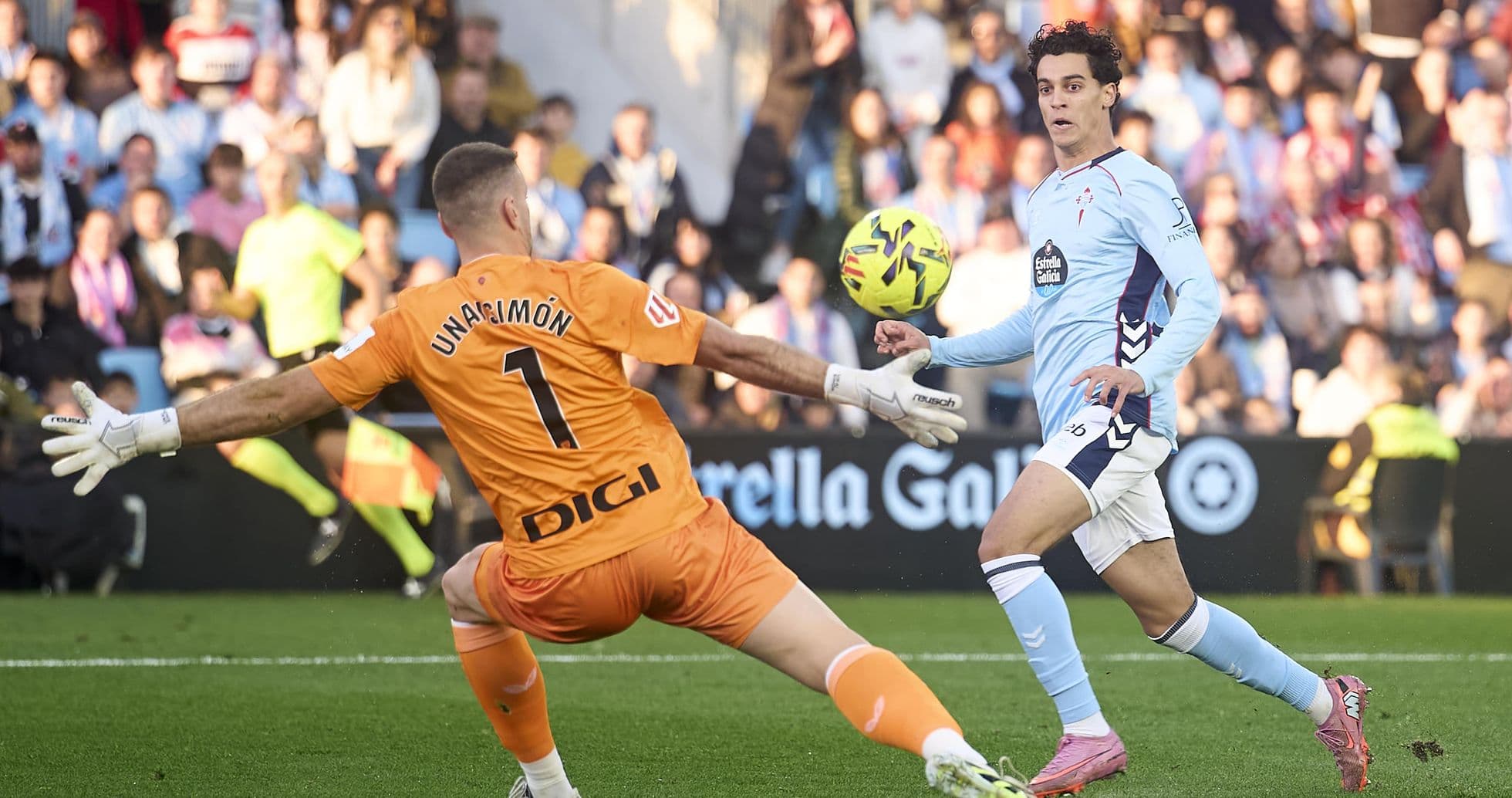
The early Celta goal at 4 minutes from Williot Swedberg, assisted by Ilaix Moriba, came directly from this transition-first plan. Athletic’s high full-backs left space behind, Moriba broke the first line under minimal pressure, and Celta exploited the disjointed rest-defense to punish Simon with one of their only two shots on target all game. From that moment, the tactical picture crystallised: Celta retreated even further, and Athletic settled into a long siege.
Possession numbers underline that pattern: Athletic had 58% of the ball to Celta’s 42%, completing 445 of 525 passes (85%) compared to Celta’s 309 of 391 (79%). The home side’s build-up was patient but purposeful. Laporte often stepped into midfield to create a 3-2 base with Ruiz de Galarreta and Jauregizar, while Berchiche pushed very high on the left to pin Rueda and isolate Berenguer in one-versus-ones. On the right, Gorosabel held a slightly deeper position, allowing Iñaki Williams to attack the half-space and combine with Unai Gomez between the lines.
This structure generated a huge shot volume: 26 total shots, 19 inside the box, and 9 on target. The xG of 2.53 reflects repeated creation of high-quality chances, especially from cut-backs and second balls around the penalty spot. Yet the finishing lagged behind the chance quality, and Radu’s performance was decisive. With 8 saves and 1.33 goals prevented, he consistently won his duels, particularly against low, driven efforts after Athletic had pulled Celta’s back line across.
Celta, by contrast, produced just 3 total shots (only 1 inside the box) and an xG of 0.15. Their offensive contribution after the early goal was minimal, but that was by design. Giraldez’s priority became preserving central compactness: Moriba and Lopez stayed tight to the back three, while the wing-backs tucked in, conceding wide crosses but denying threaded passes. When they did win the ball, the first look was always into the channels for Swedberg or Jutgla, hoping to exploit Athletic’s advanced full-backs. As the game wore on, substitutions such as Oscar Mingueza for Javier Rueda and later entries like Iago Aspas and Pablo Durán (via the changes involving Borja Iglesias and Ferran Jutgla) were less about changing the structure and more about refreshing legs within the same low-block concept.
Valverde’s in-game adjustments were more aggressive. At 46', Raul Navarro (IN) came on for Unai Gomez (OUT), adding a more vertical profile between the lines. The effect was visible in the equaliser: at 52', Iñaki Williams scored for Athletic Club, assisted by Yuri Berchiche, a move that came from sustained left-side pressure and an overlapping run that finally broke Celta’s resistance. Later, Ander Rego (IN) for Mikel Jauregizar (OUT) at 71' and attacking changes like Nico Serrano (IN) for Alex Berenguer (OUT), M. Sannadi (IN) for Gorka Guruzeta (OUT) and Izeta (IN) for Iñaki Williams (OUT) reflected a clear intent to maintain tempo and keep five attacking threats on the last line.
Defensively, Athletic were largely untroubled after the early setback. Simon faced only 2 shots on goal and made 1 save, his main task being sweeping behind a high line rather than shot-stopping. The defensive index for Athletic in this match is therefore more about counter-pressing and rest-defense structure than pure penalty-box defending; after the 4th minute, Celta’s xG barely moved, suggesting that Athletic’s counter-press, anchored by Ruiz de Galarreta and the centre-backs, effectively killed transitions at source.
Discipline played a modest but telling role. Celta collected 2 yellow cards: at 10', Javier Rueda was booked for Foul, and at 42', Ionuț Radu received a yellow for Time wasting, underlining the away side’s early shift into game-management mode. Athletic also took 2 yellows: at 38', Yuri Berchiche for Foul, and at 68', Aymeric Laporte for Foul, both consistent with an aggressive, front-foot approach to winning the ball back quickly after turnovers.
Set-piece impact was limited: Athletic’s 5 corners against Celta’s 0 added to the territorial dominance but did not change the scoreline. However, they contributed to the accumulation of pressure and second balls that underpinned the high xG figure.
Statistically, the verdict is stark. Athletic’s overall form on the day, measured by chance creation, possession control and passing accuracy, was that of a side performing above a typical 1-1 result. Their 2.53 xG versus a single goal scored points to underperformance in the box and a standout opposition goalkeeper. Celta, with 0.15 xG and only 3 shots, leaned entirely on defensive resilience and Radu’s 1.33 goals prevented to secure the draw.
From a tactical perspective, this was a match where structure and process strongly favoured Athletic Club, but execution in both boxes—an early lapse defensively and insufficient finishing offensively—meant that Celta Vigo’s low-block and time-management strategy earned them a point that the underlying numbers suggest they scarcely deserved.