Australia's Tactical Masterclass in 2-0 Win Over Türkiye
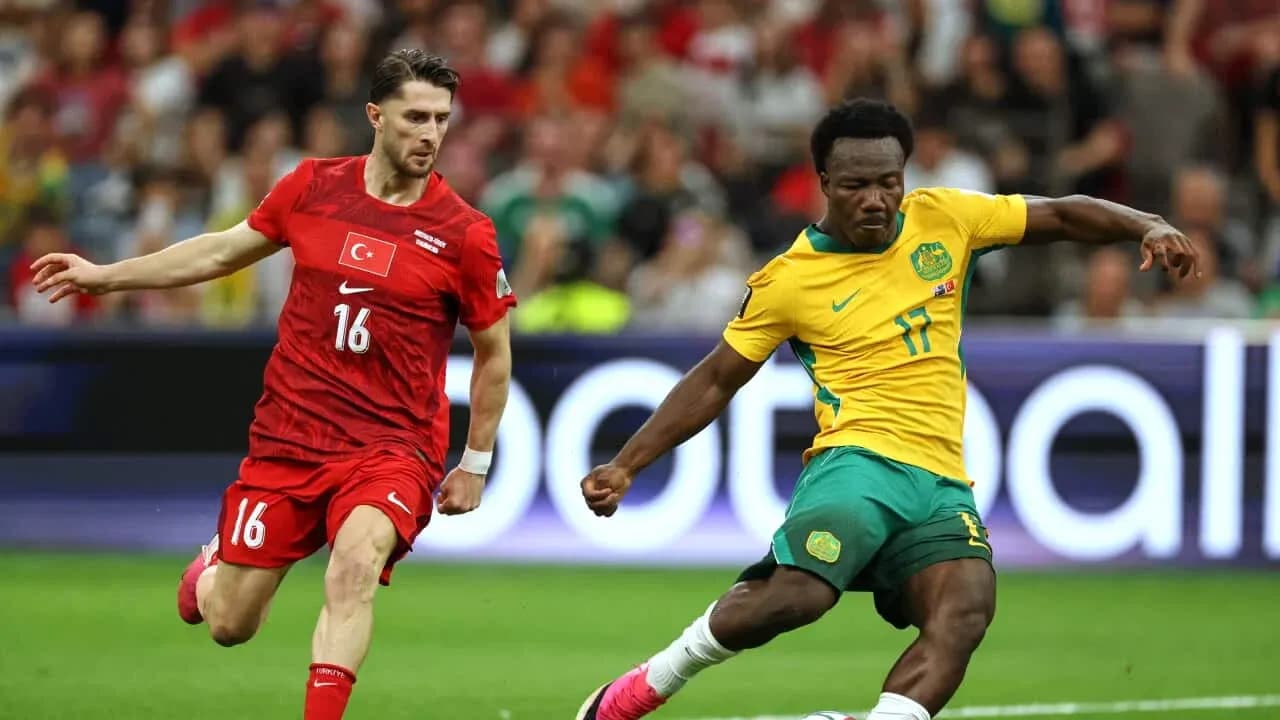
Australia’s 2-0 win over Türkiye at BC Place was a classic example of a low-possession, high-resilience game plan executed almost perfectly. In a World Cup group-stage setting, Tony Popovic’s side accepted a deep, reactive role, trusted their defensive structure, and relied on transition quality from a young, mobile front line to punish a Turkish team that dominated territory and the ball but lacked incision.
Executive Summary
Australia, set up in a 5-4-1, produced a ruthless performance without the ball: 28% possession, 9 total shots, and 2 goals. Türkiye, in a 4-2-3-1, controlled 72% possession and generated 30 shots but were repeatedly denied and exposed on counter-attacks. The halftime score was 1-0 to Australia, and they closed it out 2-0, leveraging compactness, aerial strength, and direct running to offset Türkiye’s superior passing rhythm and volume.
Scoring Sequence & Disciplinary Log
The opener came on 27'. Nestory Irankunda (Australia) struck a “Normal Goal” for 1-0, finishing a transition move initiated and assisted by Paul Okon-Engstler (Australia). It crystallised Australia’s plan: absorb pressure, then break quickly into the spaces behind Türkiye’s advanced full-backs.
On 75', Connor Metcalfe (Australia) made it 2-0 with another “Normal Goal”, this time unassisted. By then, Türkiye were fully committed forward, and Metcalfe’s timing from midfield punished a disorganised rest-defence, effectively killing the contest.
Disciplinary log (chronological, all cards):
- 86' Yunus Akgün (Türkiye) — Roughing
This was Türkiye’s only card; Australia finished without bookings, underlining how well they managed their defensive aggression and decision-making despite long spells without the ball.
Tactical Breakdown & Personnel
Popovic’s 5-4-1 was built on a clear spine. The back five of Jacob Italiano, Alessandro Circati, Harry Souttar, Cameron Burgess, and Jordan Bos stayed narrow and compact, screening central zones and forcing Türkiye into wide circulation and low-percentage crosses. The midfield four of Connor Metcalfe, Aiden O’Neill, Paul Okon-Engstler, and Nestory Irankunda worked horizontally, shuttling to close passing lanes into Hakan Çalhanoğlu and Orkun Kökçü, while Mohamed Touré led the line as the lone forward, primarily as a pressing trigger and outlet.
On the ball, Australia were minimalist but purposeful. With only 270 total passes, 202 accurate (75%), they refused to engage in prolonged build-up. Instead, they targeted quick vertical releases into Irankunda and Okon-Engstler between Türkiye’s lines, or direct balls into Touré to win territory and free the wing-backs. The first goal epitomised this: a fast, vertical transition where Okon-Engstler’s forward running and weight of pass allowed Irankunda to attack space before Türkiye could reset.
Defensively, the structure was zonal and conservative. Australia conceded 30 shots, but crucially only allowed 14 inside the box and forced many attempts under pressure, as indicated by Türkiye’s xG of 1.33 for those 30 efforts. The back three of Circati, Souttar, and Burgess were dominant in aerials and clearances, while Italiano and Bos tucked in to form a back five in the low block, only stepping out selectively to confront wide players like Barış Alper Yılmaz and Kerem Aktürkoğlu.
In goal, Patrick Beach (Australia) was decisive. Australia’s statistics show 8 Goalkeeper Saves and a goals prevented figure of -0.95, which, despite the negative value, must be read alongside the sheer volume of Turkish attempts. Beach’s shot-stopping under constant pressure was central to preserving the clean sheet, especially as Türkiye increased their tempo after the interval.
Vincenzo Montella’s Türkiye, by contrast, executed their possession scheme but lacked penetration. In a 4-2-3-1 with Zeki Çelik and Ferdi Kadıoğlu as advanced full-backs, they built through İsmail Yüksek and Çalhanoğlu, aiming to find Arda Güler and Kökçü between the lines. They completed 707 passes, 638 accurate (90%), reflecting control and technical security. However, Australia’s compact 5-4-1 forced them to circulate laterally and shoot from distance too often, as shown by 16 shots from outside the box.
Substitutions sought to add dynamism and directness. At 46', Kenan Yıldız (IN) came on for Barış Alper Yılmaz (OUT), giving Türkiye a more aggressive runner between the lines. On 62', Yunus Akgün (IN) came on for Orkun Kökçü (OUT), adding width and 1v1 threat on the flank. Later, Salih Özcan (IN) replaced İsmail Yüksek (OUT) on 81' to freshen the pivot, and Mert Müldür (IN) for Zeki Çelik (OUT) at the same minute aimed to maintain overlapping energy. Finally, Deniz Gül (IN) came on for Kerem Aktürkoğlu (OUT) on 85', a last attempt to alter the attacking profile. None of these changes, however, broke Australia’s low block.
Australia’s substitutions were strictly functional and game-state driven. Nishan Velupillay (IN) came on for Nestory Irankunda (OUT) on 61', maintaining fresh legs for transition pressing and counters. On 74', Tete Yengi (IN) replaced Mohamed Touré (OUT), and Jason Geria (IN) came on for Jacob Italiano (OUT), reinforcing both the first defensive line and right flank. At 84', Aziz Behich (IN) for Jordan Bos (OUT) and Jackson Irvine (IN) for Paul Okon-Engstler (OUT) added experience and physicality to close the game.
Uğurcan Çakır (Türkiye) faced relatively little but still had to make 2 Goalkeeper Saves. With Australia’s xG at 0.77, the goals conceded were more about structural exposure in transition than goalkeeping errors; Türkiye’s high line and aggressive full-backs repeatedly left them vulnerable to direct attacks once the first line of counter-press was broken.
The Statistical Verdict
The numbers underline the tactical story. Türkiye led 72% to 28% in Ball Possession, 30-9 in Total Shots, 8-4 in Shots on Goal, and 8-5 in Corner Kicks. They also committed only 4 Fouls to Australia’s 12, reflecting Australia’s more contact-heavy defensive approach. Yet the xG split of 1.33 (Türkiye) to 0.77 (Australia) shows that while Türkiye created more, the quality differential was not overwhelming given the shot volume.
Australia’s defensive index for this match is defined by volume management and box protection: 12 Blocked Shots by Türkiye against just 1 by Australia hints at where the defending was done—Australia mostly in and around their own area, Türkiye higher up the pitch. Beach (Australia) making 8 saves against Çakır’s 2 further quantifies the pressure imbalance.
Discipline was also asymmetrical but in Australia’s favour in terms of outcome: Türkiye finished with 1 Yellow Card (Yunus Akgün — Roughing), Australia with none. In a World Cup group context, this 2-0 result positions Australia as a dangerous, counter-punching side whose overall form can outperform their underlying possession metrics, while Türkiye’s strong passing and chance volume must now be converted into greater efficiency in both boxes if they are to progress.