USA Dominates Paraguay 4-1 in World Cup Opener
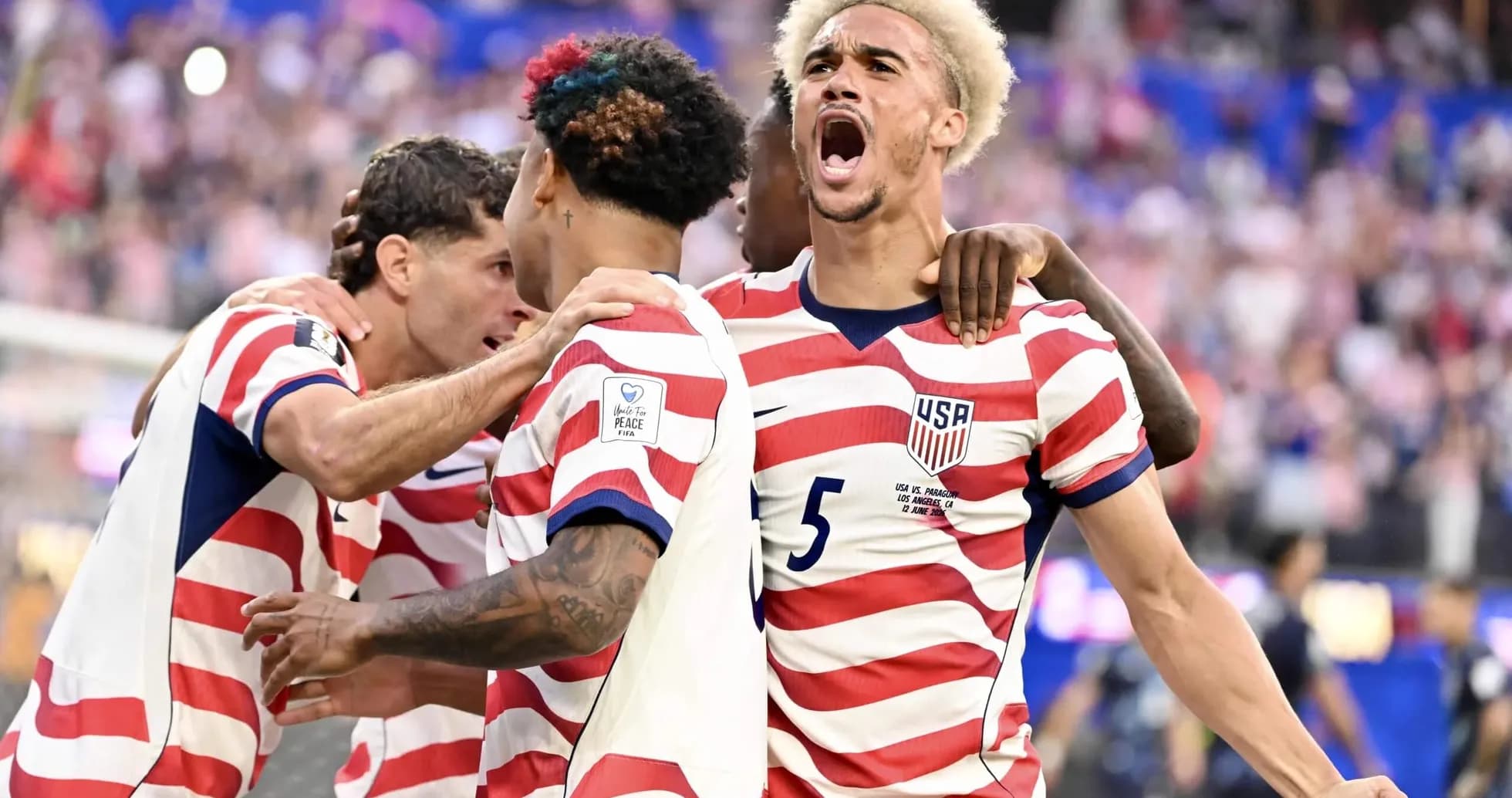
Under the California lights at SoFi Stadium, USA’s 4-1 dismantling of Paraguay felt less like an opener and more like a statement of intent. Following this result in Group D of the World Cup, USA sit 1st with 3 points, a goal difference of +3 (4 goals for, 1 against), and a performance that revealed a clear tactical identity under Mauricio Pochettino. Paraguay, rooted 4th with 0 points and a goal difference of -3 (1 for, 4 against), leave Inglewood knowing that their margin for error has already evaporated.
I. The Big Picture – Shapes, structure, and early hierarchies
Pochettino’s 4-2-3-1 was aggressive and front-footed. M. Freese started in goal behind a back four of A. Robinson, T. Ream, C. Richards, and A. Freeman. In front, T. Adams and M. Tillman formed the double pivot, with an attacking band of C. Pulisic, W. McKennie, and S. Dest supporting lone striker F. Balogun.
The structure created clear vertical lanes: Adams anchoring, Tillman stepping into half-spaces, Pulisic and Dest stretching and driving, McKennie arriving late. It is no coincidence that USA’s season averages heading into this game show 4.0 goals for in total and 1.0 conceded in total from a single match; this is a side built to dominate territory and accept some defensive risk.
Paraguay’s Gustavo Alfaro answered with a 4-4-2: O. Gill in goal, a back line of J. Alonso, O. Alderete, G. Gomez, and J. Caceres; a midfield four of M. Almiron, D. Bobadilla, A. Cubas, and D. Gomez; and a front pairing of A. Sanabria and J. Enciso. On paper, it promised compactness and counter-attacking threat. In practice, the distances between lines were too large in the first half, and the American 4-2-3-1 repeatedly found pockets between Paraguay’s midfield and defense.
USA’s half-time lead of 3-0 reflected that structural superiority. The second half became game management, with the hosts ultimately closing it out 4-1.
II. Tactical Voids – Discipline, risk, and the missing edge
The disciplinary profile of both sides is already telling. USA’s season card map shows a single yellow card, and it arrives in the 46-60 minute window with a 100.00% share of their yellows. That suggests a team that plays on the edge coming out of the break, pressing high and occasionally mistiming challenges as they reassert control after half-time.
Paraguay’s pattern is more chaotic and more worrying. Their yellows are scattered:
- 0-15 minutes: 1 yellow (20.00%)
- 46-60 minutes: 1 yellow (20.00%)
- 76-90 minutes: 2 yellows (40.00%)
- 91-105 minutes: 1 yellow (20.00%)
Five separate yellow-card windows in one match point to a side that loses composure at key junctures: early nerves, mid-game frustration, and a late-game unraveling. Individuals like A. Arce, J. Caceres, and M. Almiron already feature prominently in the yellow-card tables, and while there are no reds yet, the trendline is clear: Paraguay are living on disciplinary thin ice.
There are no recorded absences or injuries in the data, so these “voids” are not about missing personnel but about structural and emotional control. USA’s clean-sheet count remains 0 in total, but the concession of just 1 goal in total so far points more to a single lapse than systemic fragility. Paraguay, however, have conceded 4.0 goals against on their travels on average and in total, with no clean sheets; their back line is being exposed both by shape and by indiscipline.
III. Key Matchups – Hunter vs Shield, Engine Room battles
The most obvious “Hunter vs Shield” duel is F. Balogun against Paraguay’s central defense. Balogun is already the competition’s leading scorer, with 2 goals in total from 4 shots (3 on target) and a 9.2 rating. He thrives on quick service and vertical passes, drawing 4 fouls and winning duels back-to-goal. His movement between G. Gomez and O. Alderete repeatedly tore open the 4-4-2’s central channel.
On the other side, Paraguay’s “shield” is not just their centre-backs but the screening of A. Cubas in front of them. Yet with the team conceding 4.0 goals against on their travels on average and in total, that shield is being punctured too often. If this pattern continues, Balogun will remain the nightmare matchup for any opponent lacking compactness between the lines.
In the “Engine Room,” the contrast is equally stark. For USA, M. Tillman has emerged as a tempo-setter and creative hub: 38 passes with 78% accuracy, 3 key passes, 5 dribble attempts with 2 successes, and 1 interception. He links smoothly with McKennie and Dest, allowing Pulisic to stay higher and more aggressive. Pulisic himself, with 22 passes at 81% accuracy, 2 key passes, and 3 successful dribbles from 5 attempts, is already on the top-assists chart with 1 assist in total. His ability to receive between lines and turn at pace is central to USA’s 4.0 goals-for total.
Paraguay’s counterweight is M. Almiron and J. Enciso. Almiron’s 23 passes at 78% accuracy and 2 key passes, combined with Enciso’s 25 passes at 80% accuracy and 1 assist in total, show that they can create when given transitions. Enciso’s 14 duels with 8 won and 4 fouls drawn underline his willingness to carry the fight. But with A. Sanabria quiet and the midfield often stretched, their influence arrived too late and too infrequently.
Off the bench, USA’s G. Reyna offers another creative layer: 1 goal from 1 shot on target, 8 passes at 100% accuracy, and 2 duels won from 3. His cameo hints at a squad with genuine depth in the attacking midfield zone. Paraguay’s response from the bench, notably Maurício, was encouraging individually—1 goal from 1 shot on target, 20 passes at 70% accuracy, 2 tackles—but insufficient to tilt the collective balance.
IV. Statistical Prognosis – xG shadows and defensive solidity
We lack explicit xG numbers, but the statistical silhouette is clear. Heading into this game, USA’s offensive profile reads like a heavyweight: 4.0 goals for in total, 4.0 at home, with no failed-to-score matches. Their defensive line concedes 1.0 goal against in total, 1.0 at home, and has yet to record a clean sheet—but that single concession feels more like a cosmetic blemish on a dominant display.
Paraguay’s early-season metrics are the mirror image. On their travels they average 1.0 goal for and 4.0 goals against, with 0 clean sheets and 0 failed-to-score outings. They can hurt teams—Maurício and Enciso proved that—but their defensive structure is porous, and their yellow-card distribution suggests that as matches stretch into the final quarter, control slips away.
Following this result, the tactical prognosis is straightforward: USA project as a high-xG, high-possession side whose main question mark is whether they can tighten their back line enough to turn wins into routine, low-drama victories. Paraguay, meanwhile, must rapidly compress their lines, cool their temperament, and build around the technical quality of Almiron, Enciso, and Maurício if they are to reverse a trajectory that currently points away from the Round of 32 and toward an early exit.