Barcelona's Dominance Over Getafe: A Tactical Breakdown
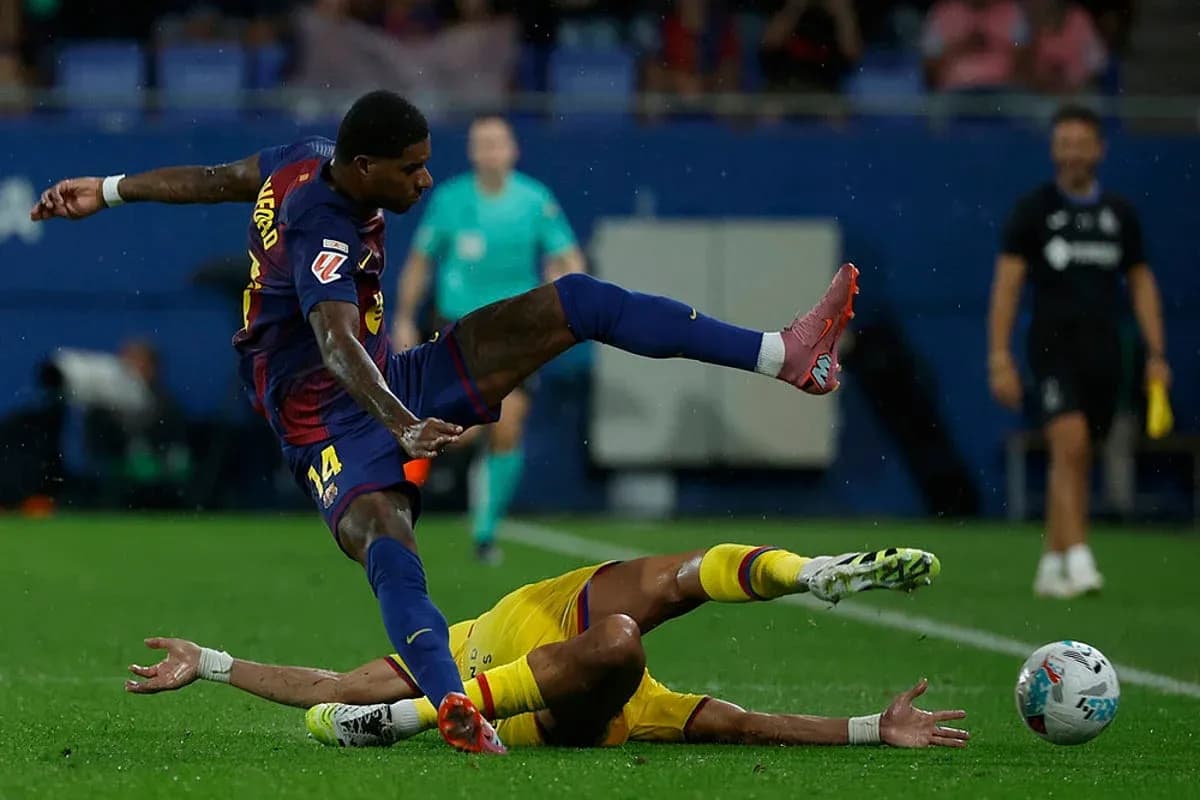
On a sunlit afternoon at the Coliseum, a clash of footballing identities unfolded: Getafe, sixth in La Liga and fighting to secure a European place, against runaway leaders Barcelona, who arrived with 85 points and a goal difference of +57 (87 scored, 30 conceded overall). The visitors’ 2–0 win, sealed within the regulation 90 minutes under the watch of Francisco Hernandez Maeso, felt less like an upset of the underdog’s script and more like a confirmation of the season-long hierarchy heading into this game.
Getafe’s season has been built on attrition and narrow margins. Overall they have scored 28 goals and conceded 34 across 33 matches, a goal difference of -6 that tells of a side comfortable living on the edge. At home, they average 0.9 goals for and 0.8 against, a tight, low-scoring profile that explains Jose Bordalas Jimenez’s loyalty to the 5-3-2. Barcelona, by contrast, arrived as a machine: 87 goals in total at 2.6 per game, with 2.2 on their travels and only 1.3 conceded away. Hansi Flick’s 4-2-3-1 has been his default, used 23 times, and it appeared again here, designed to stretch a deep defensive block and suffocate transitions.
The absentees added another layer to the tactical puzzle. Getafe were without Juanmi and B. Mayoral through injury, stripping Bordalas of penalty-box craft and a proven finisher, while Z. Romero’s suspension removed a defensive option. For a side that has already failed to score in 14 league matches in total, losing Mayoral in particular pushed even more responsibility onto M. Satriano and V. Birmancevic to chase long diagonals and scrap for second balls.
Barcelona’s missing names were even more glamorous: Lamine Yamal, Raphinha, A. Christensen, M. Bernal and E. Garcia all out, the first two robbing Flick of his most explosive wide threats and a combined 27 league goals and 14 assists in total. Yet the depth of this squad meant he could realign the front four without sacrificing quality. D. Olmo, Fermín and R. Bardghji formed a fluid line behind R. Lewandowski, with Gavi and Pedri anchoring the double pivot.
Bordalas’ shape was as advertised. D. Soria sat behind a line of five: J. Iglesias and Davinchi as wing-backs, with S. Boselli, D. Duarte and Djene as the central trio. In front of them, Mario Martín, L. Milla and M. Arambarri formed a combative, narrow midfield tasked with compressing central spaces. Birmancevic and Satriano were less a strike partnership than twin out-balls, ready to spring from deep.
The disciplinary profile of Getafe coloured every duel. Across the season they have seen yellow cards spike late, with 21 bookings in the 76–90 minute window alone, accounting for 21.43% of their total cautions. Red cards also cluster in the 46–60 and 76–90 ranges (28.57% in each), underlining how their intensity often teeters into excess as games stretch. Djene, Mario Martín, Domingos Duarte and A. Abqar all feature prominently in the league’s card charts, and that aggression was clearly baked into the game plan: disrupt Barcelona’s rhythm, contest every aerial ball, and make the Coliseum a place where leaders suffer.
Barcelona, for their part, are not innocent in the card stakes, but their bookings are more concentrated around the hour mark, with 25.93% of their yellows arriving between 46–60 minutes. Flick’s side tend to raise the tempo early in the second half, pressing higher and counter-pressing more aggressively, and that surge of intensity often comes at a disciplinary cost. It also happens to be the phase where their superior fitness and structure usually start to tell.
The “Hunter vs Shield” duel revolved around R. Lewandowski against a Getafe defence that has allowed 1.0 goals per game overall and only 0.8 at home. Lewandowski’s league line of 12 goals from 26 appearances, with 43 shots and 26 on target, speaks of a striker who still needs few chances to punish. Behind him, the creative artillery was formidable even without Lamine Yamal: Fermín, with 6 goals and 8 assists, Pedri with 8 assists and a 91% passing accuracy, and D. Olmo with 7 goals and 7 assists. The cumulative effect is a constant threat between the lines, pulling centre-backs into no-man’s-land and forcing wing-backs to choose between tucking in or tracking runners.
Against that, Bordalas trusted his “Engine Room” of L. Milla and Mario Martín to be both screen and launchpad. Milla’s 9 assists this season, alongside 69 key passes and 77% passing accuracy, make him Getafe’s primary distributor. Mario Martín brings steel: 52 tackles, 60 fouls committed and 10 yellow cards. Together, they were tasked with smothering Pedri’s and Gavi’s influence while still finding the feet of Satriano and the channels for Birmancevic. The cost of that edge, however, is always the risk of cards; Milla already has a red this season, and any early booking would have blunted his ability to step in aggressively.
Structurally, the matchup always leaned Barcelona’s way. On their travels they have scored 35 and conceded 21, while Getafe at home have only 14 goals in favour and 13 against. Barcelona have not failed to score in any league match this season, home or away, and have converted all 7 penalties they have been awarded in total. Getafe’s defensive record is admirable, with 10 clean sheets overall, but their margin for error is minimal given their modest attacking output.
From an Expected Goals perspective, even without explicit xG figures, the underlying patterns are clear. Barcelona’s shot volume, chance creation through Pedri, Fermín and Olmo, and their 2.2 away goals average suggest they routinely generate high-quality opportunities. Getafe’s 0.8 total goals per game and 0.8 conceded point to tight, low-xG contests that can be tipped by a single lapse. In a game where the leaders can sustain pressure and rotate attacking lanes, while the hosts rely on set pieces and rare counters, the probability curve leans heavily toward the visitors.
Following this result, the narrative holds: Barcelona’s structure and firepower once again overcame a stubborn, combative Getafe. The Coliseum remains a difficult stop, but against a side this relentless, Bordalas’ men needed perfection in both boxes. Their defensive shield held for stretches, yet the hunter’s arsenal was simply too varied, too precise, and ultimately decisive.