Bayern München vs Arsenal: Champions League Clash Ends in Draw
Under the Allianz Arena lights, this League Stage - 3 clash delivered a scoreline that felt like a stalemate but played like a statement from both sides. Bayern München and Arsenal, locked at 2-2 after 90 minutes, walked away with a point each, but also with clearer definitions of who they are in this Champions League season.
Heading into this game, Bayern were 14th in the overall table on 5 points, with a goal difference of 5 built from 10 scored and 5 conceded across 3 matches. Arsenal, already projecting authority at this level, sat 7th with 7 points and a goal difference of 4, having scored 6 and conceded only 2. The numbers framed the narrative: Bayern as high-variance entertainers, Arsenal as controlled climbers.
I. The Big Picture – Structures and Seasonal DNA
Bayern stayed loyal to their European blueprint: a 4-2-3-1 under V. Kompany. Manuel Neuer anchored a back four of K. Laimer, D. Upamecano, Kim Min-Jae and J. Stanišić, with T. Bischof and A. Pavlović as the double pivot. Ahead of them, S. Gnabry, I. Saibari and A. Davies worked between the lines, all in service of H. Kane, one of the competition’s standout forwards so far.
The shape reflected their season profile. At home in this campaign, Bayern had scored 7 goals in 2 matches, an average of 3.5 per game, and 10 overall at 3.3 per match. They had yet to lose, with 1 win and 2 draws in total. Their attacking pattern is strikingly time-specific: 30.00% of their goals arrive between 46-60 minutes, another 30.00% between 61-75, and a further 30.00% between 76-90. This is a side that grows into games and often overwhelms opponents in a rolling second-half surge.
Arsenal arrived with a 4-3-3 under Mikel Arteta, but with a twist in personnel that underlined their evolution. David Raya started in goal behind a back line of J. Timber, E. Konsa, Gabriel Magalhães and R. Calafiori. The midfield triangle of M. Ødegaard, Bruno Guimarães and D. Rice blended control and bite, while the front three of B. Saka, K. Havertz and N. Madueke offered width, pressing and fluid central occupation.
Their seasonal identity is defined by balance. Arsenal had played 3 matches, winning 2 and drawing 1, scoring 6 and conceding just 2. On their travels they had taken 4 points from 2 games, with 3 goals scored and 2 conceded. Their attacking timing is heavily tilted to the 61-75 window, where 66.67% of their goals arrive, with another 16.67% in the final 15 minutes. They are not volume scorers like Bayern, but they are ruthlessly efficient in specific phases.
II. Tactical Voids – Absences and Discipline
This fixture was shaped as much by who was missing as by who started. Bayern were without J. Kimmich (personal reasons), J. Musiala (muscle injury), T. Buchmann (knee injury) and M. Olise (suspended after a red card). That stripped Kompany of his natural metronome, his most gifted dribbler between the lines, a young defensive option and a right-sided creator. The response was telling: Bischof and Pavlović as a young, industrious double pivot, and Saibari trusted centrally as a link player.
For Arsenal, P. Hincapie (ankle injury), W. Saliba (back injury) and C. Tzolis (hamstring injury) were all unavailable. The absence of Saliba, in particular, could have destabilised their back line, but Konsa and Gabriel formed a new axis, protected by Rice and Bruno Guimarães. Hincapie’s absence nudged Calafiori into a key role on the left, both as a defender and as an outlet under pressure.
Disciplinary trends framed the risk zones. Bayern’s yellow cards in this campaign have clustered between 46-75 minutes, with 25.00% of their cautions in the 46-60 window and 75.00% between 61-75. Their single red card also arrived in the 61-75 spell. Arsenal’s bookings are more spread, but with a late spike: 20.00% of their yellows in each of the 0-15, 16-30 and 31-45 ranges, and 40.00% between 91-105, underlining how their aggression often rises as they protect leads or chase margins late on.
III. Key Matchups – Hunter vs Shield, Engine Room Battles
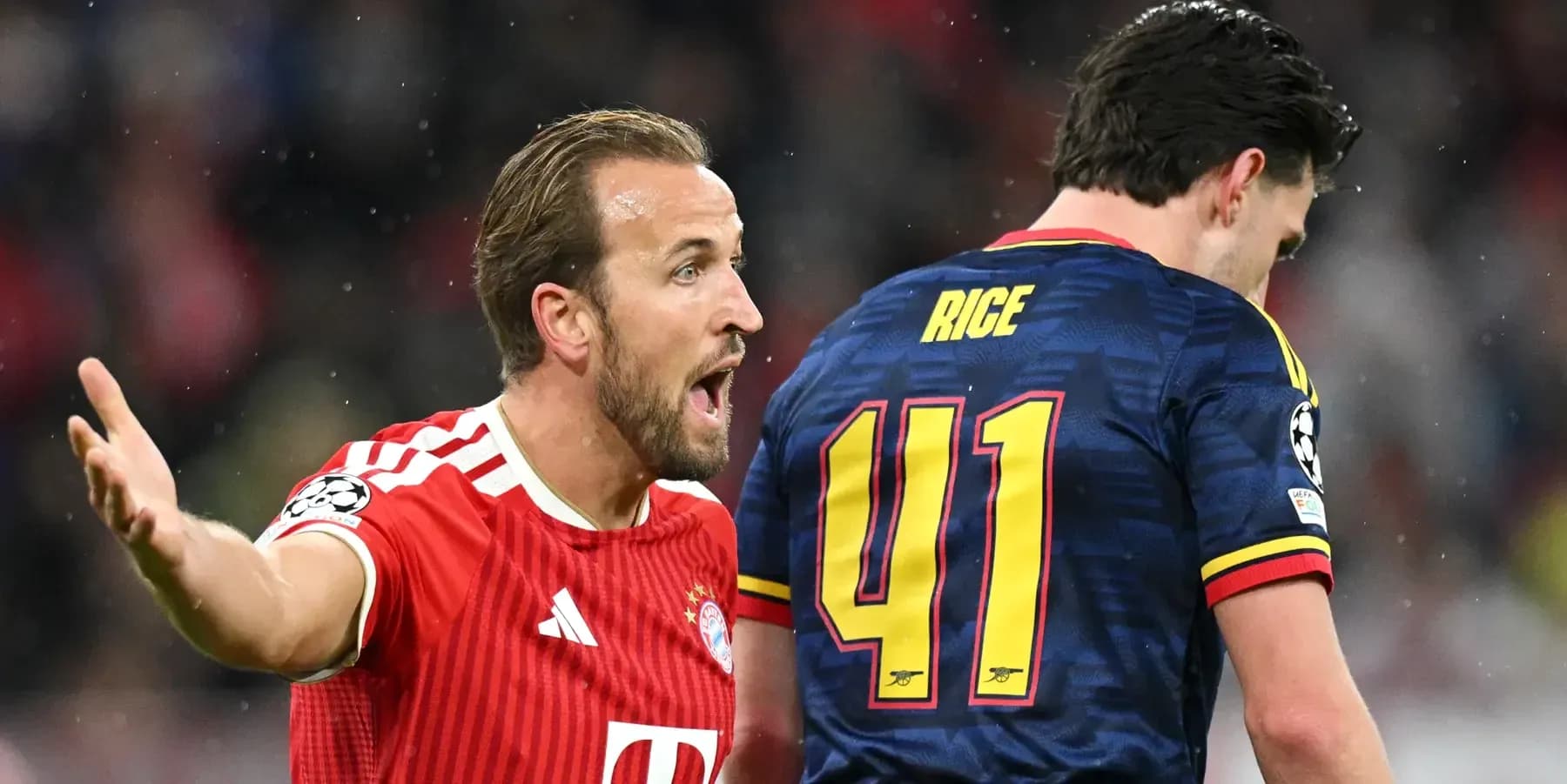
The headline duel was always going to be H. Kane against Arsenal’s reshaped defence. Kane entered the night as one of the competition’s most efficient forwards: 4 goals and 2 assists in 3 appearances, with 11 shots (7 on target), and 2 penalties scored from 2 attempts. He is not only Bayern’s finisher but also their creator, with 7 key passes and 81% passing accuracy. Against an Arsenal side that had conceded just 2 goals in total, at an average of 0.7 per match, his movement between Konsa and Gabriel was the fault line to watch.
Arsenal’s defensive record on their travels – 2 goals conceded in 2 matches, an away average of 1.0 per game – suggested they could not simply sit deep and absorb. Timber and Calafiori had to be aggressive in wide areas against Gnabry and Davies, denying the cut-backs and half-spaces from which Kane thrives.
In midfield, the engine-room confrontation was layered. For Bayern, Bischof and Pavlović were tasked with progressing the ball under Arsenal’s press while shielding a back line that, for all its strength, had conceded 5 goals overall at an average of 1.7 per game. Their vulnerability is also time-coded: 20.00% of their goals conceded in each of the 0-15, 16-30 and 31-45 periods, but a worrying 40.00% in the 76-90 window. Arsenal’s own attacking peak between 61-75, followed by 16.67% of their goals in the 76-90 range, intersected almost perfectly with Bayern’s late-game defensive wobble.
On the other side, Rice and Bruno Guimarães had to manage Bayern’s surges after half-time. With Bayern scoring 30.00% of their goals in each of the 46-60, 61-75 and 76-90 ranges, the second half is essentially a continuous wave. Ødegaard’s positioning between Bayern’s lines was crucial not just for creation, but for relieving pressure by keeping the ball in advanced zones and connecting with Saka and Madueke on transitions.
IV. Statistical Prognosis – A Draw with Knockout Weight
The 2-2 final score mirrored the numbers that framed it. Bayern, who had gone over 2.5 total goals in 2 of their 3 matches this season, once again produced a high-scoring contest. Arsenal, who had been under 2.5 in 2 of 3, were drawn into Bayern’s tempo but still maintained their unbeaten run.
From a probabilistic lens, Bayern’s attacking volume – 10 goals in 3 matches, no failures to score, and 2 penalties scored from 2 taken – suggests that their xG profile is consistently high. Arsenal’s defensive solidity, with 2 clean sheets in 3 and only 2 goals conceded, indicates that this 2-2 is more an outlier for them than for Bayern.
Yet the deeper story is about phases. Bayern’s relentless second-half scoring patterns collided with Arsenal’s mid-second-half surge and their generally compact defensive structure. The result is a match that felt like two heavyweights trading in defined windows rather than a free-flowing chaos.
Following this result, Bayern’s identity as an attacking force with late-game defensive frailty is reinforced, while Arsenal leave Munich having proven that even without key defenders like Saliba and Hincapie, they can survive – and strike – in one of Europe’s most hostile arenas. For both, the point may be shared, but the tactical lessons, and the looming implications for the play-off paths ahead, are anything but equal.