Beşiktaş Dominates FC Midtjylland in Tactical Masterclass
Beşiktaş’s 1-0 win over FC Midtjylland at Tüpraş Stadyumu was a textbook example of territorial dominance meeting structural control. Vincenzo Italiano’s 4-1-4-1 pinned the visitors deep for almost the entire night, turning a numerical equality on paper into a functional 11-v-9 after Friday Etim’s early red card and the Danes’ enforced reshaping.
From the outset, Beşiktaş built patiently with a single pivot. S. Ozcan sat as the “1” in front of the back four, giving a stable platform for the two advanced interiors, J. Olaitan and O. Kokcu, to step into the half-spaces. The wide midfielders, V. Cerny on the right and I. Fakili from the left, played aggressively high, almost as wingers, which stretched FC Midtjylland’s 4-3-3 into a flat back five at times. With 75% possession and 685 total passes (606 accurate), Beşiktaş turned the game into a rehearsed positional attack exercise.
The key structural battle was in midfield. FC Midtjylland’s initial 4-3-3, with P. Billing, P. Bravo and V. Byskov, was designed to contest central zones, but Etim’s dismissal at 15' forced Mike Tullberg to sacrifice one layer of attacking threat for defensive stability. Franculino (OUT) was replaced by M. Erlic (IN) at 46', and later D. Osorio (OUT) made way for Cho Gue-Sung (IN) at 62', but the pattern remained reactive: narrow lines, low block, and sporadic counters rather than sustained possession. Their 237 total passes, with only 146 accurate, underline how rarely they were able to string sequences together under Beşiktaş’s press.
In possession, Beşiktaş’s full-backs R. Yilmaz and M. Murillo provided constant width, allowing Cerny and Fakili to drift into the half-spaces and between the lines. The pivot Ozcan often dropped between the centre-backs T. Djalo and E. Topcu to create a three-man first line, freeing both full-backs to advance simultaneously. This created repeated 5-v-4 and even 6-v-4 situations in the final third. The result was a barrage: 28 total shots, with 15 inside the box and 13 from range, supported by 5 corner kicks and 9 free kicks in advanced areas.
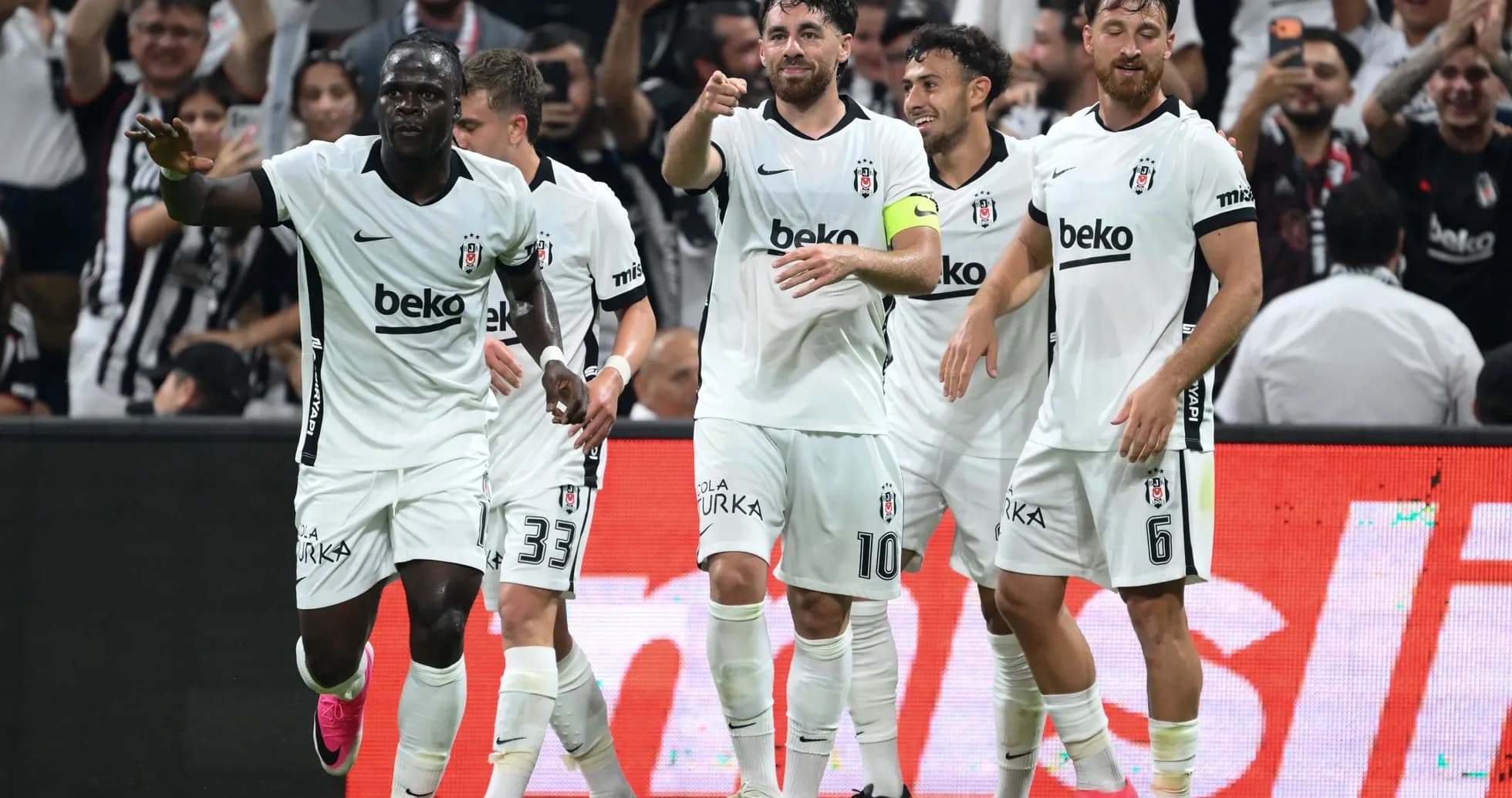
The decisive moment tactically encapsulated the game plan. At 26', Beşiktaş broke FC Midtjylland’s compactness with a classic half-space combination: Cerny received between lines on the right, drew a central midfielder, and slipped a vertical pass into the inside channel for O. Kokcu, who had timed his run beyond the last line. Kokcu’s finish gave Beşiktaş the 1-0 lead, but more importantly, it rewarded the constant occupation of those inner corridors that had been stretching Midtjylland’s block.
Out of possession, Italiano’s side were equally structured. The 4-1-4-1 morphed into a 4-4-2 press, with Oh Hyeon-Gyu leading the line and one of the advanced midfielders stepping up to close the centre-backs. The press triggers were clear: backward passes to the goalkeeper E. Olafsson, lateral balls to full-backs facing their own goal, and heavy touches from Midtjylland’s midfielders. With FC Midtjylland limited to just 5 total shots (3 inside the box, 2 outside), Beşiktaş’s rest defence—Djalo and Topcu staying tight behind Ozcan—snuffed out transitions before they developed.
Substitutions from Italiano were about energy management and maintaining control rather than changing structure. At 63', I. Fakili (OUT) made way for M. Rashica (IN), and Oh Hyeon-Gyu (OUT) was replaced by S. Kilicsoy (IN), refreshing the front line without altering the 4-1-4-1 shape. Later, Ozcan (OUT) gave way to K. Kayra Yilmaz (IN) at 73', and R. Yilmaz (OUT) was replaced by K. Ouattara (IN) in the same minute, ensuring the full-back and pivot roles stayed functionally identical. T. Djalo (OUT) then ceded his centre-back spot to E. Agbadou (IN) at 78', preserving aerial dominance and composure at the back.
Goalkeeper usage underscored the tactical story. A. Nubel (Beşiktaş) faced just 1 shot on goal and made 1 save, effectively acting as an auxiliary sweeper behind a high line rather than a traditional shot-stopper. His calm distribution helped maintain Beşiktaş’s territorial squeeze. At the other end, E. Olafsson (FC Midtjylland) was far busier, making 6 saves as Beşiktaş peppered his goal with 7 shots on target and 16 efforts off target. His interventions, combined with 3 blocked shots by his defenders, kept the scoreline respectable and prevented the tie from being effectively over in the first leg.
Discipline and game management also played into the tactical narrative. FC Midtjylland committed 9 fouls to Beşiktaş’s 12, but the crucial moment was Etim’s straight red. With 1 red card and no yellows for the visitors, and no cards at all for Beşiktaş, the Turkish side were able to keep their aggressive pressing and high defensive line without the risk of cumulative bookings altering their approach.
Set-pieces were another reflection of control rather than chaos. Beşiktaş’s 5 corners and 9 free kicks gave them repeated chances to load the box, but FC Midtjylland’s compact, numbers-behind-the-ball approach limited clear headers on goal. Conversely, Midtjylland’s 2 corners and 12 free kicks were mostly used to relieve pressure and move the block up the pitch briefly, rather than as genuine attacking platforms.
Overall, the match was a tactical demonstration of how a possession-heavy, structure-first side can suffocate a numerically reduced opponent without losing balance. Beşiktaş’s passing accuracy, shot volume, and territorial dominance were all direct products of their 4-1-4-1 architecture and intelligent rotation of roles, while FC Midtjylland’s low pass count, minimal shots and reliance on their goalkeeper highlighted the limitations of defending deep for 75 minutes against a well-drilled positional side.