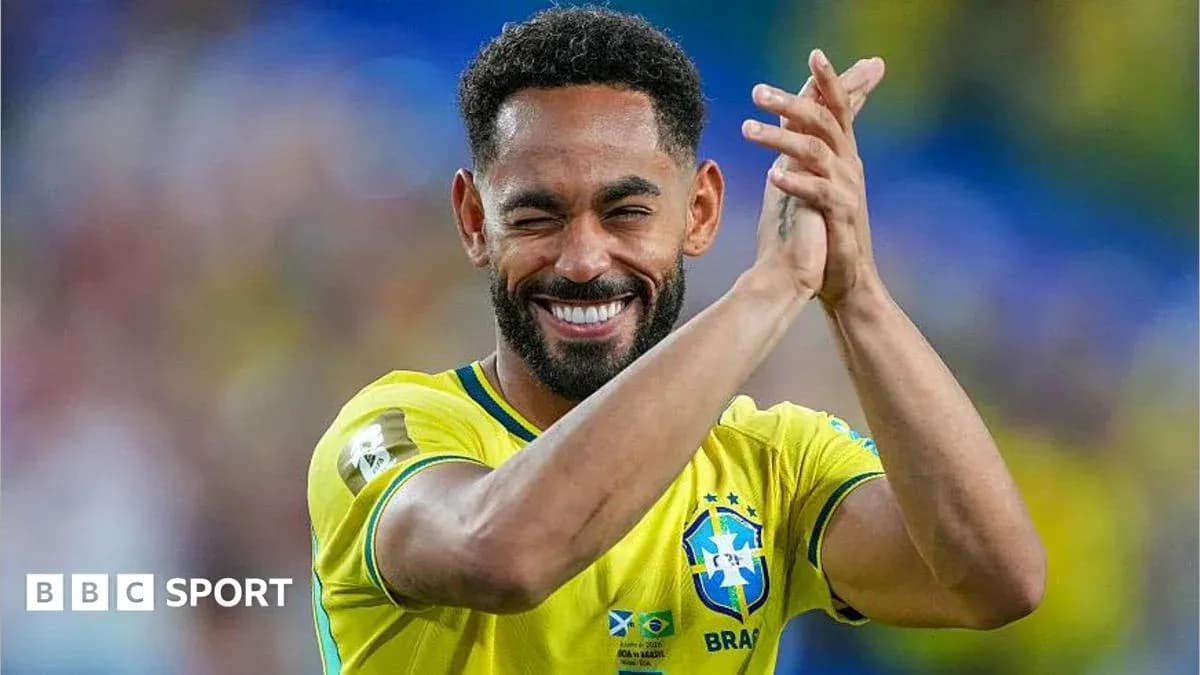
Brazil's World Cup Strategy: The Rise of Cunha and Ancelotti
Brazil’s World Cup machine is starting to hum, and so is Carlo Ancelotti’s plan.
The group stage has done something Brazil sides don’t always manage at major tournaments: it has given them clarity. The team looks settled, the ideas sharper, the confidence growing with every game. Just in time, too. Japan wait in the last 32, a side that punishes any lapse in concentration.
At the heart of this new Brazil sits a centre-forward who doesn’t quite fit the old mould, and that is exactly why he works.
Cunha, the “nine-and-a-half” who changed the picture
For decades, Brazil’s number nine shirt has carried a very specific image: a pure finisher, a penalty-box predator, a reference point. Ronaldo. Adriano. Romario. You knew what you were getting.
Matheus Cunha is something else entirely.
He moves like a striker and thinks like a playmaker, a “nine-and-a-half” who blurs the lines between the roles. He drops off the front line, links play, creates angles. Then he appears in the box and scores. Three goals already at this tournament say he is no false nine masquerading as a creator; he is both threat and conduit.
That blend gives Brazil a dimension they have rarely had through the middle. Cunha is not there just to finish moves. He starts them, knits them together, then arrives again to finish them off.
His movement constantly asks questions of defenders. Step out with him and you leave Vinicius Jr and Rayan with space to attack. Hold your position and Cunha has time to receive between the lines, turn, slide passes, or shoot. Whatever the choice, the defender is wrong.
There is a touch of Roberto Firmino about him – the same habit of dropping into awkward pockets, the same willingness to work without the ball, the same ability to unsettle a back line without even touching it. The difference is that this is happening on the biggest international stage, in a Brazil shirt that usually demands something more traditional.
Crucially, Cunha looks entirely at ease in the role. He presses from the front, sometimes even operating like a temporary number six when Brazil step up as a unit. He sacrifices himself defensively, yet still carries the sharpness to decide games. That balance has become central to Ancelotti’s reshaped attack.
Ancelotti’s accidental discovery
The plan was not obvious a few weeks ago. Brazil arrived at the World Cup without a clear first-choice centre-forward – an unusual situation for a nation that usually has a queue of number nines.
Cunha, Igor Thiago, Endrick, Joao Pedro, Richarlison: all were tried. None was nailed on.
Even as the tournament approached, the position remained open. Then football’s old selector, injury, intervened.
Raphinha, brilliant but restless, started the opening game against Morocco as a roaming 10 behind Igor Thiago, having also shown he can play on either wing. His hamstring injury in that match changed everything. On came Rayan, a more disciplined right-sided option, a player who naturally holds the flank.
With Vinicius pinning the left and Rayan stretching the right, the central lane cleared. Space opened up exactly where Cunha likes to operate – alone between the lines, free to drift and dictate. Suddenly the geometry of Brazil’s attack made sense.
Now, Cunha has become the reference point without being a static target. Vini wide left, Rayan wide right, Cunha knitting and cutting through the middle. Defenders are pulled apart, not by sheer pace or endless crosses, but by angles and timing.
Igor Thiago still offers something different – a more physical presence who can plant himself on the centre-backs if Brazil need to chase a game or fight a more direct battle. Ancelotti has that card in his pocket. For now, though, the public back home is increasingly convinced that Cunha is the answer. They see a clever forward, hard to read, harder to stop.
Opponents now know what he does. That does not mean they know how to deal with it.
A coach who sets traps, not just line-ups
This Brazil side carries Ancelotti’s fingerprints in more ways than one.
His reputation often centres on man-management, the ability to handle stars and keep dressing rooms calm. What can get overlooked is how adaptable he is tactically. His Brazil does not cling to the ball for the sake of an identity. It uses it, or gives it away, depending on what hurts the opponent most.
They do not need 70% possession. They do not want it just to prove a point.
Against Scotland, that approach was ruthless. Brazil allowed Scotland to have the ball, but not the control. They shepherded play into specific areas, guiding the Scots into the trap. Then, at the chosen moment, they sprang the press with the right intensity and numbers.
The first goal came from that plan. So did the second, harshly ruled out. These were not isolated incidents. Similar patterns had already appeared in warm-up wins over Panama and Egypt. This is a rehearsed weapon, not a lucky punch.
Brazil, without the ball, still felt in charge. They dictated where Scotland could go, then punished them when they arrived there. It was Ancelotti’s Brazil in microcosm: calm, pragmatic, utterly clear about when to bite.
So when the debate turns to “identity” – possession side or counter-attacking side, expansive or conservative – this team offers a different answer. It adapts. The opponent and the moment dictate the shape, not a rigid doctrine. With players as versatile as these, why would you lock them into one idea?
A different kind of Brazil
This is not a throwback to the great Brazil sides of the past, and it is not trying to be.
The most obvious shift is in the full-back positions. For the first time at a World Cup in modern memory, Brazil are not sending their full-backs flying forward at every opportunity. No Roberto Carlos tearing down the left, no Cafu or Dani Alves endlessly overlapping, no Maicon or Marcelo rampaging high and wide.
Instead, Douglas Santos, Roger Ibanez or Danilo offer something more measured. They pick their moments, stay compact, and protect the structure. That caution is not a step back; it is a trade-off. It allows Vinicius to stay higher, to conserve energy, to be fresher and more explosive when Brazil break.
The result is a back four that looks solid, a platform that has conceded only one goal so far. In front of them, the midfield has quietly found its balance too.
Casemiro’s early struggles against Morocco told their own story. Left alone in the centre in a 4-2-3-1, he was asked to cover impossible ground. Criticism followed, but it missed the point. At 34, he was never going to be the one-man pressing machine some seemed to demand. That has never truly been his game.
Ancelotti adjusted. Brazil shifted into a 4-3-3. Now, when Bruno Guimaraes surges forward as planned, Casemiro has Lucas Paqueta close by. The veteran no longer has to patrol the entire middle third on his own. The spaces are smaller, the distances shorter, the decisions simpler.
Against Haiti and Scotland, the difference was clear. Brazil controlled transitions, closed gaps, and dictated tempo far more effectively. That structure will be vital against Japan, a side far more fluid and dangerous in attack than either of those two.
The mood turns, the stakes rise
Seven goals scored, one conceded, a coach in command of his options, and a centre-forward redefining the role. On paper, Brazil’s start looks strong. On the streets back home, the transformation feels even bigger.
Before the first game, there was anxiety. After it, there was real concern. The doubts were loud, the questions sharper. Three matches later, the mood has flipped. Excitement has replaced tension. The public is smiling again.
Brazil know that in the end, only one thing matters: keep winning. Performances, patterns, tactical tweaks – all of it is judged by that simple metric.
The World Cup is taking shape. So is this Brazil. The real question now is whether this new, more pragmatic, more flexible version can carry the weight of that yellow shirt when the knockout pressure hits – starting with Japan.