Brazil's World Cup Collapse: An Analysis of Ageing Players and Missed Opportunities
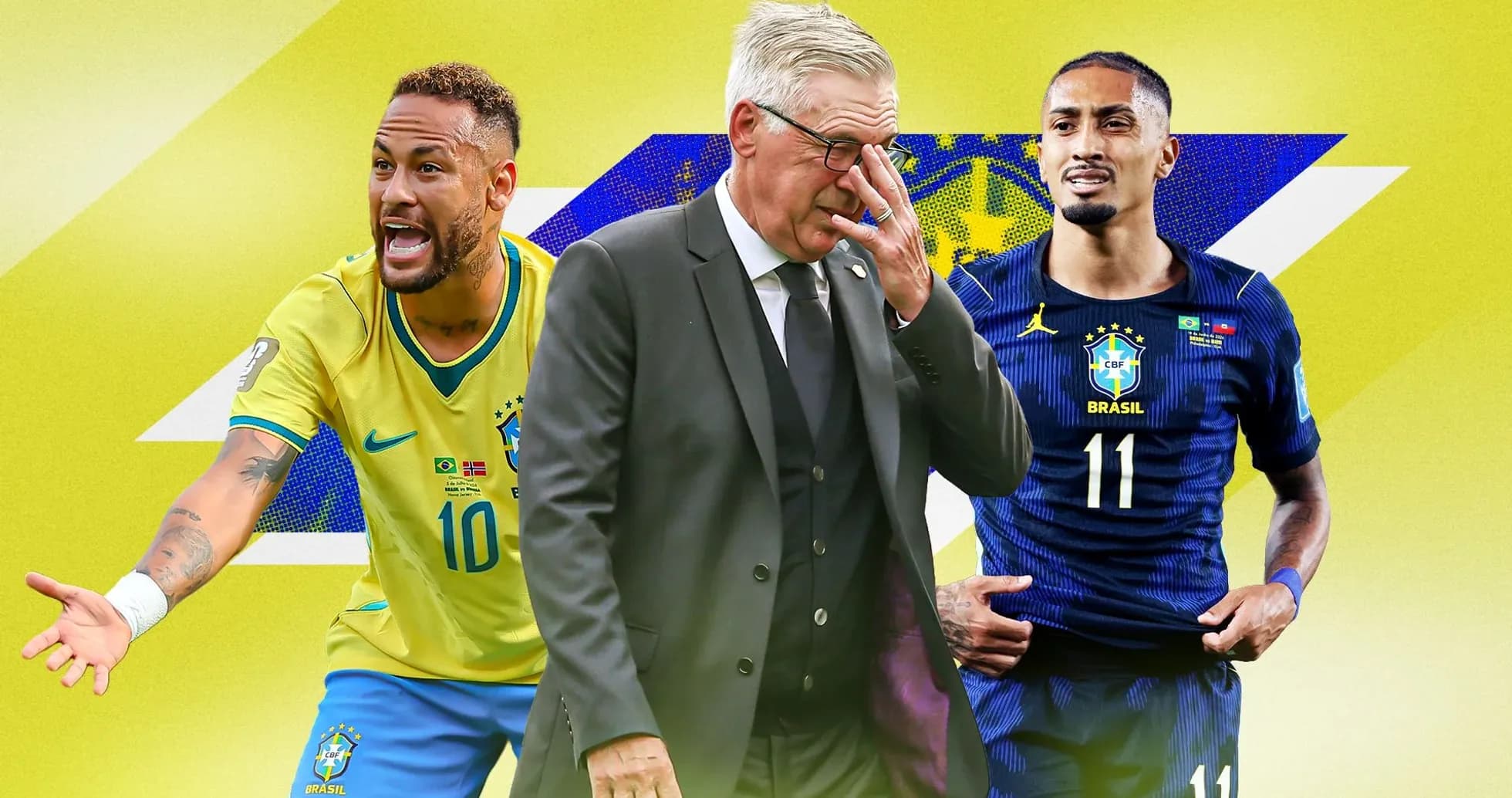
Brazil’s World Cup collapse did not come out of nowhere. It was built, brick by brick, in Carlo Ancelotti’s team sheets.
For all the talk of bad luck and key injuries, the core of the problem was brutally simple: Brazil went to a World Cup with a squad that looked like a testimonial XI in too many areas, and paid the price.
An ageing spine and a tired idea
Everywhere you looked, there were miles in those legs. The three goalkeepers were 33, 32 and 38. The defenders who made the cut averaged 31, with Danilo and Alex Sandro – once elite full-backs at Juventus – now resembling echoes of a different era rather than standard-bearers of a new one.
In midfield, the story was the same. Casemiro, 34, was again asked to anchor a campaign at the highest level. Fabinho, 32, logged heavy minutes. These are players who have seen and done everything, but the tempo of a World Cup is unforgiving, and Brazil’s midfield often looked like it was running through sand.
There were glimmers of tomorrow. Bournemouth teenager Rayan, just 19, and Botafogo’s 25-year-old Danilo hinted at a fresher, more dynamic Brazil. They were the exception, not the rule. Ancelotti admitted as much once the campaign fell apart.
“We need some young talent, we need some high-level players coming into Brazilian football,” he said. A sober assessment, delivered after the damage had already been done.
Neymar: the risky recall that backfired
One selection overshadowed almost everything else. Neymar.
At 34, and with his last cap dating back to October 2023, his inclusion was a gamble dressed up as inevitability. Pressure from the media, nostalgia from the stands, and the pull of a national icon combined to push him onto the plane.
Then reality intervened.
On the eve of the tournament, Neymar suffered a calf injury, ruling him out for “two to three weeks”. He missed Brazil’s first two group matches and managed just 14 subdued minutes against Scotland in Miami. That cameo felt less like the return of a talisman and more like a farewell tour – the pace gone, the sharpness missing, the aura dimmed.
Ancelotti did not turn to him at all in the dramatic last-32 win over Japan. Chasing the game against Norway in the round of 16, he finally sent Neymar on with more time to influence the contest. The forward converted a late penalty, but it was a consolation goal and a symbolic one: a legend scoring in what will almost certainly be his final act in a Brazil shirt, unable to change the outcome.
The risk had not been worth it. And it made another decision look even worse.
The Joao Pedro question that won’t go away
If Neymar was the sentimental pick, Joao Pedro was the cold, clinical omission.
The Chelsea striker, 24, had just finished a superb debut season at Stamford Bridge, directly involved in 29 goals. He could play across the front line, link play, attack space, and finish. He looked, on form and profile, like the obvious No.9 for a Brazil in need of freshness and mobility.
Instead, he stayed at home.
It was widely assumed he would not only travel but potentially start at the World Cup. Ancelotti himself admitted when naming the squad that Joao Pedro “probably deserved to be on this list”. That line has aged badly.
As the inquest into Brazil’s exit gathers steam, that call is already being dissected. It will not stop any time soon.
“I have to be honest, I think this elimination begins with the decisions from the bench,” Ronaldo Nazario said. “I still don’t understand why Joao Pedro was not part of this squad. He has had an exceptional season, he is in form, and Brazil needed a striker who could offer something different.”
The accusation is clear: Brazil chose memory over momentum.
Midfield strain and one man carrying the load
The age profile and omissions left Brazil light in the one area you cannot afford to be weak: midfield.
Ancelotti initially named just five central midfielders, one of them Lucas Paqueta, who is more of a No.10 than a controller. Only when right-back Wesley withdrew injured did Manchester United-bound Ederson come in as a late replacement.
That put an enormous burden on Bruno Guimaraes. The Newcastle captain was asked to create, to graft, to dictate tempo, to lead. He responded with four assists and huge defensive shifts. It still wasn’t enough.
The alternatives were barely trusted. Ederson and Danilo saw only scraps of game time from the bench. Brazil’s midfield became a one-man engine room, and as the tournament wore on, that imbalance grew more obvious.
After the defeat to Norway, Ancelotti did not hide from where he felt the rebuild must start. “We have to think about the future, but it is very evident that in the midfield, I think that we have to move some players,” he said. It sounded like an admission that Brazil had turned up with the wrong mix for the demands of modern international football.
A penalty, a spreadsheet, and a turning point
The defining moment of Brazil’s World Cup may have come from 12 yards.
With the score still goalless against Norway, Bruno Guimaraes stepped up to take a first-half penalty. Vinicius Junior, Brazil’s leading scorer at the tournament and in electric form, watched on. So did everyone else, surprised.
Guimaraes’ effort was saved. Norway would later score. Brazil never clawed their way back.
The choice of taker wasn’t about instinct or hierarchy. Ancelotti later revealed it was data-driven.
“We did statistics for the players and according to that, Raphinha was the best option,” he said. “The best person would be Raphinha and then Neymar [who weren’t on the pitch], and after that, Bruno Guimaraes. After Bruno, it would be Martinelli, so we chose Bruno Guimaraes as we felt he would be the best.”
On paper, it made sense. On grass, in the heat of a knockout tie, it looked detached from the rhythm of the team. Vinicius, in full flow and carrying the side, stood aside because the numbers said so. The miss became a symbol of a campaign where logic and feel never quite met.
Injuries and thin margins
Ancelotti is not wrong to point to the injuries that stripped Brazil of depth and variety.
Before the squad was even announced, Eder Militao, Rodrygo and Estevao Willian were all ruled out. That meant no first-choice right-back and no Rodrygo or Estevao as potential starters or game-changing options from the bench on the wings. The pool of difference-makers shrank dramatically.
Once the tournament began, the hits kept coming. Neymar’s calf issue was almost cruelly predictable, but still damaging. Raphinha pulled up with a hamstring problem in the first half against Haiti in the second group game and did not play again. Paqueta, crucial between the lines, was forced off at half-time in the knockout win over Japan.
By the time Norway arrived, Brazil were patched up, short of spark, and reliant on the same core to deliver again and again. For a squad already carrying too many veterans, the margin for error disappeared.
Ancelotti’s next cycle
For Ancelotti, this is a stain on an otherwise glittering résumé, but also a starting point.
“A defeat is the beginning of a new adventure,” he said. “We have to keep improving, to find new ideas. It is not an end, it is the start of a new cycle.
“We will manage this defeat by bringing a fresh impetus to our work and the assessment of the players. We will try to improve and look for new ideas. The same as we did this year.
“I think the work we’ve done has been good. Football is like this; sometimes you have to manage the sadness of a defeat. I am used to this.”
He will need more than resilience. Brazil cannot afford another World Cup built on sentiment, seniority and spreadsheets. The next squad must be younger, braver, sharper – and chosen for the demands of tomorrow, not the memories of yesterday.
The question now is stark: will this be remembered as the moment Brazil finally broke from the past, or as the warning they ignored on the way to another fall?