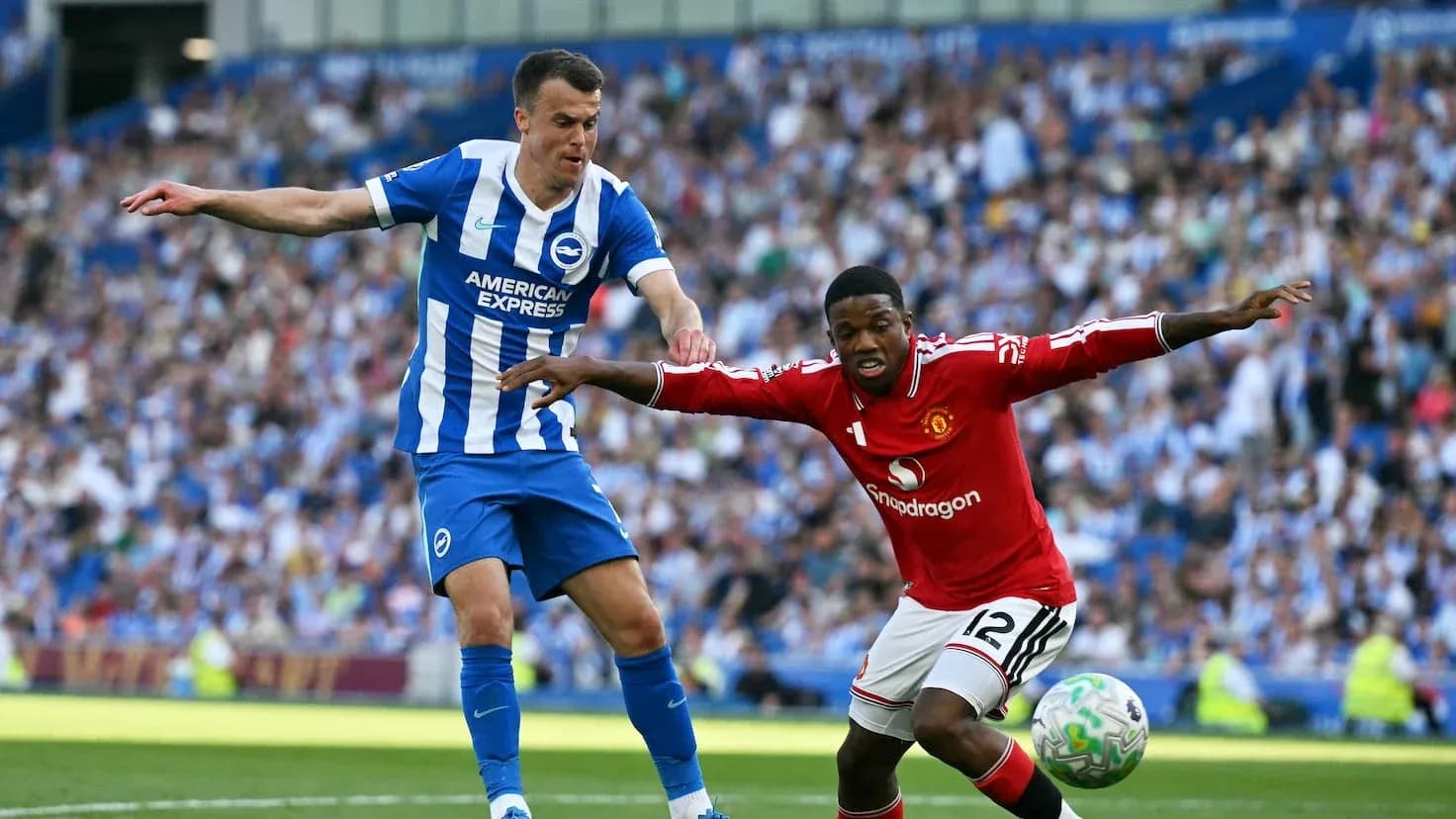
Brighton vs Manchester United: Tactical Analysis of 0-3 Defeat
Brighton’s 0-3 home defeat to Manchester United at Amex Stadium was shaped less by possession and volume of shots and more by structure, vertical threat, and efficiency in both boxes. Both sides lined up in a 4-2-3-1, but Manchester United’s version was far more aggressive without the ball and direct with it, turning 49% possession and 11 total shots into three goals, while Brighton’s more patient 51% share and 13 attempts never translated into genuine control of the contest.
Out of possession, Brighton’s 4-2-3-1 often flattened into a 4-4-1-1, with P. Gross and J. Milner as the double pivot in front of L. Dunk and J. P. van Hecke. Full-backs M. Wieffer and F. Kadioglu pushed relatively high, trying to lock Manchester United in, but that left large channels either side of Dunk that the visitors repeatedly attacked. The hosts’ 0.81 xG from 13 shots underlines how much of their shooting came from suboptimal positions: 9 efforts inside the box, but only 2 on target, many of them rushed or under pressure once United had collapsed into their defensive block.
On the ball, Brighton’s structure was clean: 463 passes, 397 accurate (86%), with steady circulation through the back four and Gross dropping to form a three in build-up. However, the lack of penetration was stark. With no corner kicks won across 90 minutes and only 1 offside, Brighton rarely stretched United vertically. D. Welbeck was often isolated, receiving in front of the centre-backs rather than spinning behind them, and the advanced midfield trio struggled to find pockets between the lines against a compact visiting double pivot of M. Mount and K. Mainoo.
Substitutions
The substitutions on 59 minutes — S. March (IN) for D. Gomez (OUT), C. Baleba (IN) for J. Milner (OUT), and C. Kostoulas (IN) for D. Welbeck (OUT) — were a clear attempt by Fabian Hurzeler to inject dynamism and direct running. Later, G. Rutter (IN) for J. Hinshelwood (OUT) at 74' added another forward reference point. Yet the underlying pattern remained: Brighton could circulate but not destabilize. Five blocked shots out of 13 total show United’s back line consistently in position to contest efforts rather than being pulled apart by combinations.
Defensive Struggles
Defensively, Brighton’s high line without consistent pressure on the ball was repeatedly punished. Manchester United’s first goal at 33' — P. Dorgu finishing from a B. Fernandes assist — reflected the visitors’ plan: quick progression into the half-spaces, then final-third quality. The second at 44' saw B. Mbeumo convert from an A. Diallo assist, again exploiting transition spaces before Brighton’s block could reset. The third, on 48', with B. Fernandes scoring from a P. Dorgu assist, underlined how United’s attacking midfielders were able to arrive free at the edge or inside the box. The VAR check at 50' confirming the goal reinforced that United’s runs and timings were consistently troubling the hosts’ defensive line.
In goal, B. Verbruggen (Brighton) was heavily involved, making 5 saves and posting 0.32 goals prevented. That combination indicates he did enough to stop the scoreline becoming heavier, but he was exposed by the quality and proximity of United’s chances; the 1.82 xG conceded reflects repeated high-value situations inside the area. At the other end, S. Lammens (Manchester United) had a comparatively quiet afternoon, called upon for just 2 saves behind a well-protected penalty area. United’s back four and double pivot restricted Brighton largely to low-quality efforts, allowing their goalkeeper to manage the game rather than rescue it.
Manchester United's Strategy
Manchester United’s 4-2-3-1 was built for verticality and counter-pressure. With 447 passes and 369 accurate (83%), they were less focused on sterile possession and more on compressing space around the ball. The front four — A. Diallo, B. Fernandes, P. Dorgu and B. Mbeumo — rotated fluidly, with Fernandes often dropping into the right half-space to dictate, while Dorgu attacked the left channel. Their 7 shots on goal from 11 total, and only 1 blocked, show how effectively they created clear sightlines at goal rather than speculative attempts.
The visitors also managed the game well through substitutions. S. Lacey (IN) for P. Dorgu (OUT) at 62' came after the third goal and VAR confirmation, signalling a shift toward game management rather than relentless attack. At 74', J. Zirkzee (IN) for B. Mbeumo (OUT), L. Yoro (IN) for N. Mazraoui (OUT), and T. Fletcher (IN) for M. Mount (OUT) refreshed all three lines, while T. Malacia (IN) for L. Shaw (OUT) at 82' added defensive security on the left. These changes maintained United’s intensity in the press and defensive concentration, preventing Brighton’s late attacking reshapes from gaining traction.
Discipline and Statistics
Discipline played a minor but telling role. Manchester United committed 8 fouls to Brighton’s 11, yet only one card was shown: 45+3' Kobbie Mainoo (Manchester United) — Foul. That yellow, arriving at the end of first-half added time, reflected United’s readiness to disrupt Brighton’s rare central progressions when necessary, but overall the visitors’ defensive structure reduced their need for last-ditch interventions.
Statistically, the match narrative is clear. Brighton edged possession (51% to 49%) and out-shot United 13-11, but their 0.81 xG and 2 shots on goal illustrate a sterile territorial advantage. United, with 1.82 xG, 7 shots on goal, and only 1 blocked shot, produced fewer but far better chances and finished them ruthlessly. Brighton’s 0 corner kicks highlight how little sustained pressure they generated in the final third, while United’s 3 corners and repeated box entries show a side that knew how to turn transitions into territory.
In season-context terms, this is the kind of performance that underlines a clear contrast in overall form and defensive index. Manchester United combined compact defending, efficient pressing, and incisive attacking patterns to turn a near-parity possession game into a commanding 0-3 away win. Brighton, despite their passing accuracy and structured build-up, lacked the vertical threat and penalty-box presence to trouble a well-organized opponent and were repeatedly punished in transition for their ambitious, but insufficiently protected, positional play.