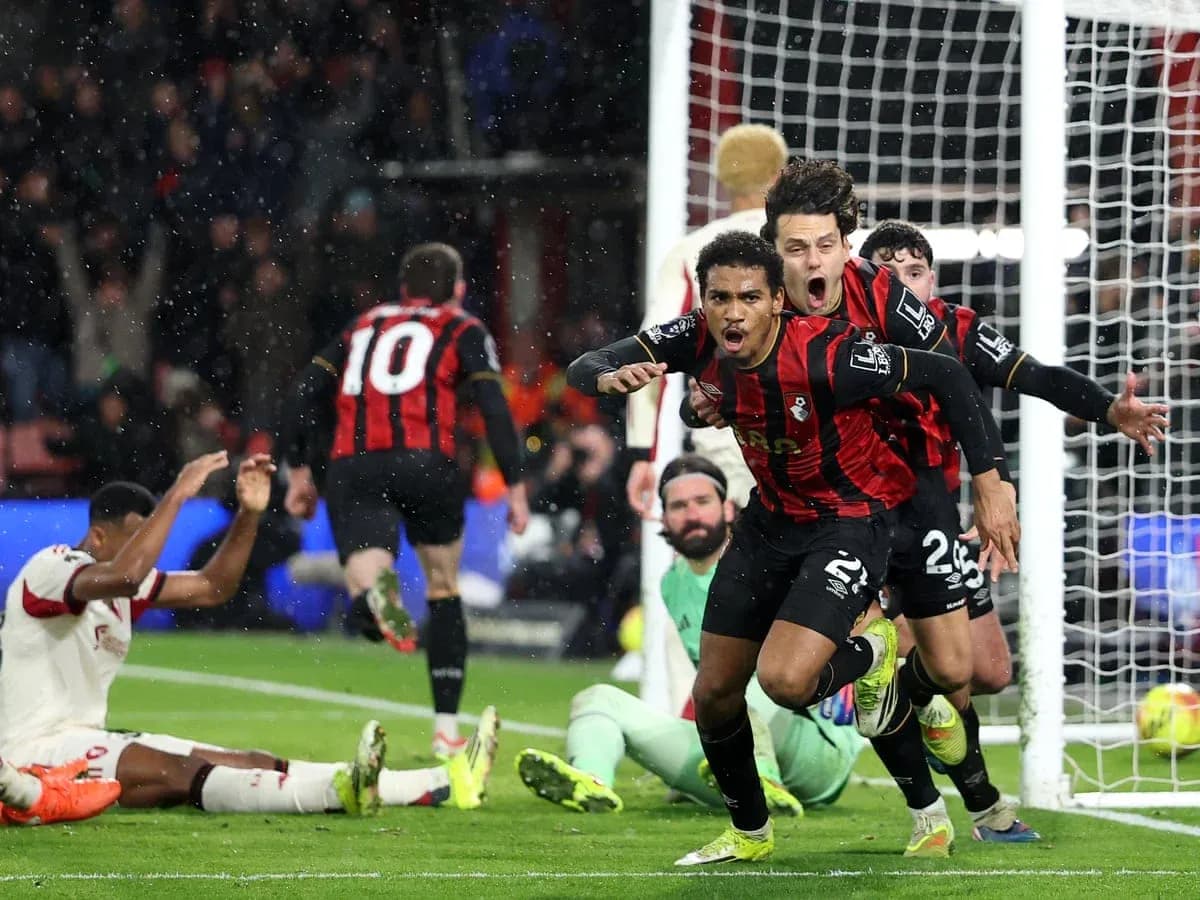
Brighton vs Manchester United: A Season Finale in Red
The Amex Stadium closed its Premier League season under a grey Brighton sky, but the story that unfolded was painted in Manchester United red. Following this result, a 3-0 away win, United locked in 3rd place on 71 points, while Brighton’s brave campaign settled in 8th on 53. It was a fitting snapshot of their seasonal identities: Brighton inventive but fragile, United imperfect yet ruthlessly decisive.
Across the season overall, Brighton scored 52 and conceded 46, a goal difference of +6 built on a strong record at home, where they scored 30 and let in 20. Manchester United finished with 69 goals for and 50 against overall, a goal difference of +19, powered by an attack that averaged 2.1 goals at home and 1.6 on their travels. On this final day, United’s away cutting edge and Brighton’s defensive looseness converged into a clear narrative.
I. The Big Picture – Shapes, Stakes, and Season DNA
Both sides lined up in a mirrored 4-2-3-1, but with very different emotional weights. For Brighton, Fabian Hurzeler’s selection felt like a statement of continuity: B. Verbruggen behind a back four of M. Wieffer, J. P. van Hecke, L. Dunk, and F. Kadioglu; a double pivot of P. Gross and J. Milner; with D. Gomez, J. Hinshelwood, and M. De Cuyper supporting lone striker D. Welbeck.
United, already assured of Champions League football heading into this game, showed Michael Carrick’s evolving blueprint: S. Lammens in goal; a back line of N. Mazraoui, H. Maguire, L. Martinez, and L. Shaw; K. Mainoo and M. Mount as the double pivot; and a fluid band of three in A. Diallo, B. Fernandes, and P. Dorgu behind B. Mbeumo.
Brighton’s season-long pattern was clear: at home they averaged 1.6 goals for and 1.1 against, leaning on controlled possession and patient construction. United, by contrast, thrived in transition, with 69 goals overall at 1.8 per game and only 4 matches in which they failed to score. This match became a distilled version of those tendencies: Brighton probing, United punishing.
II. Tactical Voids – Absences and Discipline
The absentees shaped the tone. Brighton were without K. Mitoma, S. Tzimas, and A. Webster, stripping Hurzeler of a direct wide threat and one of his senior centre-backs. It forced L. Dunk into an even more central leadership role, anchoring the line and orchestrating build-up from deep. Dunk’s season has been defined by high responsibility: 2484 completed passes at 92% accuracy and 27 successful blocks underline his role as both distributor and last-ditch protector.
For United, the missing spine was just as notable: Casemiro, B. Šeško, and M. de Ligt all sidelined. Without Casemiro, Carrick leaned on the youth and composure of K. Mainoo and the energy of M. Mount to control central spaces. The risk was defensive exposure, but Brighton’s lack of direct runners in Mitoma’s mould blunted that threat.
Disciplinary trends across the season hinted at where the temperature of the game might rise. Brighton’s yellow-card peak came between 46-60 minutes, with 27.91% of their cautions in that window, reflecting a side that often ramps up intensity just after half-time. United’s yellows were more spread but also spiked in the 46-60 range at 21.88%, and they showed a tendency toward late-game edge, with 20.31% of yellows from 76-90 and 17.19% from 91-105. While this particular match did not descend into chaos, the underlying data framed a contest where the middle third of the game was always likely to be the most combustible.
III. Key Matchups – Hunter vs Shield, Engine Room Battles
The headline duel was D. Welbeck versus United’s back line. Welbeck’s season total of 13 league goals and 1 assist came from intelligent movement rather than sheer volume: 46 shots, 28 on target. His penalty record, though, told a different story – 1 scored but 2 missed. That fragility from the spot mirrored Brighton’s broader issue: they created enough to threaten but not enough to overwhelm. Up against the physicality of H. Maguire and the aggression of L. Martinez, Welbeck was often forced away from the central danger zone, turning into a link-man rather than a finisher.
On the other side, B. Mbeumo led United’s line with a blend of work rate and incision. His 11 goals and 3 assists this season, backed by 59 shots (32 on target), marked him as the “Hunter” in Carrick’s structure. Up against L. Dunk, one of the league’s most reliable defenders with 27 blocks and 30 interceptions, the battle was as much about positioning as duels. Dunk’s tendency to step in front and win 127 of 217 duels meant Mbeumo often had to drift wide or drop to combine with B. Fernandes.
In the engine room, the contest was almost symbolic. P. Gross and J. Milner, both masters of tempo and small-space decisions, tried to dictate the rhythm for Brighton. Gross’s passing range and Milner’s tactical intelligence were designed to pull K. Mainoo and M. Mount out of shape. Yet United’s pair, especially Mainoo, brought verticality and bite that Brighton struggled to disrupt often enough.
Higher up, B. Fernandes was the game’s true conductor. His season numbers – 9 goals, 21 assists, 137 key passes, and 1994 total passes – reveal a player who lives on the ball and in the half-spaces. Brighton’s midfield line, with J. Hinshelwood and D. Gomez stepping out, could not consistently close his angles. Every time United broke Brighton’s first press, Fernandes found pockets between the lines, threading passes into Mbeumo or releasing A. Diallo and P. Dorgu into the channels.
IV. Statistical Prognosis – xG Echoes and Defensive Solidity
Even without explicit xG values, the season data frames the logic of this 3-0 scoreline. Heading into this game, Brighton’s overall averages of 1.4 goals scored and 1.2 conceded suggested a side that tends to play in balanced, often tight matches. United, by contrast, lived at higher variance: 1.8 scored and 1.3 conceded overall, with only 4 clean sheets away from home and 4 at Old Trafford, 8 in total.
Brighton’s 10 clean sheets overall, split evenly between home and away, showed they can shut games down. But the absence of Webster and the reliance on a full-back like M. Wieffer on the right of a back four left them vulnerable to United’s wide overloads and late runs.
United’s penalty record – 4 taken, 4 scored, 100.00% – added a layer of threat whenever they entered the box, even if no spot-kick arrived here. By contrast, Welbeck’s two missed penalties this season underlined a small but telling gap in Brighton’s ability to convert pressure into goals.
In narrative terms, the match felt like an xG story where United’s chances were fewer but cleaner, and Brighton’s more numerous but lower quality. Carrick’s side, used to playing with either a 4-2-3-1 or a 3-4-2-1 (20 and 18 games respectively this season), were comfortable dropping into a compact block and then springing forward. Brighton, who used 4-2-3-1 in 33 league games, tried to impose their usual structure but found their final-third patterns too slow and too central.
Following this result, the numbers and the narrative align. Brighton’s season remains a success – European qualification secured, a clear identity, and young pieces like J. Hinshelwood and D. Gomez integrated. But the defeat to United exposed the enduring flaw: against elite transition sides, their back line can be stretched beyond its limits.
For Manchester United, the 3-0 away win is more than a final flourish. It validates a campaign in which B. Fernandes’ creativity, Mbeumo’s movement, and the growing authority of K. Mainoo have formed the spine of a side that scores freely and increasingly controls big occasions. The xG story behind their season – high-volume chance creation, occasional defensive looseness – is trending in the right direction.
At the Amex, the final whistle felt like a curtain call on two intersecting arcs: Brighton’s brave, technical project still searching for defensive perfection, and United’s resurgent, structured chaos beginning to look like a serious force again.