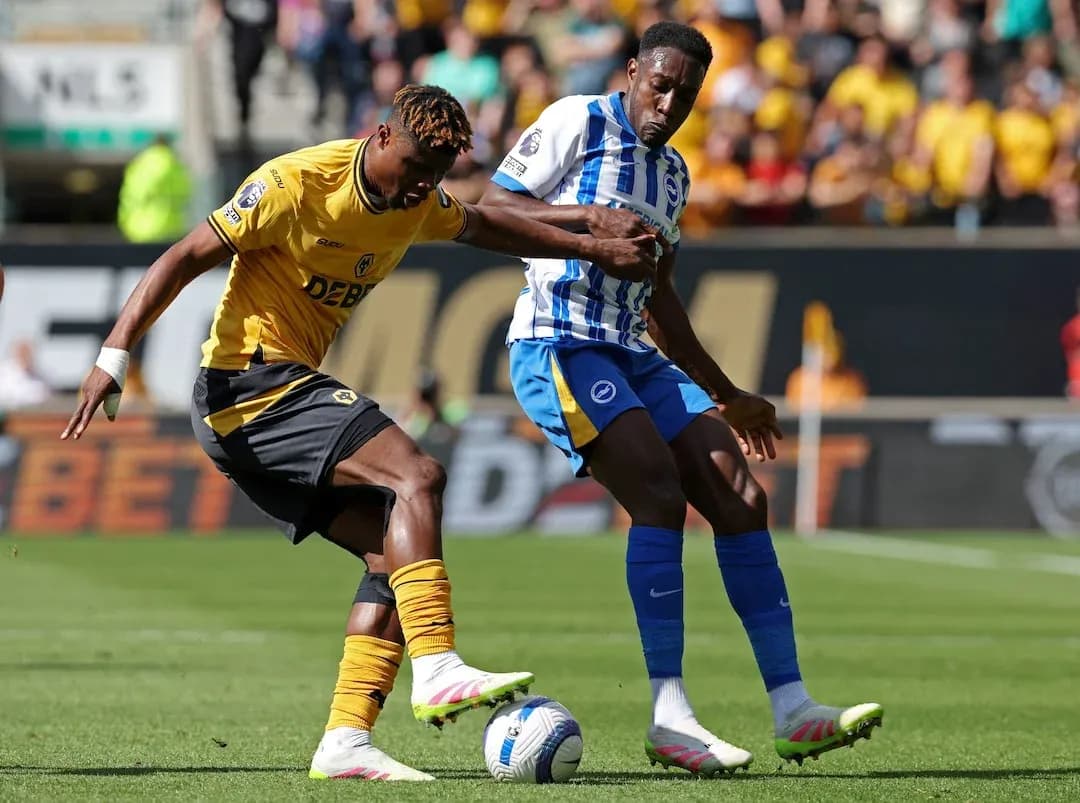
Brighton vs Wolves: Premier League Clash on 9 May 2026
Relegation fear and European ambition collide at Amex Stadium in Brighton on 9 May 2026, as Brighton welcome Wolves in a Premier League clash that could shape the narrative at both ends of the table.
Season Context
Brighton arrive in the closing stretch sitting 8th with 50 points from 35 matches, their positive goal difference of +7 built on 49 goals scored and 42 conceded. With 13 wins and 11 draws, they are pushing to turn a solid campaign into a genuinely memorable one by staying in the European conversation through a strong finish.
For Wolves, the picture is far darker. They are 20th with 18 points from 35 games, burdened by a -38 goal difference after scoring just 25 times and conceding 63. With only 3 wins and 23 defeats, and a description line that explicitly flags “Relegation - Championship”, they travel to the south coast fighting to keep even a faint survival hope alive.
Form & Momentum
Brighton’s recent league form string of LWDWW suggests a side finishing strongly (3 wins in their last 5). Combined with 50 points from 35 games and only 11 losses overall, they look confident and relatively consistent heading into this fixture.
Wolves, by contrast, carry the form code DLLLD, which underlines a struggling side (no wins in the last 5 and 3 defeats in that run). Their 3 wins from 35 matches and 63 goals conceded reinforce the sense of a team low on momentum and constantly under pressure.
Head-to-Head Patterns
The recent history between these clubs tells a story of Brighton generally having the upper hand, but Wolves finding ways to disrupt them. At Molineux Stadium on 5 October 2025, the sides played out a 1-1 draw (Premier League, October 2025). Earlier in the same calendar year, Brighton had travelled to Molineux Stadium and won 2-0 (Premier League, May 2025), a controlled away performance that underlined their growing superiority. Back on 26 October 2024 at American Express Stadium, the meeting on the south coast ended 2-2 (Premier League, October 2024), showing that Wolves can still pose a threat on Brighton turf even when second best over the longer term.
Tactical Preview
Brighton’s statistical profile and lineup data point strongly towards a possession-based, front-foot approach, most commonly in a 4-2-3-1 shape (used in 30 league matches), with occasional switches to 4-3-3 and even a 3-4-2-1. Their 49 league goals at an average of 1.4 per game, with 27 of those at home, suggest a proactive attacking side that tends to sustain pressure rather than rely on isolated moments. The balance between 27 home goals for and 17 against indicates a relatively secure home platform (home goals conceded averaging 1.0 per match).
Personnel-wise, Brighton’s spine looks robust. At the back, L. Dunk has been a central figure, making 30 appearances with a high passing volume (2214 passes at 92% accuracy) and strong defensive output (32 tackles, 26 blocks, 29 interceptions), indicating a defender who initiates build-up while anchoring the back line. Alongside him, J. van Hecke has been one of the standout performers, with 33 starts, 3 goals and 3 assists from defence plus 2265 passes at 86% accuracy and 51 tackles, underlining Brighton’s ability to construct attacks from deep and threaten on set pieces. In midfield, D. Gómez offers energy and bite (77 tackles and 5 goals in 30 appearances), giving Brighton a box-to-box presence who can both disrupt Wolves’ build-up and arrive late in the final third.
Up front, D. Welbeck is a clear focal point, with 13 league goals from 34 appearances and 25 shots on target from 43 attempts, supported by 20 key passes. Those numbers show a forward who not only finishes but also links play. Around him, creative and wide players from the squad list such as S. March, G. Rutter and K. Mitoma give Brighton the flexibility to overload wide areas in that 4-2-3-1, stretching a Wolves defence that has struggled all year (63 goals conceded, 1.8 per game).
Wolves, by contrast, are structurally more fluid but far less effective. Their formations data shows heavy use of back-three systems: 3-4-2-1 (10 matches), 3-5-2 (9) and 3-4-3 (5), supplemented by occasional 4-3-3, 5-3-2, 3-5-1-1, 4-2-3-1 and 3-4-1-2. This tactical restlessness reflects a search for solutions in a side that averages only 0.7 goals per game and has failed to score 18 times. Away from home, their attacking return is especially thin, with just 7 goals in 17 away fixtures (0.4 per match), which will be a major concern coming to a ground where Brighton are relatively solid.
Defensively, Wolves’ numbers tell a story of constant strain. Conceding 63 goals across 35 games, with identical home and away averages of 1.8, they have been porous in almost every environment. Discipline is another issue: their yellow-card leaders include Y. Mosquera with 11 bookings and midfielders João Gomes and André both on 10 yellows, while Toti Gomes has one red card. That profile suggests a team often forced into late or desperate challenges, particularly in midfield, which could become a problem against Brighton’s fluid passing through the centre.
In midfield, João Gomes and André stand out as volume players, with 1392 and 1228 passes respectively and high tackle counts (100 and 75). They will be central to Wolves’ attempt to slow Brighton’s rhythm and protect a back line that has been repeatedly exposed. Further forward, the likes of Hwang Hee-Chan and A. Armstrong from the squad list will need to be ruthless on the counter, because Wolves’ chance volume is low and their margin for error tiny.
The prediction model leans heavily towards Brighton, rating them stronger in form (83% vs 17%), attack (77% vs 23%) and defence (65% vs 35%), with an overall model edge of 71.5% to 28.5%. Recent five-game indicators reinforce this: Brighton’s last-five attack metric sits at 48% with 10 goals scored, while Wolves’ is just 14% with 3 goals, underlining the likely territorial and chance-creation imbalance.
Statistical Snapshot
- Competition: Premier League, season 2025 — 9 May 2026.
- Venue: Amex Stadium, Brighton.
- Prediction: Win or draw — Double chance : Brighton or draw.
- Win Probabilities: Home 45% / Draw 45% / Away 10%.
- Model: Brighton 71.5% — Wolves 28.5%.
Betting Verdict
With Brighton strong at home and pushing for European places, and Wolves bottom with only 3 wins and a -38 goal difference, the analytical case clearly tilts towards the hosts. The head-to-head record supports Brighton’s edge but also warns of Wolves’ capacity to make it awkward, as seen in the 1-1 at Molineux Stadium in October 2025 and the 2-2 at American Express Stadium in October 2024. Given the market prices around 1.25–1.31 for the home win and 5.4–6.27 for the draw, the model-backed advice of “Double chance : Brighton or draw” looks a pragmatic way to side with Brighton’s superiority while respecting the possibility of a tense stalemate. For those seeking value, Brighton to win remains the likeliest outcome, but the double-chance angle aligns most closely with both the prediction data and the recent H2H pattern.