Burnley vs Aston Villa: Tactical Analysis of 2-2 Premier League Draw
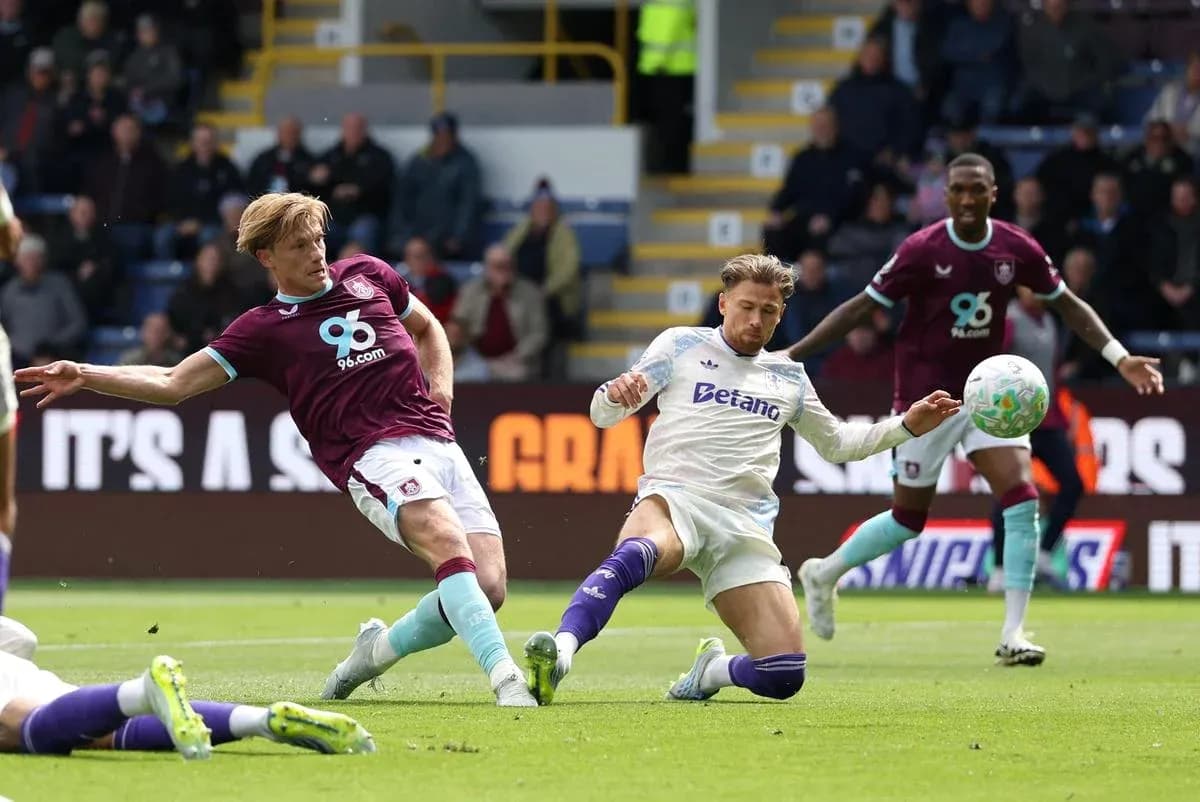
Burnley and Aston Villa shared a 2-2 draw at Turf Moor in Round 36 of the Premier League, a match that neatly reflected contrasting game models. Burnley, under Mike Jackson, leaned into a compact 4-2-3-1 built on direct progression and high running intensity. Unai Emery’s Aston Villa imposed a territorial, possession-heavy 4-2-3-1, circulating the ball with patience and creating a steady stream of shots rather than overwhelming volume of clear chances. The xG balance (Burnley 1.77, Aston Villa 1.42) and the final scoreline both suggest a contest where Burnley’s punchy transitions matched Villa’s control.
Executive Summary
Burnley took an early lead and were pegged back before the interval, going in at half-time level at 1-1. Villa turned the game around after the break, only for Burnley to respond almost immediately, setting up a tense final half-hour in which Emery’s side dominated territory but could not convert control into a winner. Statistically, Villa’s 66% possession and 18 total shots framed the pattern of play, yet Burnley’s efficiency in attacking phases and set structures in a 4-2-3-1 allowed them to remain competitive and, on xG, marginally ahead.
Scoring Sequence & Disciplinary Log
The game’s first key moment came on 8', when Jaidon Anthony struck for Burnley. Operating from the left of the three behind the striker, Anthony exploited Burnley’s direct approach: quick progression from deep, then incisive work in the final third. His early goal reinforced Burnley’s plan to defend compactly and spring forward rather than build slowly.
On 40', a potential goal by Ollie Watkins for Aston Villa was disallowed by VAR, a warning sign of Villa’s growing territorial pressure but without changing the score. Villa’s equaliser arrived on 42', Ross Barkley finishing after a move linked by John McGinn. Barkley’s role as the central attacking midfielder, finding pockets between Burnley’s double pivot and back four, was central to Villa’s ability to break lines.
After the break, Villa’s control translated again into the scoreline. On 56', Ollie Watkins scored, assisted directly by goalkeeper Emiliano Martínez. The pattern underlined Villa’s vertical threat even from deep: Martínez’s distribution bypassed Burnley’s first two lines, allowing Watkins to exploit space behind.
Burnley responded almost immediately. On 58', Zian Flemming equalised, assisted by Hannibal Mejbri. Flemming, the lone striker in the 4-2-3-1, benefited from Mejbri’s advanced positioning and willingness to carry the ball through the half-spaces, a classic Burnley transition pattern: regain, first vertical pass, then support runner.
Disciplinary log (all cards):
- 60' Zian Flemming (Burnley) — Persistent fouling
- 49' Tyrone Mings (Aston Villa) — Foul
There were exactly 2 yellow cards in the match: Burnley 1, Aston Villa 1, Total 2.
Tactical Breakdown & Personnel
Burnley’s 4-2-3-1 was clearly designed to compress central spaces and then break quickly. The back four of Kyle Walker, Axel Tuanzebe, Maxime Estève and Lucas Pires sat relatively narrow, allowing the full-backs to defend inside first and concede wide circulation to Villa. In front, Florentino Luís and Lesley Ugochukwu formed a physically strong double pivot; their brief was more about screening and second-ball recovery than orchestrating long possession spells.
In attack, Loum Tchaouna, Hannibal Mejbri and Jaidon Anthony supported Zian Flemming. Anthony’s early goal reflected Burnley’s use of the wide midfielder to attack the far post and half-space when the ball was moved quickly from back to front. Flemming’s later equaliser showed his capacity to drop and combine, not just run in behind. Hannibal, as the nominal No. 10, operated more like a high-energy connector, helping Burnley turn regains into attacks.
Without the ball, Burnley accepted Villa’s dominance: only 255 passes, 186 accurate (73%). Their pressing was selective rather than high and constant. The yellow card for Zian Flemming on 60' for Persistent fouling reflects the cumulative effect of Burnley’s attempts to disrupt Villa’s build-up and counter-press when the first line was beaten.
Aston Villa’s 4-2-3-1 was built around controlled possession and width. Matty Cash and Ian Maatsen provided advanced full-back width, while Ezri Konsa and Tyrone Mings managed rest defence against Burnley’s transitions. The double pivot of Victor Lindelöf and Youri Tielemans gave Villa both security and distribution: Tielemans as the main deep playmaker, Lindelöf offering stability.
Ahead of them, John McGinn and Ross Barkley constantly rotated between inside and outside channels, with Morgan Rogers tucking in from the left and Ollie Watkins leading the line. The disallowed potential goal by Watkins at 40' and his legitimate strike on 56' both emerged from Villa’s ability to pin Burnley deep and then exploit gaps in the back line.
In goal, Max Weiss for Burnley made 5 saves, compared to Emiliano Martínez’s 4 for Villa. The higher save count for Weiss mirrors Villa’s greater shot volume and territorial edge. Both keepers, however, finished with the same goals prevented value (-0.16), suggesting each conceded slightly more than the modelled expectation of the chances faced. Weiss was more reactive under sustained pressure; Martínez’s key contribution was not just shot-stopping but distribution, highlighted by his assist for Watkins.
Substitutions reflected the tactical adjustments. For Burnley, Lyle Foster (IN) came on for Hannibal Mejbri (OUT) on 69', adding a second focal point and more direct running. Josh Laurent (IN) replaced Lesley Ugochukwu (OUT) on 79', injecting fresh legs into midfield pressing, while Zeki Amdouni (IN) came on for Zian Flemming (OUT) at the same minute, offering more mobility between the lines. Late on, James Ward-Prowse (IN) replaced Florentino Luís (OUT) on 87', giving Burnley a better passing range and set-piece quality, and Jacob Bruun Larsen (IN) came on for Jaidon Anthony (OUT) also on 87', keeping the wide threat alive.
Villa’s changes were more about maintaining control and freshness. Lucas Digne (IN) came on for Ian Maatsen (OUT) on 74', and Emiliano Buendía (IN) for Victor Lindelöf (OUT) at the same time signalled a tilt towards more creativity, with Buendía adding another line-breaking passer. Douglas Luiz (IN) replaced Ross Barkley (OUT) on 80', rebalancing the midfield with more structure after the attacking push. Lamare Bogarde (IN) came on for Matty Cash (OUT) on 80', and Leon Bailey (IN) replaced John McGinn (OUT) on 85', giving Villa fresh wide pace and legs for the final spell while keeping the same base shape.
The Statistical Verdict
The numbers underline Villa’s structural dominance but also explain why Burnley were never out of the contest. Villa’s 66% possession and 510 passes, 439 accurate (86%), reflect a side comfortable circulating the ball and probing. Their 18 total shots, 7 on goal, show steady chance creation, but the xG of 1.42 suggests many efforts were from less-than-prime locations or under pressure.
Burnley, with just 34% possession and 255 passes, 186 accurate (73%), maximised their more limited attacking phases. Their 15 total shots, 6 on goal, produced a higher xG of 1.77, indicating that when they did reach the final third, they created relatively high-quality opportunities. The foul count (Burnley 17, Villa 8) and the two yellow cards — Tyrone Mings (Foul) on 49' and Zian Flemming (Persistent fouling) on 60' — fit the tactical picture: Burnley working at the edge of aggression to disrupt Villa’s rhythm, Villa committing fewer but more controlled infringements.
With both keepers at -0.16 in goals prevented, the 2-2 scoreline aligns closely with the underlying chance quality. Villa’s control did not translate into a decisive margin, while Burnley’s efficiency ensured that their compact, transitional game plan yielded a fully merited point.