Burnley vs Wolves: Tactical Stalemate at Turf Moor
Burnley’s 1-1 draw with Wolves at Turf Moor was a tactical arm-wrestle defined by contrasting game plans: Burnley’s high-possession, structure-heavy 4-2-3-1 against Wolves’ compact, transition-oriented 3-4-2-1. Across 90 minutes, the numbers underline how Mike Jackson’s side controlled territory and tempo, while Rob Edwards’ Wolves repeatedly threatened to punish them on the break.
Burnley built their game around a 4-2-3-1 with Florentino and L. Ugochukwu as the double pivot in front of a back four of K. Walker, A. Tuanzebe, B. Humphreys and Lucas Pires. The structure was clear: the pivots provided the rest-defense platform that allowed the three attacking midfielders – L. Tchaouna right, Hannibal Mejbri centrally, J. Anthony left – to occupy advanced pockets between Wolves’ lines, with Z. Flemming as the focal point up front.
The control this gave Burnley is reflected in their 70% possession and 558 total passes, with 488 accurate at an 87% success rate. They circulated the ball methodically from side to side, using Walker and Pires high and wide to stretch Wolves’ back five. The shot profile – 16 total shots, 8 on goal, 7 from inside the box and 6 blocked – shows a team that consistently worked the ball into good areas but often faced a packed penalty area. Wolves’ 7 blocked shots underline how frequently Burnley’s final actions were contested in dense central zones.
Wolves’ 3-4-2-1, with J. Sa in goal behind a back three of Y. Mosquera, S. Bueno and L. Krejci, was designed to absorb pressure and spring forward quickly. Wing-backs R. Gomes and D. M. Wolfe (before his substitution) plus the double pivot of Andre and A. Gomes formed a compact midfield box in front of the defence. Ahead of them, M. Mane and Hwang Hee-Chan supported A. Armstrong, giving Wolves three vertical outlets whenever they recovered the ball.
The early pattern was set by that approach. A VAR intervention for “Penalty confirmed” on Ladislav Krejčí’s involvement at 4' was the direct product of Wolves’ willingness to attack quickly into space once they bypassed Burnley’s press. A. Armstrong’s successful penalty at 5' meant Wolves could lean even more heavily into a low-to-mid block, conceding the ball but defending the central lane aggressively.
Out of possession, Wolves compressed the middle of the pitch, forcing Burnley into wide circulation and long passing sequences. Their 223 passes (164 accurate, 74%) and just 30% possession show how rarely they looked to sustain the ball. Instead, they prioritised verticality: 16 total shots, 10 from inside the box, despite so little possession, is a classic counter-attacking shot map. Their xG of 2.05 compared to Burnley’s 1.06 reinforces that Wolves’ chances, though fewer in volume relative to Burnley’s control, were of higher quality on average.
In goal, M. Weiss (Burnley) made 3 saves with a goals prevented figure of 0.29, indicating he performed slightly above the expectation of the chances faced. J. Sa (Wolves), with 7 saves and the same 0.29 goals prevented, had the heavier workload, repeatedly denying Burnley’s efforts from structured attacks and set plays. The discrepancy in saves mirrors the territorial pattern: Burnley’s sustained pressure versus Wolves’ sporadic but dangerous incursions.
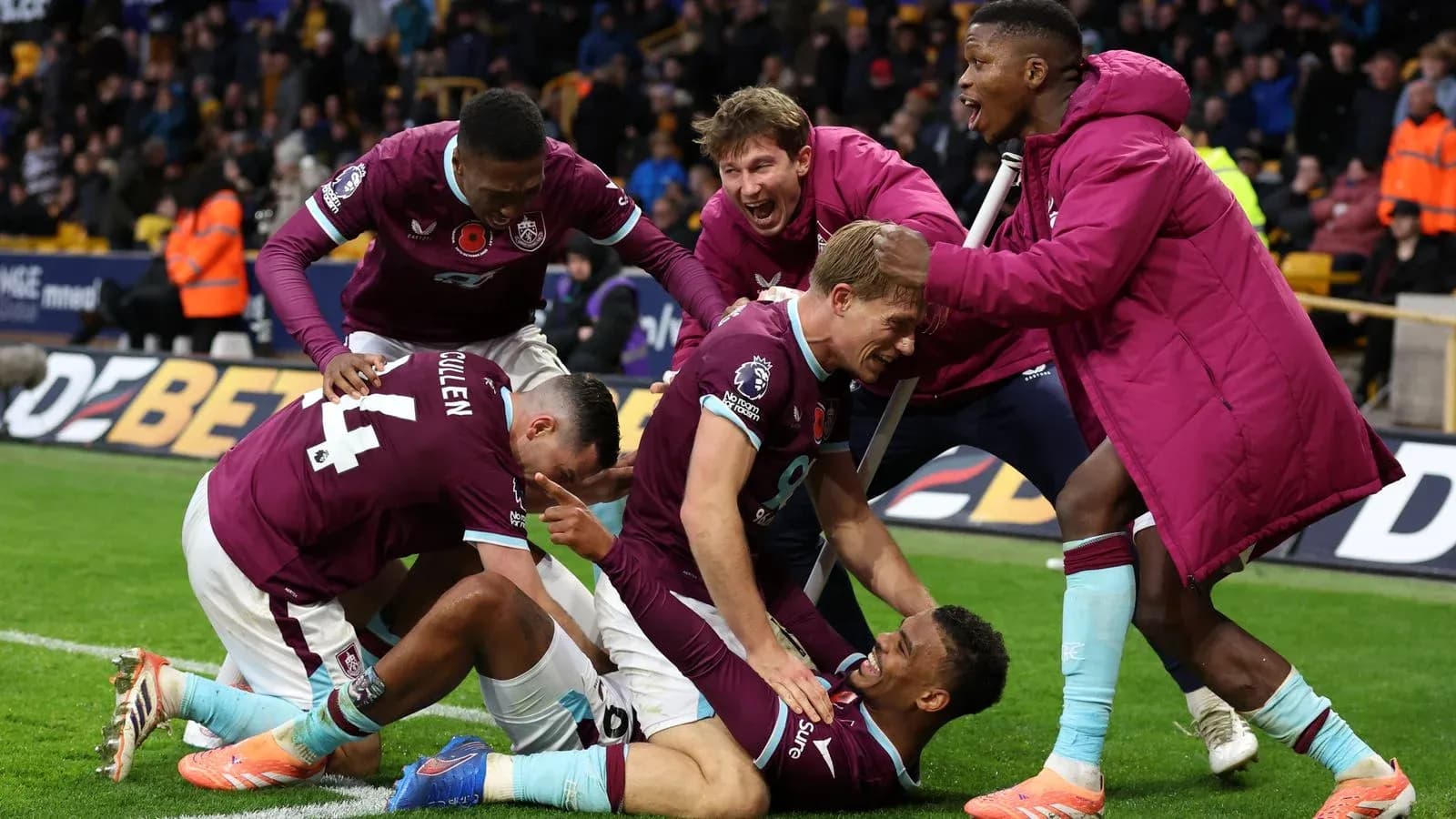
Burnley’s equaliser at 47' – Z. Flemming finishing from a pass by L. Tchaouna – was tactically emblematic. It arrived just after the interval, a period when Burnley’s 4-2-3-1 finally succeeded in pinning Wolves too deep. Tchaouna’s assist from the right half-space exploited the gap between Wolves’ wing-back and outside centre-back, a zone Burnley had been targeting throughout the first half. Flemming’s movement off the front line into that channel disrupted Wolves’ back three’s marking scheme.
The substitutions around the hour mark further shaped the tactical narrative. At 66', Burnley adjusted their attacking midfield structure: H. Mejbri (OUT) was replaced by Z. Amdouni (IN), a move aimed at adding more penalty-box presence and late runs from midfield rather than Mejbri’s more connective, ball-to-feet profile. Simultaneously, Wolves refreshed their midfield and back line: A. Gomes (OUT) for T. Arokodare (IN) suggested a shift towards more direct play and aerial threat, while L. Krejci (OUT) for Toti (IN) maintained the back three but with fresh legs and potentially a slightly different distribution profile from the left centre-back position.
At 74', Wolves made a double attacking tweak: D. M. Wolfe (OUT) for H. Bueno (IN) and A. Armstrong (OUT) for J. Abbey (IN). Replacing Wolfe with H. Bueno on the flank re-energised their ability to step out and contest Burnley’s full-backs, while swapping the penalty scorer Armstrong for Abbey pointed to a desire for more mobility and pressing from the front as Burnley’s build-up continued to dominate.
Burnley’s 75' changes – L. Ugochukwu (OUT) for J. Ward-Prowse (IN) and L. Tchaouna (OUT) for M. Edwards (IN) – subtly rebalanced the side. Ward-Prowse’s introduction added range of passing and set-piece quality, hinting at a plan to exploit their 7 corner kicks and sustained territorial advantage. Edwards offered fresh 1v1 threat on the flank, keeping pressure on Wolves’ wing-backs and outside centre-backs.
By 82' and 84', both coaches had largely committed their benches to the final phase. Wolves replaced R. Gomes (OUT) with Pedro Lima (IN), maintaining the wing-back structure but with renewed energy to defend wide spaces. Burnley then refreshed their front line: Z. Flemming (OUT) for Ashley Barnes (IN) and J. Anthony (OUT) for J. Bruun Larsen (IN). Barnes’ presence as a more traditional target forward gave Burnley a direct option to attack crosses and second balls, complementing Ward-Prowse’s delivery and further tilting the game towards Wolves’ box.
Discipline reflected the game’s intensity more than recklessness. Hwang Hee-Chan (Wolves) was booked at 41' for an “Off the ball foul”, a sign of Wolves’ willingness to disrupt Burnley’s rhythm even away from immediate danger. In first-half added time at 45+9', Hannibal Mejbri (Burnley) received a yellow card for “Argument”, underlining the emotional stakes as Burnley pushed for parity. In stoppage time, tempers again flared: at 90+4', Ashley Barnes (Burnley) was booked for “Argument”, followed moments later at 90+4' by Yerson Mosquera (Wolves) also cautioned for “Argument”. These late bookings mirrored a match that had become increasingly fractious as Burnley chased a winner and Wolves fought to preserve their point.
Statistically, the draw sits awkwardly against the underlying numbers. Wolves, with the higher xG (2.05 to Burnley’s 1.06) and 10 shots inside the box, can argue they fashioned the more clear-cut opportunities despite having far less of the ball. Burnley, however, will point to the territorial dominance, superior passing structure, and 8 shots on goal as evidence that their 4-2-3-1 imposed the game’s rhythm. The 7-6 split in blocked shots (Wolves 7, Burnley 6) and identical goals prevented values for both goalkeepers highlight how both defensive units, in different ways, managed to protect their boxes.
Ultimately, this was a match where stylistic contrast produced balance on the scoreboard: Burnley’s possession-and-structure model versus Wolves’ compact, counter-focused plan. The 1-1 at Turf Moor is a tactical stalemate in which each side can find validation in different metrics – Burnley in control and territory, Wolves in efficiency and chance quality.