Canada vs Morocco: World Cup Round of 16 Tactical Breakdown
Under the roof of NRG Stadium in Houston, this Round of 16 tie brought together two very different World Cup profiles. Canada arrived as Group B’s second-place side, a team defined by volatility: in total this campaign they had scored 9 goals and conceded 6 across 5 matches, with a 4-4-2 used in all of them. Morocco, Group C’s runners-up, came in as a machine of control and efficiency, unbeaten in total with 4 wins and 1 draw, and a settled 4-2-3-1 that had produced 11 goals for and only 4 against.
By full time, the contrast in tactical maturity was brutal on the scoreboard: Canada 0–3 Morocco, a Moroccan performance that felt like the logical extension of their group-stage numbers.
I. The Big Picture: Structures and Seasonal DNA
Canada’s shape was clear and familiar. Jesse Marsch stayed loyal to the 4-4-2 that had carried them through five matches, with M. Crepeau behind a back four of A. Johnston, M. Bombito, L. De Fougerolles and R. Laryea. The double axis of S. Eustaquio and N. Sigur was flanked by T. Buchanan and A. Ahmed, with J. David and T. Oluwaseyi leading the line.
Heading into this game, Canada’s profile was that of a high-variance side: at home they had averaged 2.3 goals for and 1.3 against, on their travels 1.0 scored and 1.0 conceded, for an overall average of 1.8 scored and 1.2 conceded per match. They could destroy opponents (a 6-0 home win) but were also capable of collapsing (a 0-3 home defeat). Their goal difference in total stood at +3 (9 scored, 6 conceded), a positive margin underpinned by just 2 clean sheets and 1 match in which they failed to score.
Morocco, by contrast, were all about control and defensive certainty. Mohamed Ouahbi’s 4-2-3-1 had been used in all 5 matches, with Bono in goal, a back four of A. Hakimi, I. Diop, R. Halhal and N. Mazraoui, a double pivot of A. Bouaddi and N. El Aynaoui, and a fluid band of three – B. Diaz, A. Ounahi, B. El Khannouss – supporting lone forward I. Saibari.
Their underlying numbers told a story of balance and discipline. In total they had scored 11 and conceded 4, for a goal difference of +7. On their travels they averaged 1.8 goals for and just 0.5 against, with 2 away clean sheets, and they had yet to fail to score in any venue. Even their biggest away win, 0-3, was a study in controlled aggression rather than chaos.
II. Tactical Voids and Discipline
Canada’s one confirmed absence was significant: I. Koné, ruled out with a fracture of the lower leg. In a side that leans heavily on vertical transitions and second-ball intensity, losing a dynamic midfield profile narrowed Marsch’s options between a more conservative pairing and an aggressive, risk-taking structure. He chose the latter, trusting Sigur and Eustaquio to cover huge spaces behind advanced wingers.
The disciplinary profile hinted at further risk. Canada had already lived on the edge in this tournament. L. De Fougerolles, starting again at centre-back, came into the knockout tie with 2 yellow cards and also appeared among the red-card leaders, a sign of how often he had been forced into last-ditch interventions. C. Larin, waiting on the bench, likewise had 2 yellows in only 189 minutes, an aggressive pressing forward whose introduction always carries the possibility of disruption – for both teams.
Team-wide, Canada’s yellow cards were spread across the 90 minutes, but with a clear spike between 31-45 and 46-60 minutes, each interval accounting for 27.27% of their cautions. That pattern – growing frustration as the first half wears on, then early second-half overreach – dovetailed dangerously with Morocco’s tendency to tighten their grip after the break.
Morocco, by contrast, had a cleaner defensive record. No red cards, and a yellow-card profile concentrated between 16-60 minutes, with 33.33% of their cautions in each of the 16-30, 31-45 and 46-60 windows. The implication: an intense, front-foot block in the middle of each half, but rarely losing control late on.
III. Key Matchups: Hunter vs Shield, Engine Room vs Enforcer
The headline duel was always going to be J. David against Morocco’s defensive shield. David arrived with 3 goals in total, 12 shots and 8 on target, plus a surprising amount of defensive work – 4 tackles, 1 blocked shot and 3 interceptions. His role in the 4-4-2 was not just to finish, but to be the first presser and a connector in transition.
Waiting for him was a defence that had conceded just 4 goals in total, anchored by I. Diop. The Moroccan centre-back had 4 successful blocks and 5 interceptions in his campaign, and his duel numbers (11 won from 18) underlined how often he stepped out to challenge. Behind them, Bono’s presence and Morocco’s 2 clean sheets – both on their travels – framed a unit comfortable defending space and box entries.
On the other side, Morocco’s attacking “hunter” was I. Saibari. With 3 goals from 6 shots and 36 duels contested (15 won), he embodied the physical, back-to-goal threat that can pull apart a back four. His movement into the right half-space asked constant questions of De Fougerolles and Bombito, particularly when combined with A. Hakimi’s overlaps.
And then there was the engine room. For Morocco, B. Diaz and Hakimi were the creative levers. Diaz led the World Cup in creativity metrics: 4 assists, 8 key passes, 11 attempted dribbles with 5 successful, and 136 total passes at 90% accuracy. Hakimi, from right-back, had 1 goal and 2 assists, 15 key passes and 343 total passes also at 90% accuracy. Together they formed a right-sided overload capable of pinning any 4-4-2 deep and wide.
Canada’s counterweights were S. Eustaquio’s distribution and the emerging influence of N. Saliba off the bench. Saliba’s tournament – 1 goal, 2 assists, 4 key passes and 83% passing accuracy in 182 minutes – suggested a player who could change the rhythm between the lines. But starting from the bench again, his impact was always going to be reactive rather than structural.
IV. Statistical Prognosis and How It Played Out
Heading into this match, the statistical tilt was clear. Morocco’s overall goal difference of +7 against Canada’s +3, their unbeaten run in total (4 wins, 1 draw, 0 losses) versus Canada’s more modest 2 wins, 1 draw and 2 defeats, and their defensive averages – 0.8 goals conceded per match in total, 0.5 on their travels – all pointed toward a side more likely to control xG and territory.
Canada’s path to an upset lay in chaos: leveraging a home average of 2.3 goals scored, the direct running of Buchanan and Ahmed, and the penalty-box instincts of David and, later, Larin. Yet Morocco’s record from the spot – 5 penalties in total, with 3 scored and 2 missed – underlined a team that creates decisive moments in the area even if their conversion is imperfect.
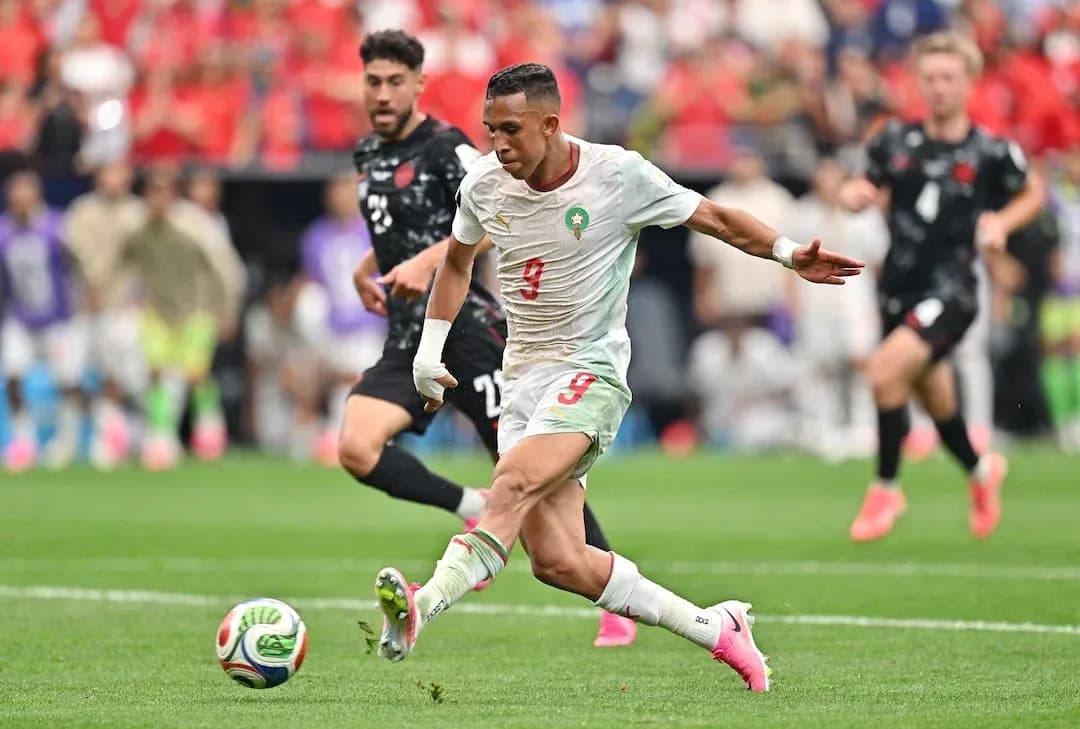
In Houston, Morocco imposed their pattern. The 4-2-3-1 smothered Canada’s central outlets, Diaz and Ounahi found pockets between the lines, and Hakimi’s surges forced Canada’s wide midfielders into a back-six for long stretches. The Canadian 4-4-2, so reliant on vertical transitions and emotional momentum, was reduced to chasing shadows.
Following this result, the numbers and the narrative finally aligned. Morocco’s defensive solidity and structured creativity overwhelmed Canada’s volatility, and a 3-0 scoreline felt less like a shock and more like the statistical prognosis coming to life under the bright lights of the World Cup knockout stage.