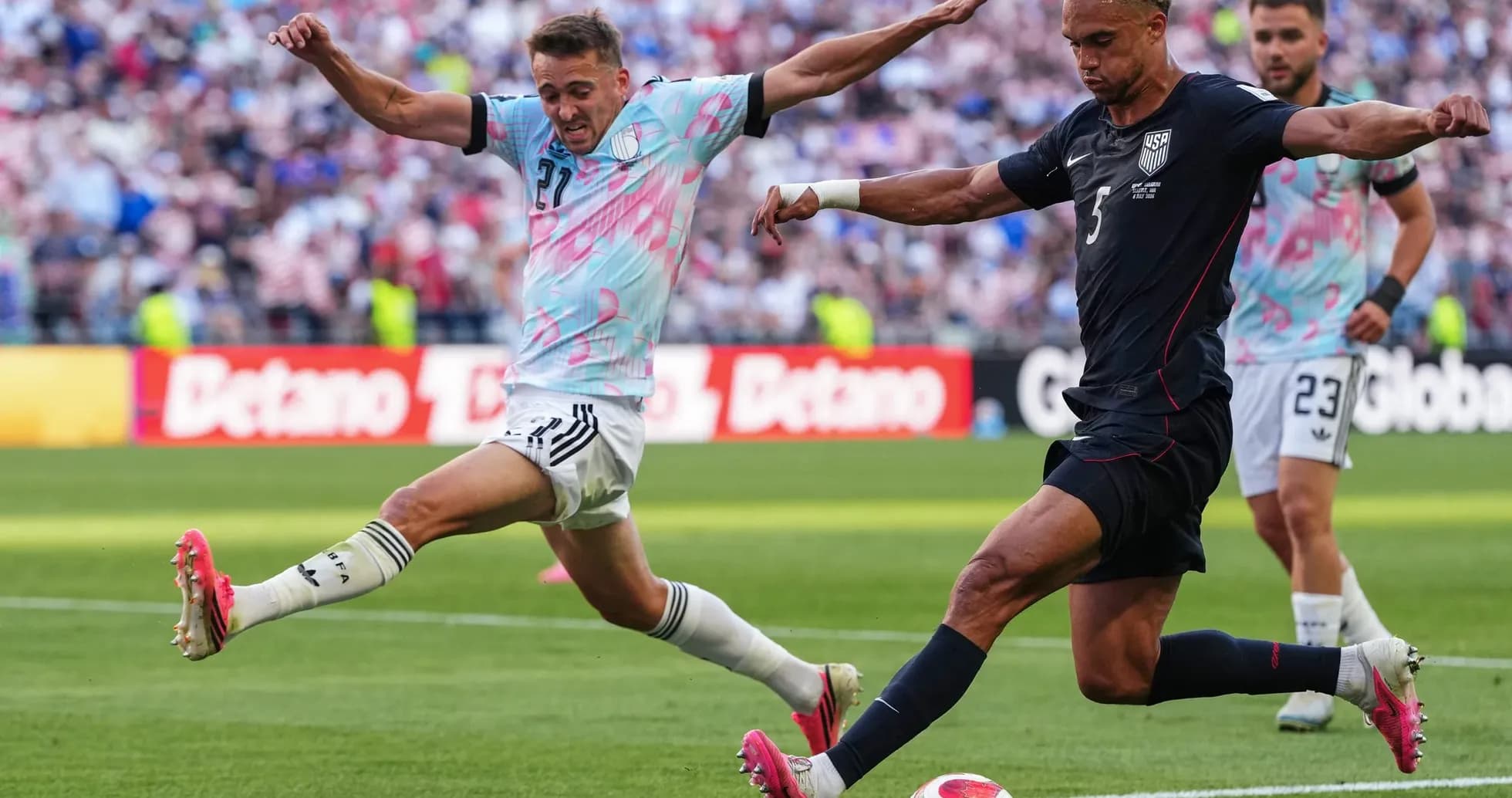
USA's Tactical Struggles Against Belgium's Efficient Play
USA’s 4-3-3 against Belgium’s 4-2-3-1 at Lumen Field produced a match where structure and efficiency decisively outweighed possession. USA had more of the ball (56% to 44%) and circulated it well, but Belgium’s verticality, quality between the lines, and penalty-box presence translated into a 4-1 win and a clear xG edge (2.15 to 0.67).
Tactical Overview
Mauricio Pochettino’s USA tried to build through a three-man midfield of Tyler Adams, Weston McKennie and Malik Tillman, using Sergiño Dest and Antonee Robinson to provide width outside the front three of Christian Pulišić, Folarin Balogun and Dest initially advanced on the right. Rudi Garcia’s Belgium, in contrast, played a classic 4-2-3-1 with Amadou Onana and Nicolas Raskin anchoring, Youri Tielemans and Leandro Trossard connecting to Charles De Ketelaere as a mobile central forward. The tactical story is of Belgium repeatedly accessing dangerous central pockets and attacking the box with numbers, while USA’s possession lacked punch.
Possession and Passing
In possession, USA’s 4-3-3 often morphed into a 2-3-5 in settled attack: Chris Richards and Tim Ream stayed as the first line, Adams dropped centrally, with McKennie and Tillman higher between Belgian lines. With 527 total passes and 458 accurate (87%), USA clearly controlled tempo, but much of it was in front of Belgium’s block. Belgium’s 410 passes at 81% accuracy show a more direct, purpose-driven use of the ball, playing forward early once they regained possession.
Shot Profile
The shot profile underlines the structural difference. USA managed only 7 total shots, 2 on goal, with 5 from inside the box. Belgium generated 15 shots, 7 on goal, and 10 from inside the box, consistently turning their attacking patterns into high-quality looks. Belgium’s 4 blocked shots versus USA’s 0 show how often Garcia’s side arrived in shooting zones and how USA’s attempts were mostly uncontested or from less threatening positions.
Defensive Structure
Out of possession, USA’s press was intermittent rather than sustained. The front three tried to angle pressure onto Belgium’s full-backs, but Belgium’s double pivot of Onana and Raskin provided clean outlets. Once Belgium broke the first line, Tielemans and Trossard occupied the half-spaces, drawing Adams and McKennie into difficult decisions: step out and risk exposing the back line, or hold and concede territory. Belgium’s ability to find De Ketelaere between Ream and Richards was central to their threat, reflected in his early brace and continued involvement.
Belgium’s defensive structure was more compact and pragmatic. In the 4-2-3-1 block, the wingers Lukebakio and Trossard dropped alongside Tielemans to form a narrow second line, funneling USA wide. With only 3 corner kicks won and no offsides, USA rarely stretched Belgium’s back four with penetrative runs behind; much of their play came to feet, where Belgium could compress space. Belgium conceded just 2 shots on goal and needed only 1 save from Thibaut Courtois (Belgium), a sign of how well they protected the penalty area.
Goalkeeper Performance
By contrast, Matthew Freese (USA) faced sustained, high-quality pressure. USA’s statistics show 3 goalkeeper saves and a goals prevented figure of -0.69, indicating that the chances Belgium created were not only numerous but also above what the USA defensive and goalkeeping unit could neutralize. Belgium’s own goals prevented number of -0.69 is less consequential in context, as USA simply did not produce enough high-value chances to test Courtois.
xG Analysis
The xG gap (Belgium 2.15, USA 0.67) is tactically revealing. USA’s possession and pass completion suggest control, but the low xG and shot volume show their 4-3-3 failed to consistently progress into truly dangerous zones. Belgium’s 2.15 xG from 15 shots, 10 in the box, shows a side repeatedly exploiting the central channels and half-spaces, especially through De Ketelaere’s movement and the late introduction of Romelu Lukaku as a penalty-box reference.
Discipline and Fouls
Discipline and duels also tilted subtly toward Belgium’s control. USA committed 11 fouls to Belgium’s 9, picking up 2 yellow cards, both for “Tripping”. That pattern hints at USA’s midfield and back line reacting late to Belgian combinations, often having to halt transitions or late runs with recovery fouls. Belgium, with no yellow cards, managed their aggression more cleanly and rarely looked stretched enough to resort to cynical challenges.
Substitution Patterns
Substitution patterns reinforced the tactical narrative. Garcia’s changes — Hans Vanaken for Onana at 21', Jérémy Doku for Dodi Lukebakio and Romelu Lukaku for Charles De Ketelaere at 67', then Alexis Saelemaekers for Trossard and Axel Witsel for Raskin at 89' — steadily refreshed the spine and attacking edge without altering the basic 4-2-3-1 structure. Belgium finished with fresh legs in all key corridors, enabling them to maintain vertical threat and secure the late fourth goal.
Pochettino’s substitutions — Giovanni Reyna for Dest at 46', Sebastian Berhalter for Pulišić at 59', Ricardo Pepi for Adams at 72', then Haji Wright for Balogun and Maximilian Arfsten for Robinson at 90+2' — moved USA toward a more attacking, less balanced shape. Removing Adams, the primary screening midfielder, in particular, further exposed a back line already struggling with Belgium’s central overloads.
Conclusion
Statistically and tactically, the verdict is clear: USA’s superior possession and pass accuracy did not translate into territorial or chance-quality dominance. Belgium’s lower share of the ball but higher xG, more shots (15 vs 7), more shots on goal (7 vs 2), and more shots inside the box (10 vs 5) reflect a game plan built on compact defending, efficient progression, and ruthless exploitation of central spaces. The 4-1 scoreline, aligned with the underlying metrics, is the logical outcome of that structural superiority.