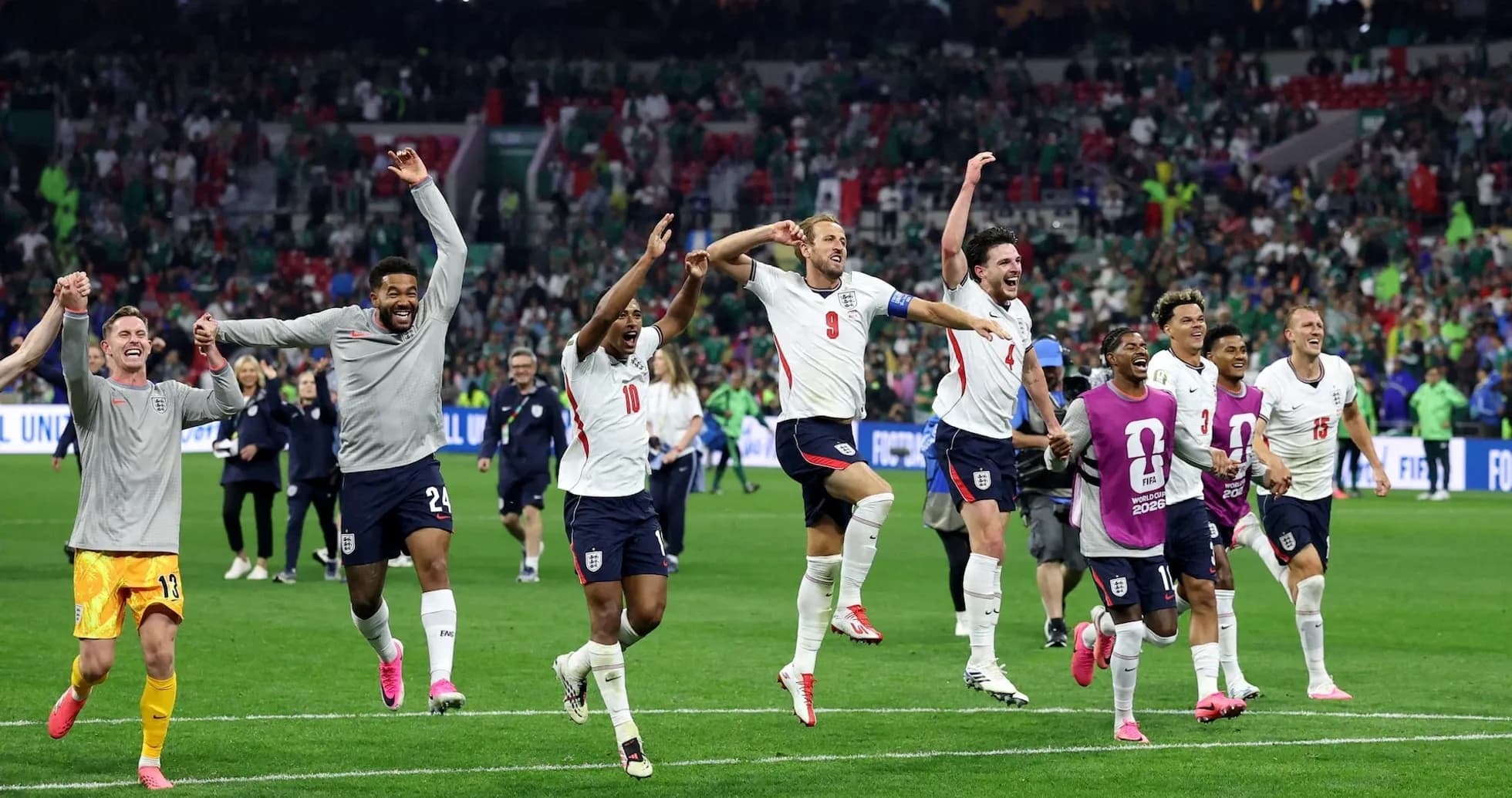
England Edges Mexico 3–2 in Thrilling Knockout Clash
The night at Estadio Banorte ended with England edging Mexico 3–2, a Round of 16 tie that felt less like a knockout formality and more like a clash of fully formed footballing identities. Both sides arrived as group winners and unbeaten overall; only England leave with that aura intact.
I. The Big Picture – Styles Collide in Mexico City
Mexico came into the knockout phase as the most pristine group winner of the tournament. They topped Group A with 9 points, a perfect record from 3 matches, scoring 6 and conceding none. That goal difference of 6 was the statistical imprint of a side built on control and clean sheets. Across the whole World Cup campaign before this fixture, Mexico had played 5 matches in total, winning 4 and losing just 1, with 10 goals scored overall and only 3 conceded. At home they had been especially tidy: 4 matches, 3 wins, 1 defeat, 7 goals for and 3 against, an average of 1.8 goals scored and 0.8 conceded at home.
England’s path was less immaculate but equally imposing. They topped Group L with 7 points, 2 wins and 1 draw, scoring 6 and conceding 2 for a group-stage goal difference of 4. Overall, before this knockout tie, they were unbeaten in 5 matches, with 4 wins and 1 draw, 11 goals scored and 5 conceded. England’s scoring profile was slightly more expansive than Mexico’s: 2.2 goals per match overall, with 2.5 on their travels and 2.0 at home, balanced by 1.0 goal conceded on average in both home and away settings.
This tactical duel was framed by formations that told their own stories. Javier Aguirre kept faith with Mexico’s 4-3-3, the shape they had used in 4 of their 5 World Cup outings, while Thomas Tuchel doubled down on England’s 4-2-3-1, deployed in 4 of their 5 matches. One side sought to dominate the middle with a three-man interior; the other trusted a double pivot to release a devastating line of three behind Harry Kane.
II. Tactical Voids and Discipline – Edges on the Margins
Neither side was obviously weakened by absences; the squad lists were full and unencumbered by suspensions. But the disciplinary backstories mattered. Mexico’s defensive leader César Montes arrived carrying the stain of a previous red card at this World Cup. In 4 appearances he had been sent off once, despite otherwise calm numbers: 176 passes at 90% accuracy, 2 tackles, 1 successful block, 2 interceptions. His presence in the starting XI here was a gamble on composure under knockout pressure.
England’s back line contained a similar wildcard. Jarell Quansah, starting at right-back, had already collected both a yellow and a red card in just 2 tournament appearances, his aggression evident in 13 duels contested and 10 won. Tuchel trusted that edge rather than fearing it, but it meant England’s right side walked a disciplinary tightrope.
Further forward, Declan Rice anchored England’s midfield with the profile of a controlled enforcer. In 4 appearances he had already been booked twice, but he also led England’s buildup: 166 passes at 91% accuracy, 12 key passes, and a quiet 3 fouls committed. For Mexico, the caution map was cleaner in terms of individuals, but their team yellow-card distribution told a story: 25.00% of their cautions arrived between 16–30 minutes, and 50.00% between 61–75 minutes, a clear tendency to pick up cards as the intensity spikes after the hour.
England’s yellow-card curve was broader: 14.29% in each of the 0–15, 16–30, 31–45, and 46–60 minute windows, then a jump to 28.57% between 61–75 minutes, plus another 14.29% in added time of the first extra period. Both teams, in other words, were most combustible just as legs and minds began to tire. In a match that finished 3–2 in normal time, it was a minor miracle that neither side saw red.
III. Key Matchups – Hunter vs Shield, Engine vs Engine
The headline duel was always going to be Harry Kane against Mexico’s previously watertight defence. Kane entered this match as the tournament’s most ruthless finisher: 6 goals and 1 assist in 5 appearances, from 15 shots with 10 on target. He had converted both of his penalties, committed 1 of them, and carried a 7.6 rating. Against him stood a Mexico rearguard that, before this knockout, had conceded only 3 goals overall across 5 matches, with 4 clean sheets and an average of 0.6 goals conceded per game. At home, Mexico’s defence had allowed just 3 goals in 4 matches, never conceding away.
This time, the hunter won. England’s 3 goals shattered Mexico’s perfect group-stage defensive record and exposed the limits of their compact 4-3-3 when dragged into wide and half-space duels by England’s band of creators.
On the other side, Mexico’s attacking spear was two-pronged. Julián Quiñones arrived with 4 goals and 1 assist in 5 matches, plus 10 key passes and 9 successful dribbles from 15 attempts. Raúl Jiménez had 3 goals from 4 appearances, 7 shots on target from 14 attempts, and a penalty converted. Roberto Alvarado, meanwhile, was Mexico’s creative metronome: 3 assists, 13 key passes, 191 total passes at 83% accuracy, and 7 successful dribbles from 8 attempts.
They faced an England defence that had conceded 5 goals in 5 matches overall, 3 at home and 2 on their travels, averaging 1.0 goal conceded both home and away. Marc Guéhi and Ezri Konsa formed the central wall, with N. O’Reilly on the left and Quansah on the right, shielded by Rice and Elliot Anderson. For long spells, England’s structure held, but Mexico’s wide overloads and Alvarado’s movement between the lines did carve out the 2 goals that kept this tie alive until deep into the second half.
In midfield, the “engine room” confrontation was decisive. For England, Jude Bellingham’s all-court game was the hinge. He came in with 4 goals, 1 assist, 8 key passes, 15 dribble attempts with 9 successful, and 12 tackles. Rice, as noted, was the tempo-setter and protector. Against them, Luis Romo, Erick Lira and G. Mora had to both compress space and feed the front three. Mexico’s 4-3-3 sought to create a 3v2 in central zones, but Bellingham’s willingness to drop alongside Rice often restored parity, while Bukayo Saka and Anthony Gordon tracked Mexico’s full-backs to deny easy progression.
IV. Statistical Prognosis – Why England Survived the Storm
Looking at the broader tournament numbers, this match always had the makings of a high-event contest. Mexico averaged 2.0 goals scored per game overall and conceded just 0.6, while England averaged 2.2 scored and 1.0 conceded. Both sides had spotless penalty records in this World Cup: Mexico had taken 1 penalty and scored it; England had converted both of their 2 penalties. There was no underlying hint of wastefulness from the spot to tilt the balance.
The decisive edge lay in England’s attacking ceiling. Their biggest home win in this campaign was 4–2, and their biggest away win 2–0; Mexico’s best home result was 2–0, with a 3–0 win on their travels. England had shown they could both blow teams away and manage games, while Mexico’s dominance was built more on control than on repeated multi-goal shootouts.
In the end, a 3–2 scoreline in England’s favour fits the statistical contours: England leaned into their superior firepower, with Kane and Bellingham embodying a side that can hurt from central and wide areas, in transition and in set possession. Mexico’s own stars – Quiñones, Jiménez, Alvarado – ensured this was no one-sided narrative, but their previously impregnable defensive record finally cracked under the weight of England’s variety.
Following this result, Mexico’s World Cup run ends with their numbers finally human: 5 wins, 2 defeats, 12 goals scored and 6 conceded overall, their goal difference trimmed but still positive. England march on, still unbeaten, their attack validated against one of the tournament’s best defences, and their 4-2-3-1 now battle-tested in the most hostile of knockout environments.