Chelsea’s Dominance Over Manchester United: A Tactical Analysis
Under the grey London sky at Stamford Bridge, Chelsea’s 2–0 win over Manchester United felt less like a single result and more like a confirmation of diverging trajectories. In this Premier League Regular Season - 9 fixture, Xabi Alonso’s side, already sitting 4th heading into this game with 16 points and a goal difference of 4 (19 scored, 15 conceded in total), played with the assurance of a team whose seasonal identity is crystallising: aggressive, front‑foot, and happy to trade blows.
Manchester United arrived in stark contrast. Seventeenth in the table before kick-off with 7 points and a goal difference of -5 (10 scored, 15 conceded overall), M. Carrick’s team were living on the edge of the relegation battle. Their campaign so far has been defined by late goals at both ends and a worrying inability to keep clean sheets – none in total across 9 league matches.
Both managers opted for a 4‑2‑3‑1, but the same shape housed very different ideas. Chelsea, who had used this system 4 times in the league before this, leaned into verticality and early pressure. United, who have lined up in 4‑2‑3‑1 in all 9 league games, tried to find control through Bruno Fernandes between the lines and the running power of B. Mbeumo and A. Diallo.
Tactical Voids and Absences
This was a meeting of heavily patched squads. Chelsea’s absentee list was long: A. Anselmino, J. Gittens, J. Hato, R. James, Joao Pedro, M. Lacroix and E. Martinez all missed out through various injuries, stripping Alonso of depth at centre‑back, full‑back and in attack. The absence of Joao Pedro, one of the league’s standout forwards with 5 goals and 3 assists in 6 appearances, forced a reconfiguration of the front line. Instead of a pure penalty‑box striker, Chelsea leaned on Pedro Neto’s mobility and M. Rogers’ capacity to attack space from the left.
Manchester United were no less depleted. P. Dorgu, M. Rashford, B. Sesko, L. Shaw and M. Ugarte all missed the fixture, taking away a natural left‑back, a primary goal threat, and a specialist ball‑winner in midfield. Without Ugarte’s screening, Carrick had to trust the double pivot of Andrey Santos and C. Baleba to handle transitions against one of the league’s most explosive attacking units.
Discipline was always likely to shape the rhythm. Across the season, Chelsea’s yellow cards are spread fairly evenly but with a late spike: 22.22% of their bookings arrive from 76–90 minutes. United are even more combustible late on, with 38.10% of their yellows in that same period and a red card already shown to Lisandro Martínez this campaign. The pattern held: as Chelsea turned the screw after the interval, United’s back line, led by the often‑booked H. Maguire, increasingly defended on the edge.
Key Matchups
With Joao Pedro unavailable, the goalscoring burden fell primarily on M. Rogers and Pedro Neto. Rogers came into the fixture as one of the Premier League’s form attackers: 5 goals and 1 assist in 9 appearances, underpinned by 17 key passes and 118 duels contested, 56 of them won. His blend of physicality and technical quality made him the natural “hunter” against a United defence conceding 1.7 goals per game in total and 1.6 on their travels.
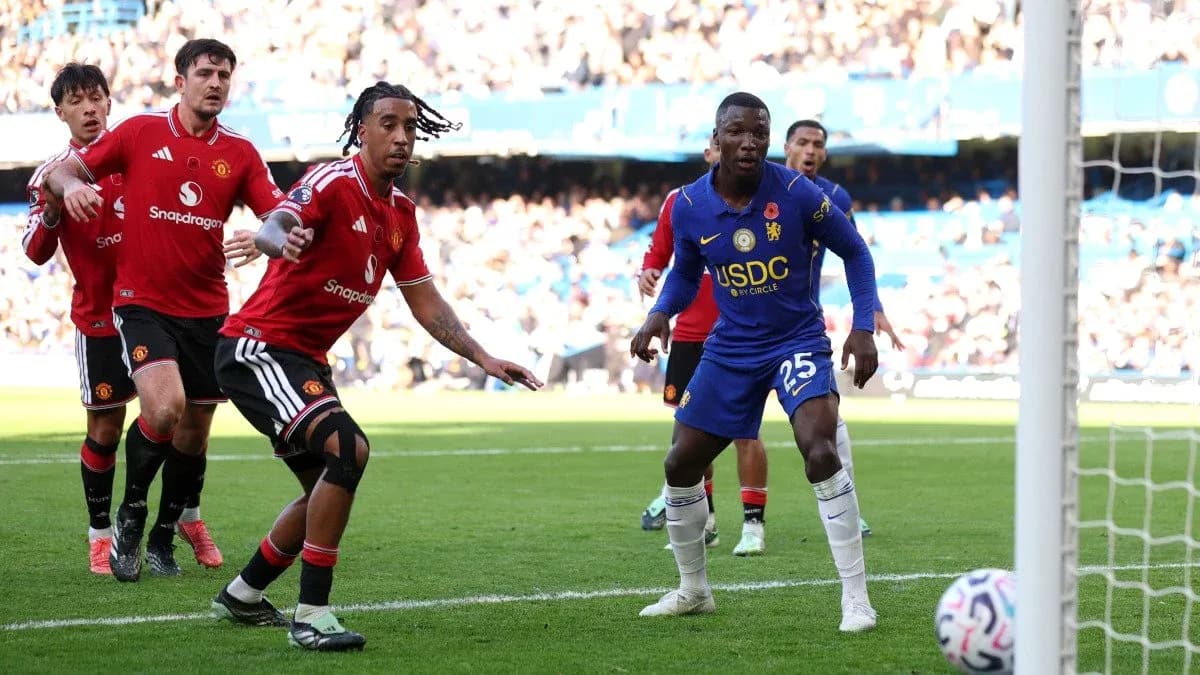
Opposite him, the “shield” was a United unit anchored by Maguire and Lisandro Martínez. Maguire’s campaign has been busy: 9 tackles, 3 successful blocks and 17 interceptions in total, with 4 yellow cards already hinting at how often he is dragged into emergency defending. Lisandro Martínez, with 5 blocks and a red card on his record, is similarly aggressive. Against Chelsea’s wide rotations – Rogers drifting inside, Pedro Neto driving at Diogo Dalot, and Estêvão stepping in from the right – United’s centre‑backs were repeatedly forced to defend their box while retreating.
Chelsea’s season‑long attacking timing made this matchup even more dangerous for United. They score freely in waves: 33.33% of their league goals arrive between 0–15 minutes, with further surges at 46–60 (19.05%) and 61–75 (28.57%). United, meanwhile, concede heavily after the break, with 26.67% of their goals against coming between 46–60 minutes and 20.00% from 76–90. The second‑half window where Chelsea usually accelerate is precisely where United tend to unravel, and the pattern repeated here as the hosts took control after half‑time.
Engine Room
The game’s central argument was staged in midfield. For Chelsea, the double pivot of R. Lavia and M. Caicedo sat beneath an inventive band of three: Estêvão, C. Palmer and M. Rogers. Palmer, one of the league’s top creators with 3 goals, 3 assists and 20 key passes, is Chelsea’s metronome and chaos agent rolled into one. His ability to receive between lines and either slide passes into the channels or combine with Neto made him the primary reference point.
United’s response centred on Bruno Fernandes, supported by Andrey Santos and C. Baleba. Bruno arrived with 15 key passes and a reputation for forcing the issue, but his influence depended on whether United could play through Chelsea’s first line. With Chelsea averaging 2.6 goals at home and only 1.6 conceded there, their press at Stamford Bridge has been backed by enough firepower to accept risk.
As the match wore on, Chelsea’s structure in the engine room told. Caicedo’s ball‑winning and Lavia’s distribution allowed Palmer to receive in pockets between Maguire and Baleba, forcing United’s midfield to constantly turn towards their own goal. When United did break, Mbeumo’s running from the right offered an outlet – his 4 goals from midfield and 20 shots in total underline his threat – but with no clean sheets all season and a fragile back line behind him, the balance of play tilted blue.
Statistical Prognosis and Tactical Verdict
Heading into this game, Chelsea’s profile was that of a high‑variance contender: 19 goals scored and 15 conceded in total across 9 matches, with only 2 clean sheets but just 2 failures to score. United mirrored that chaos from a weaker base: 10 scored, 15 conceded, and 0 clean sheets in total, failing to score in 4 games.
The 2–0 scoreline at Stamford Bridge fits the underlying numbers and trends. Chelsea’s attacking surges in the opening and middle thirds of each half aligned almost perfectly with United’s soft underbelly after the break. Alonso’s 4‑2‑3‑1, even without Joao Pedro, still had enough creativity and movement through Palmer, Rogers and Neto to repeatedly stress a United defence that already conceded 8 goals away from home before this fixture.
From a tactical and statistical standpoint, Chelsea’s victory looks sustainable rather than accidental. Their home average of 2.6 goals for and 1.6 against suggests that, when they get the first punch in, they tend to stay in control. United, by contrast, will leave London with their season’s story unchanged: a team structurally committed to 4‑2‑3‑1, but without the defensive solidity or midfield control to make that shape feel secure.
Following this result, Chelsea’s Champions League ambitions harden into something real, while United’s season remains trapped in a spiral of late‑game stress and defensive exposure. The numbers said Chelsea should dominate; the pitch at Stamford Bridge merely confirmed it.