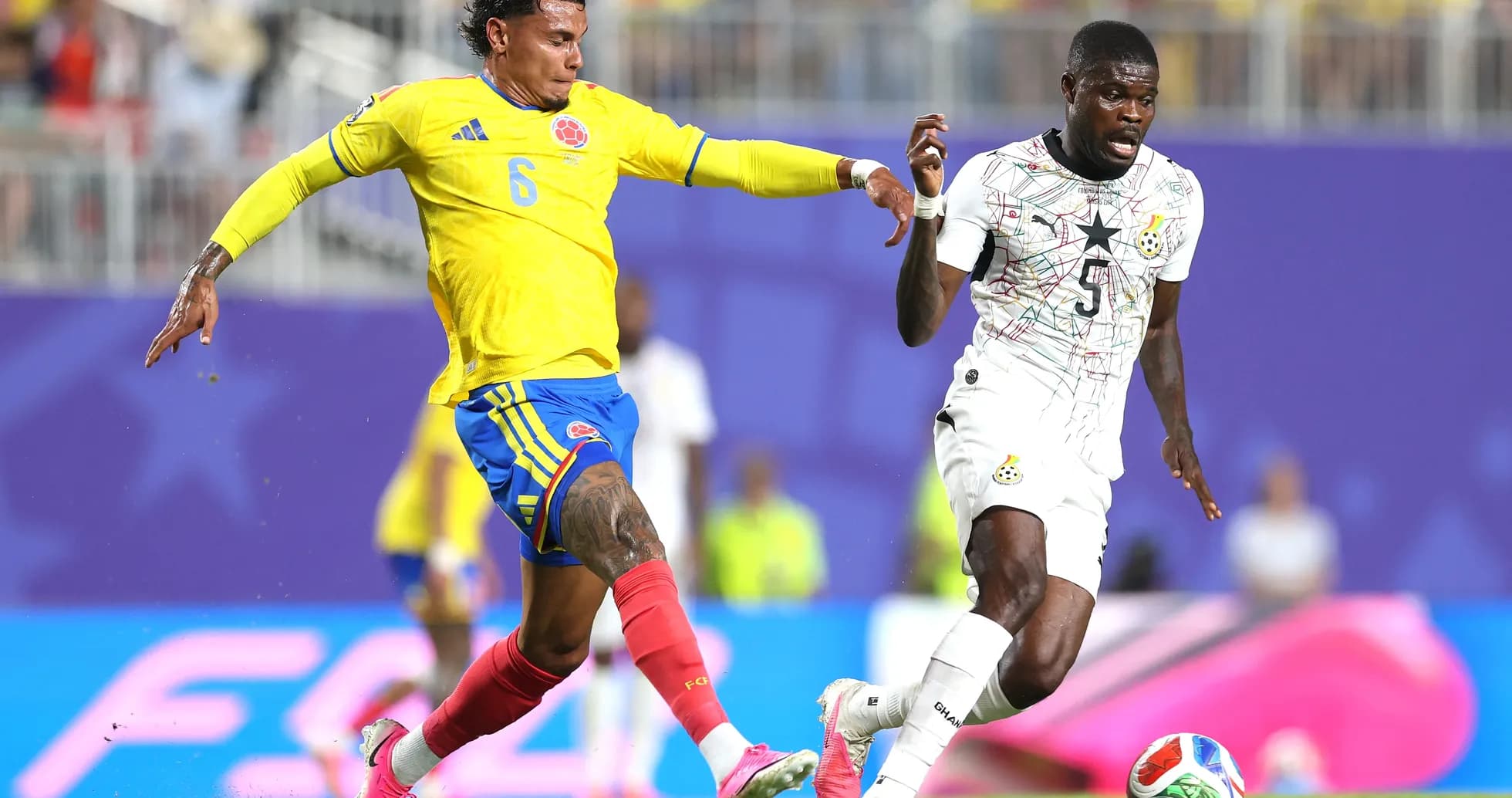
Colombia Edges Ghana in World Cup Round of 32 Clash
Arrowhead Stadium in Kansas City hosted a World Cup Round of 32 tie that felt more like a chess match than a shootout. Colombia arrived as group winners from Group K, top of their section with 7 points from 3 matches and a goal difference of 3, their campaign built on control and defensive clarity. Ghana slipped through Group L with 4 points and a goal difference of 0, a side still searching for fluency but hardened by tight margins. Over 90 minutes, Colombia’s 1-0 win echoed their broader seasonal DNA: measured, minimalist, and ruthlessly efficient.
Colombia's Campaign
Heading into this game, Colombia’s numbers told a clear story. Overall this campaign they had played 4 matches, winning 3 and drawing 1, with no defeats. At home they had played 3 times, winning 2 and drawing 1; on their travels they had a single away victory. The attacking output was modest but precise: in total this campaign they had scored 5 goals, with 2 at home and 3 away. That translated to 1.3 goals per match overall, split into 0.7 at home and 3.0 away. Defensively, they were close to flawless: in total this campaign they had conceded just 1 goal, 0 at home and 1 away, an average of 0.3 per match overall, with 0.0 at home and 1.0 away. The goal difference of 4 scored minus 1 conceded in the group phase underlined why they topped Group K.
Ghana's Path
Ghana’s path was more fragile. In total this campaign they had played 4 matches, with 1 win, 1 draw, and 2 defeats. At home they had a single win from 1 match; on their travels, 3 games had yielded 1 draw and 2 losses. They had scored 2 goals overall, 1 at home and 1 away, for an average of 0.5 per match, split into 1.0 at home and 0.3 away. Defensively, they had conceded 3 in total, 0 at home and 3 away, an average of 0.8 overall and 1.0 away. The group-stage goal difference of 2 scored and 2 conceded summed them up: balanced on paper, but with attacking bluntness and away-day vulnerability.
Tactical Approaches
Nestor Lorenzo’s decision to lean again on a 4-3-3 was a statement of continuity. C. Vargas in goal anchored a back four of D. Munoz, D. Sanchez, J. Lucumi, and J. Mojica. Ahead of them, the midfield triangle of G. Puerta, J. Lerma, and J. Arias offered a blend of energy and discipline, while the front three of J. Rodriguez, J. Cordoba, and L. Diaz gave Colombia their familiar asymmetric threat: Diaz stretching the left, Rodriguez drifting into pockets, Cordoba pinning centre-backs.
Carlos Queiroz answered with a 4-1-4-1 for Ghana, designed to compress the central lanes and frustrate Colombia’s creators. L. Ati Zigi started in goal behind a back line of M. Senaya, D. Luckassen, J. Opoku, and G. Mensah. T. Partey sat as the single pivot, shielding and recycling, with a line of four in front: I. Williams, C. Yirenkyi, K. Sibo, and A. Semenyo, supporting lone forward J. Ayew.
Defensive Structures
The tactical voids in this contest were less about absentees and more about structural risk. Colombia’s season data showed a side that rarely collapses: in total this campaign they had kept 3 clean sheets, all of them at home. They had never failed to score away, and only once at home. Ghana, by contrast, had already failed to score twice on their travels, and while they had kept 2 clean sheets overall (1 at home, 1 away), their away defensive average of 1.0 goals conceded per match hinted at exactly the kind of narrow defeat that unfolded here.
Discipline and Rhythm
Discipline was always likely to shape the rhythm. Colombia’s yellow-card distribution revealed two pressure points: 33.33% of their yellows came in the opening 0–15 minutes and another 33.33% in the 76–90 window, with a further 16.67% between 46–60 and 16.67% in the 91–105 range. This is a team that tackles hard early to set the tone, then again late to protect leads. Ghana’s yellows clustered differently: 16.67% in the 16–30 period, 33.33% between 46–60, and 16.67% in each of the 61–75, 76–90, and 91–105 windows. That pattern suggests a side that grows more desperate as matches progress, particularly just after half-time.
Key Battles
Within that framework, the “Hunter vs Shield” duel was embodied by Colombia’s front line against Ghana’s away defence. Colombia’s overall attacking average of 1.3 goals per match, coupled with their biggest away win of 3-1, met a Ghanaian unit that conceded 3 goals on their travels and had already lost away by 2-1. The single Colombian goal here fit the statistical script: not an avalanche, but enough.
In midfield, the “Engine Room” battle revolved around J. Lerma and G. Puerta against T. Partey and C. Yirenkyi. Lerma’s role as a stabiliser allowed Rodriguez to float between lines, while Puerta’s presence ensured Colombia could recycle possession without overexposing the back four. For Ghana, Partey’s screening was essential, but Yirenkyi brought an edge of volatility. Across the tournament he had committed 7 fouls and drawn 3, picking up 2 yellow cards but no reds, and had blocked 2 shots while making 3 interceptions. That profile of controlled aggression and defensive contribution made him both Ghana’s enforcer and their creative hinge: 70 completed passes at 88% accuracy, with 1 key pass and 1 goal to his name. In this match, his ability to step out of the line to press Rodriguez or Diaz was central to Queiroz’s plan to disrupt Colombia’s rhythm.
Late-Game Dynamics
The late-game dynamic was always likely to favour Colombia. Their habit of picking up cards in the final quarter-hour reflects a team comfortable suffering without the ball, while Ghana’s tendency to collect yellows from 46–90 suggests emotional spikes rather than calculated fouls. Protecting a 1-0 advantage, Lorenzo could lean on a defensive structure that had conceded just 1 goal in 4 matches overall, while Queiroz had to chase with a side averaging only 0.5 goals per match and 0.3 away.
Conclusion
Statistically, a tight Colombian win aligned with the underlying trends. Colombia’s superior defensive solidity, their clean-sheet record at home, and Ghana’s limited away scoring output all converged on a narrow margin. In a World Cup Round of 32 where one mistake can redraw the tournament bracket, Colombia’s blend of tactical continuity, disciplined aggression, and controlled attacking threat proved enough to edge past a Ghana side that fought, but could not quite bend the numbers in their favour.