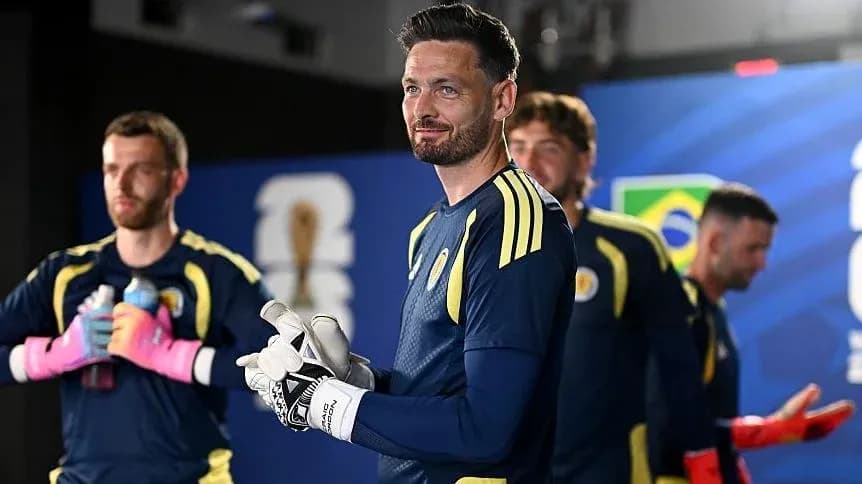
Craig Gordon’s Incredible Scotland Farewell
By the time Craig Gordon walked away from international football at this summer’s World Cup, his story already felt larger than the stage itself. Not just a veteran goalkeeper bowing out in dark blue, but a man who had dragged himself back from an injury that ends most careers, never mind at 39.
Former striker Rory Loy, who knows that road all too well, called it “incredible” on the BBC’s Scottish Football Podcast. It wasn’t hyperbole. It was lived experience.
Loy suffered the same double leg break that shattered Gordon’s shin. He did it in his early twenties, at an age when players still believe they’re indestructible.
“I did the same thing, but I did it when I was 20, 23,” Loy said, drawing a stark line between their situations. At 23, the body heals quicker, the mind is wired to chase the comeback, and the horizon of a career still feels distant. The clock isn’t ticking quite so loudly.
Gordon didn’t have that luxury.
He went through it in his late thirties, when most goalkeepers are already calculating their exit, not plotting another chapter. To even contemplate returning from a double leg break at that stage is rare. To actually do it, and then play at a World Cup for Scotland, is something else entirely.
Loy lifted the curtain on what that journey really looks like.
“The shin bone just snaps basically,” he explained. Brutal, simple, final. Once it heals, the real work begins. The body is never quite the same. Everything changes: the way you walk, the way you move, the way you plant your feet and push off. For a goalkeeper, whose game is built on balance, timing and explosive movement, that’s a fundamental rewrite.
Loy spoke about needing orthotics in his boots just to adapt to his new mechanics, to cope with the way his body now moved differently. One small adjustment, but a symbol of the layers of adaptation required. There’s the rehab, the gym work, the drills. Then there’s the quiet battle in your own head.
“Trust me, I know how difficult it is to come back from that injury, psychologically as well as physically,” he said. “It’s not easy.”
Gordon faced all of that with years more wear and tear in his legs and far less margin for error. That he chose not only to fight back, but to do so at a level high enough to reclaim his place and reach a World Cup with Scotland, speaks to something beyond talent or technique.
“For him to go through that type of thing at the age he was at and still have the motivation to come back and play football just sums up the type of mindset he had,” Loy said.
That mindset defined the closing act of Gordon’s career. The comeback was not sentimental; it was competitive. He returned not as a ceremonial figure, but as a goalkeeper still capable of the kind of saves that had marked his time with Celtic, Hearts and Sunderland.
“But, away from all of that, the level of goalkeeping and saves he had was incredible,” Loy added, bringing it back to the basics that matter most between the posts.
In the end, that is how Gordon will be remembered: not just as the man who refused to let a double leg break dictate his final chapter, but as the goalkeeper who came back, stood tall on the biggest stage, and left Scotland with a legacy built on resilience as much as reflexes.