Why the Pistons Committed $200 Million to Jalen Duren Despite Playoff Woes
At just 22 years old, Jalen Duren has emerged as an All-NBA center and recently signed a five-year deal worth $200 million with the Detroit Pistons. This contract is notably less than the $287 million maximum he could have received. Despite the hefty payout, doubts about his playoff performances linger.
Strengths Shown During the Regular Season
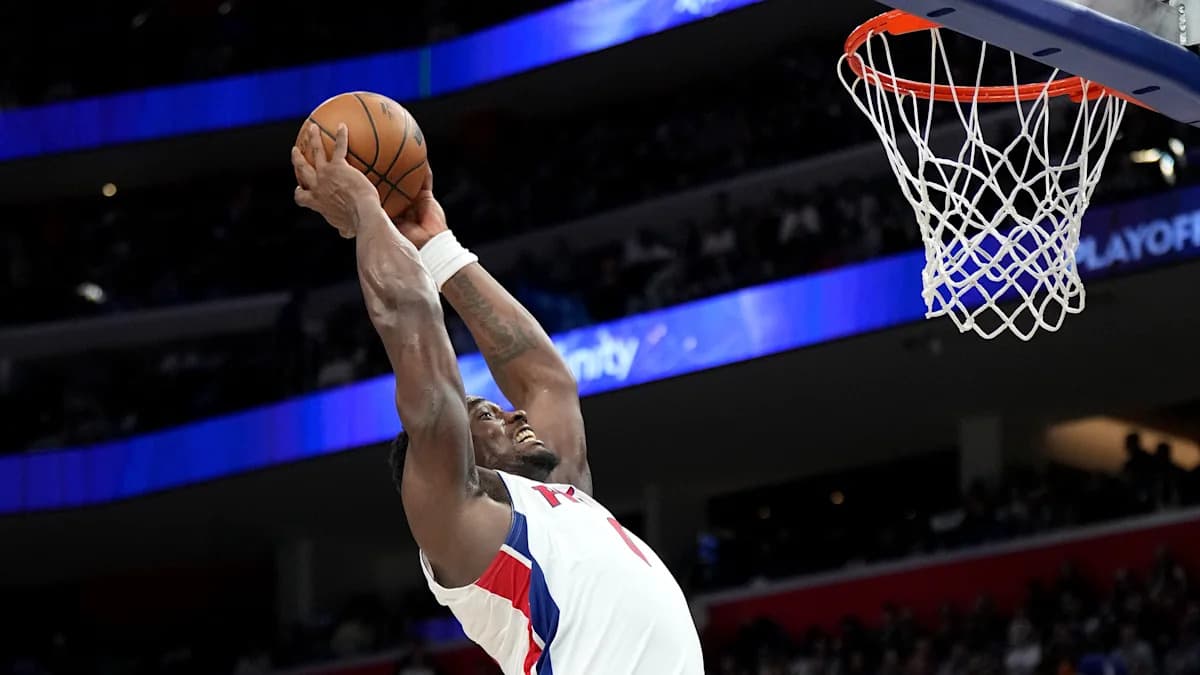
Duren’s presence gives teammate Cade Cunningham a reliable target near the rim. He excels at catching lobs, powering through defenders, and crashing the offensive glass for second-chance points without needing set plays. Last season, he grew his game by reducing turnovers and taking on more roles such as ball handling, passing, and setting screens.
With Cunningham off the court, Duren showcased a developing face-up post game and nearly doubled his free throw attempts per game. His averages were impressive: 19.5 points and 10.5 rebounds per game while anchoring the league's second-best defense, earning him rightful All-NBA recognition.
Playoff Struggles That Raised Concerns
Yet, when the playoffs arrived, Duren’s performance slipped. He was outplayed in the first round by Wendell Carter Jr. and struggled even more against Evan Mobley and Jarrett Allen in the next round. His scoring dropped to 10.2 points per game, and his shooting efficiency fell sharply from 65% to 51.4%. What looked like star-level play in the regular season turned inconsistent under postseason pressure.
"I'm man enough to acknowledge my flaws and that I'm not perfect. I'm also man enough to get my ass in the gym and work on those things and get better," Duren said at a recent press conference. "I'm not trying to run from anything. I know I will make things better in the future."
Reasons Behind the Hesitation in Maxing Out Duren
The playoffs partly explain why the Pistons avoided offering the full max deal. Another factor is his uneven play over his first three seasons. At times, he dominated; other times, his defense seemed lazy, and he didn’t assert himself enough offensively. Some scouts believe this inconsistency relates to focus or mentality, others to conditioning—Detroit even tried to include weight clauses in his contract during talks.
Maturity plays a role too. Duren has transitioned from a teenager into a young man who is now serious about his craft, seemingly entering the early stages of his prime.
Looking Ahead: Potential and Growth
To justify this big contract, Duren must prove that last season’s improvements weren’t a one-time thing and bring that level to the playoffs. To surpass expectations, he’ll need to keep growing. When asked about his goals for the season, Duren said:
"I would say just creating my own shot. I try to be versatile and usable in different ways so you never have to put me in a box. I want to be a tool my coaches and teammates can use for anything."
Last season, Duren took more pull-up jumpers than in all previous seasons combined, hitting 48.4% of 31 attempts—a small sample but a promising sign. He also shot efficiently in post-ups (54.5%) and isolations (46%). If these glimpses develop into reliable weapons, it explains why the Pistons rejected trades involving older players like Domantas Sabonis or injury-prone stars like Anthony Davis.
The Need for Shooting and Team Fit
Despite progress, Duren remains largely a player of potential. The Pistons really want him to add spot-up three-point shooting, which might still be years away, if it ever happens. This matters because of how he fits alongside Ausar Thompson, who also struggles as a shooter.
During the playoffs, spacing was a big problem. With Thompson on the floor and Duren off, Detroit outscored opponents by 11.2 points per 100 possessions. But with both on, the Pistons had a net rating of -0.9, and with Duren without Thompson, they were -1.7. The lack of shooting hurt the flow, especially compared to when Paul Reed was playing alongside Thompson.
This lineup issue motivated Detroit to add shooters like John Collins, Isaiah Joe, Taurean Prince, and rookie Ebuka Okorie, all aiming to provide spacing.
Youthful Core and Future Outlook
The Pistons exceeded expectations last season with 60 wins despite their playoff disappointment. Key players remain young: Cunningham is 25, Thompson 24, and Ron Holland just 21. Many are not yet in their prime.
Duren contributed heavily to that success and might still improve. Executive Trajan Langdon’s challenge is to judge how much of Duren’s potential will mesh with the team’s direction. Signing him was only part of the equation; if Duren doesn’t progress as hoped, the team retains flexibility thanks to the contract’s reasonable terms.
The ideal scenario involves Duren or Thompson adding a dependable three-point shot, Okorie or Holland stepping up, and Cunningham continuing his rise. There’s good reason to give this group time. Still, the NBA shifts fast. If another postseason exposes the same problems, patience will wear thin.
"I want to be a Detroit Piston for life," Duren said. "Making that happen means becoming not just a better player but a better fit for the team."