Cristiano Ronaldo: The Journey from Tears to Triumph
On August 20, 2003, in a low-key friendly against Kazakhstan, an era quietly began. An 18-year-old Cristiano Ronaldo, freshly plucked from Sporting by Manchester United, pulled on the Portugal shirt for the first time in an official match. Luiz Felipe Scolari threw him into a dressing room ruled by Luís Figo and the old guard.
Portugal won 1-0. The scoreline barely mattered. What lingered was the sight of a skinny teenager with the No. 17 on his back, all stepovers and raw nerve, trying to force his way into a team of established stars.
Less than a year later, the stage changed, not the ambition. Euro 2004. At home. Ronaldo’s first major tournament.
In the opening match against Greece, he rose in stoppage time and headed in his first-ever goal for the national team. The stadium erupted, but the roar was hollowed out within minutes. Portugal still lost 2-1. The new kid had his goal; the country had its warning. This wouldn’t be easy.
The team grew as the tournament went on, and so did he. In the semifinal against the Netherlands, Ronaldo opened the scoring, setting Portugal on course for their first major final. Lisbon shook that night. It felt like the coronation of a generation.
Then came Greece again. Then came the tears.
A 1-0 defeat in the final turned the party into a wake. The cameras found Ronaldo, still a teenager, sobbing on the pitch as the trophy slipped away on home soil. That image — the prodigy in tears under the Lisbon lights — became the first great portrait of his international career. It would not be the last.
The night he dragged Portugal to Brazil
Fast forward to 2013. No longer a promise, but a global phenomenon. Yet Portugal, as so often, had complicated their route. No direct ticket to the 2014 World Cup. A play-off against Sweden stood between them and Brazil.
Ronaldo versus Zlatan Ibrahimovic. Two superstars, one plane ticket.
In Lisbon, Ronaldo struck the only goal in a tense 1-0 first-leg win. Advantage Portugal, but nothing settled. The real drama waited in Solna.
The second leg turned into a duel wrapped inside a match. Ronaldo opened the scoring in the second half, apparently killing the tie. Ibrahimovic refused to accept the script, thundering in two goals to flip the night and put Sweden 2-1 ahead. For a few minutes, Portugal’s World Cup dream swayed on a knife edge.
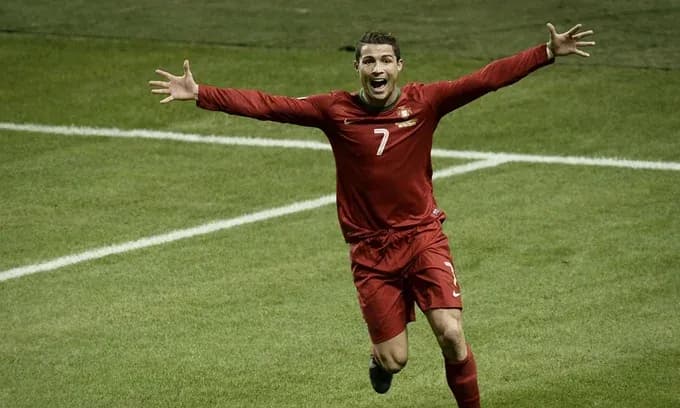
Ronaldo seized it back. First, a devastating run and finish. Then another. A ruthless hat-trick, completed with cold precision, silenced the Swedish crowd and sealed a 3-2 victory on the night, 4-2 on aggregate.
Across the two legs, Portugal scored four goals. All four belonged to Ronaldo. He didn’t just lead them to Brazil. He carried them there on his back.
From Lisbon’s heartbreak to Parisian redemption
Euro 2016 began in a way that mocked Portugal’s ambitions. Three group matches, three draws. Stuttering, scrappy, unconvincing.
In the final group game against Hungary, chaos reigned. Portugal fell behind three times. Each time, Ronaldo dragged them back. He scored twice in a wild 3-3 draw that kept the campaign alive by the thinnest of margins. The performance felt less like a captain guiding his team and more like a man refusing to let his tournament end in a group-stage obituary.
The team hardened in the knockouts. In the semi-final against Wales, Ronaldo rose again — literally. A towering header opened the scoring in a 2-0 win, propelling Portugal into another European final.
This time, France awaited in Paris. A home crowd, a star-studded opponent, a chance to rewrite 2004.
Then, in the 25th minute, disaster. Ronaldo crumpled after a challenge, tried to continue, then collapsed again. Tears streamed down his face as he left the pitch on a stretcher, the captain’s armband slipping from his arm. The ghosts of that night against Greece suddenly felt very real.
But Portugal refused to follow the old script. They fought, defended, suffered. The match stumbled into extra time, still goalless, still tense.
Then Eder, a forward few outside Portugal had truly believed in, unleashed a long-range strike that ripped into the French net. 1-0. The underdogs had turned Europe upside down.
On the podium, Ronaldo — tracksuit on, knee bandaged — finally lifted the trophy that had eluded him in 2004. The boy who once cried on home soil now stood as European champion. Portugal’s first major international title belonged to a collective, but its defining arc ran straight through the No. 7.
The Sochi masterpiece at 33
By the time the 2018 World Cup rolled around, Portugal were no longer the nearly-men of Europe. They arrived in Russia as reigning European champions, and Ronaldo arrived as a 33-year-old still playing as if time had misread his birth certificate.
Their opening match against Spain in Sochi turned into one of the defining nights of his international career.
Four minutes in, Ronaldo won a penalty and buried it. Late in the first half, he fired again, capitalising on an error from goalkeeper David de Gea to make it 2-1. Spain, wounded but not broken, responded after the break with the full weight of their talent. They turned the game around to lead 3-2.
The clock ticked down. Two minutes left. One more act.
Ronaldo stood over a free kick, 25 yards out. The stadium held its breath. He curled the ball over the wall and into the top corner, a perfect, arcing strike that froze the moment in World Cup history. Hat-trick complete. 3-3.
At 33, he became the oldest player to score a World Cup hat-trick. The numbers told one story. The performance told another: the fire was nowhere near out.
Benched, eclipsed, and broken in Qatar
Qatar 2022 began with another entry in the record books. Ronaldo scored and became the first male player to find the net in five different World Cup tournaments. Even as the years piled up, the milestones kept falling.
Then came the rupture.
In the final group game, Fernando Santos did not like what he saw in Ronaldo’s reaction to being substituted. The tension spilled into team selection. For the Round of 16 clash against Switzerland, the unthinkable happened: Portugal’s captain, their icon, was dropped to the bench in favour of Goncalo Ramos.
The decision looked ruthless. It also looked right on the night. Ramos exploded with a hat-trick in a 6-1 demolition, while Ronaldo entered late, reduced to a supporting role in a team suddenly playing with new verve.
Santos stayed firm. In the quarter-final against Morocco, Ronaldo again started among the substitutes. He came on early in the second half, chasing yet another rescue act. This time, there was no miracle. Morocco held on for a 1-0 win, and Ronaldo left the World Cup in tears once more, walking down a tunnel that felt heavier with every step.
The tournament that began with history ended with heartbreak and the image of a legend confronting his own limits.
Nations League glory and the goalscoring summit
Ronaldo’s Portugal story was never just about World Cups and Euros. It was also about carving his name into every available surface of the international game.
In 2019, he drove Portugal to the inaugural UEFA Nations League title. A semi-final against Switzerland turned into another personal showcase as he rattled in a hat-trick, then watched his teammates edge the Netherlands 1-0 in the final to lift yet another trophy.
Two years later, in September 2021, he climbed a different kind of podium. Facing Ireland, Portugal trailed late on. Ronaldo struck twice in the dying minutes, flipping the result and, in the process, surpassing Ali Daei’s long-standing record of 109 international goals. He stood alone as the all-time leading goalscorer in men’s international football.
The years kept rolling, the records kept falling. Six years after that first Nations League triumph, at the age of 40, he was still deciding finals. Against Spain in the 2025 Nations League showpiece, Ronaldo scored in the 61st minute to level the match at 2-2. Portugal held their nerve in the penalty shootout and claimed the title again, adding another chapter to a story that refused to end quietly.
A sixth World Cup, a bitter farewell
The 2026 World Cup offered one last grand stage. Ronaldo walked into the tournament as a living anomaly: his sixth World Cup appearance, another record, another reminder of his refusal to step aside.
He became the first player ever to score in six different World Cups, stretching a personal timeline that no one else in the men’s game could match. Yet the one prize he craved most remained stubbornly out of reach. Portugal fell 1-0 to Spain in the Round of 16, and the dream of lifting the World Cup died for good.
What followed off the pitch was as turbulent as anything he had experienced on it.
In the months after the tournament, his relationship with head coach Jorge Jesus fractured in public view. Ronaldo left a September training camp early, then accused the coach of breaking promises. The dispute cast a shadow over what should have been a long, slow, celebrated goodbye.
Instead, the end came via a screen. On November 5, he posted a video announcing his retirement from the national team. He spoke of the honor and weight of wearing the No. 7 for 23 years, and of the moment every great player eventually faces — the moment to pass the torch.
He walked away with numbers that look almost fictional: 234 appearances, 146 goals, three major international trophies. Euro 2016. Two Nations League crowns. Records scattered across two decades.
The World Cup remained unfinished business, the one gap on an otherwise overflowing shelf.
But international football will measure itself against his shadow for years to come. How do you follow a man who turned tears at 19 into a 23-year epic, and left the game still arguing about where his story truly ends?