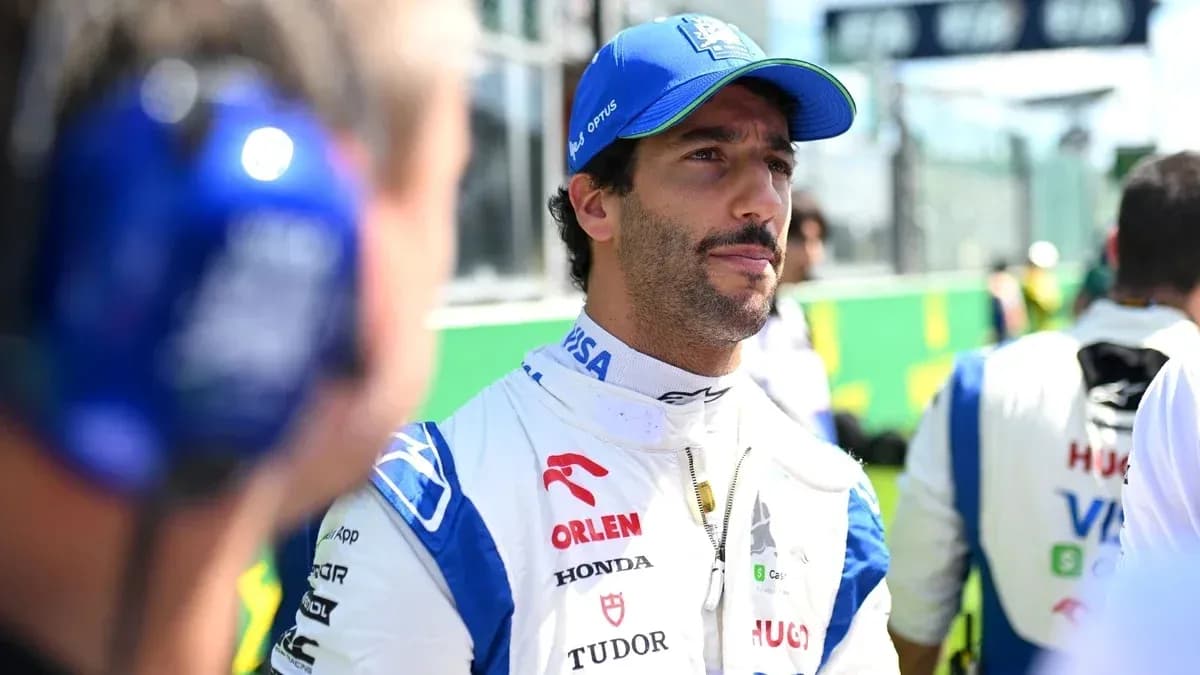
Daniel Ricciardo's Journey: From Formula 1 Glory to Finding Passion Again
Daniel Ricciardo has always worn the smile of a man who could outrun doubt. On the Beyond The Grid podcast last month, that smile was still there – but the edges had hardened. The jokes were softer, the reflections sharper. Two years out of Formula 1’s firing line have done something no engineer ever could: they’ve given him distance.
Distance from the way it ended. Distance from the bruises he carried out of McLaren and back into Faenza. Distance from the fairy tale he chased all the way to the door of Red Bull, only to find it locked.
The long fade
The numbers tell their own cold story. After that shock win at Monza in 2021, Ricciardo never stood on a Formula 1 podium again. Seventy races. One high, a lot of hard landings.
Losing his McLaren seat should have been the warning siren. Instead, it became another chapter in the grind. He went back to his old Faenza home, now RB, with one clear aim: fight his way into a Red Bull Racing seat and rekindle the old magic alongside Max Verstappen.
It never came. The lap time didn’t come back, the consistency didn’t come back. The sport moved on. Red Bull made its call and turned to Liam Lawson for the second RB seat. Ricciardo’s adventure ended not with a goodbye tour, but with a decision taken for him.
On the podcast, he admitted he had already been running on emotional fumes.
“By that point, I was done getting knocked down; I was, I guess, getting beat up,” he said of his mindset at his last race, the 2024 Singapore GP.
He still felt the hunger, still wanted to prove something to himself, but the internal monologue had turned into a tug of war. One side yelling that he was strong enough, that he could push through. The other whispering something far more dangerous for a racing driver: “I don’t love this anymore. I don’t really want to be here.”
He tried to sleep it off, to ride the wave of the odd good race, the odd flash of the old fire. But the pattern kept repeating. Brief sparks. Long shadows.
Chasing the fairy tale
Ricciardo never hid what he wanted. He wanted the story to loop back to the beginning. A return to Red Bull Racing. A reunion with Verstappen. A shot, however unlikely, at racing at the front again.
“I still wanted the fairy tale, of course,” he said. “I wanted to get back with Red Bull Racing and all of that, and I would have loved to have been team-mates with Max again and tried to race at the front again.”
The reality was harsher. Deep down, he knew he was burning out. The simple act of performing at the level he once did had become a grind. Others his age – and older – were still delivering at a frighteningly high level. For him, the process had turned heavy.
“There was just a lot of pain, process, a lot of things that just were happening and had happened over the years, that I think just built up, and it was just very hard for me to shut all that out and do it.”
He talks now like a man who understands he might never have been able to pull the plug himself. That is perhaps the most revealing admission of all.
‘I don’t want to do this anymore’
The fear, he says, sits in hindsight. What if the contracts had kept coming? Would he have kept signing? Would he ever have turned the tap off?
“I know I wanted to at times,” he admitted. “I can tell you right now, Monaco 2022 after the race, I'm sitting in my apartment, talking to my team, and I was like, 'I don't want to do this anymore, I'm done'.”
That wasn’t the first time. He’d felt it as far back as Silverstone 2015.
Both weekends were jarring snapshots. Monaco 2022, where he had been king of the streets in 2018, turned into a slog: 14th on the grid, 13th at the flag in a McLaren that never looked comfortable. Seven years earlier at the British GP, his ninth-fastest qualifying lap was scrubbed for track limits, leaving him 10th on the grid. Contact with Romain Grosjean at the start, a race mired in the pack, then an electrical failure to finish it off.
Moments like that plant seeds. Over time, they grow.
“You have people around you that tell you, 'You're great, you can still do it', and you end up also believing a lot of these voices – I know they don't mean harm, but you don't really get a chance to have your own thoughts much,” he said.
That’s where the gratitude creeps in, awkwardly, next to the disappointment.
“I still don't like how it ended, but there's also a part of me which is grateful they pulled the trigger, because I wouldn't want to be doing it now.”
The weight of ‘failure’
Strip away the trophies, the shoeys, the paddock persona, and Ricciardo’s description of those final months is brutally simple: he felt like he had failed.
“You start racing at such a young age, and over the years you build, I guess, a ruthlessness – but that also is inward as well,” he explained. “You can be very harsh on yourself and expect a lot from yourself.”
So when the results dried up, when he couldn’t reach the level he demanded of himself, it wasn’t just professional frustration. It was humiliation.
“Failing – that was my view of it, failing, not performing to the level I needed to at the time, or not being able to finish out the season, or whatever – it's then a sense of humiliation. I failed, and I didn't do what I once could.”
He coped the way many athletes do when the lights go out. He hid in plain sight.
“Trying to deal with that, those next few months, I understood it as I was just hiding from the humiliation. People saw me out in public, I was, 'Ha ha ha, I'm having a good time', having a drink or whatever, and I was just hiding from what I really felt deep inside, which was a lot of pain and sadness.”
The dream that had powered him from kart tracks to grand prix victories felt gone.
“'It's gone. I was once this kid that was hoping to fight for a world title and winning races; it's gone'.”
Learning to breathe again
So he stepped away. Not just from the car, but from the whole circus: the paddock, the media, the constant noise.
“In terms of driving, I was burned out, let alone emotions and all that, I was just tired,” he said. “I just knew I needed time from everything – even people.”
He disappeared into something far less glamorous than a race weekend: solo travel, hiking, long stretches of time with no schedule and no stopwatch. He needed, as he put it, “to breathe on my own”.
Yet the sport has a way of pulling you back, even when you think you’re done with it. For Ricciardo, the spark returned not in a Formula 1 garage, but in the grandstands at the Indianapolis 500 last May.
He went as a fan. No debriefs, no data, no pressure. Just noise, speed and pure racing.
“Being a fan again reminded me that I do love motorsports.”
The fairy tale with Red Bull is over. The world title dream he once chased has slipped out of reach. But the story isn’t simply about what he lost at the end. It’s about what he managed to recover once the helmets and headlines fell away: the answer to a simple question that every great driver eventually has to face.
Do you still love it when there’s nothing left to prove?