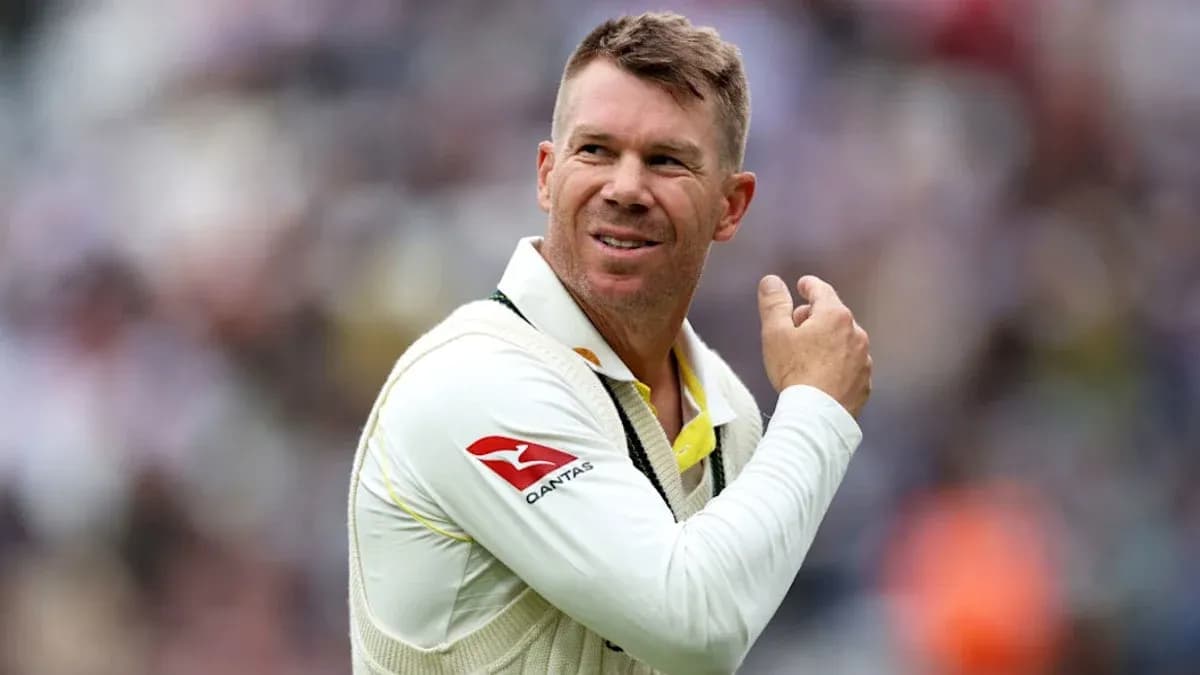
David Warner's Allegations on Cricket Australia’s Sandpaper Scandal
David Warner has torn open the scars of Cape Town again, this time with a claim that goes straight to the heart of Cricket Australia’s handling of the sandpaper scandal.
In a fresh blast on social media, Warner alleged that Josh Hazlewood, Mitchell Starc and Nathan Lyon were never interviewed as part of CA’s internal investigation into the 2018 fiasco. In his view, that omission speaks to something darker.
“As far as I am aware, CA did not interview (them),” Warner wrote on Instagram. “If that’s correct, then how can CA push the idea that the bowlers didn’t know?
“It looks like they had decided who they wanted to blame from the very beginning, and ran a shoddy investigation to serve the purpose, and now they want to maintain the false narrative that the bowlers had no idea.
“That stinks of a cover-up.”
Those words landed like a grenade. But The Age, citing two sources with direct knowledge of the process, reports that Hazlewood, Starc and Lyon were in fact interviewed by investigators, directly contradicting Warner’s accusation and deepening the sense of confusion over who knew what, and when.
Old scandal, new fractures
The sandpaper saga has never really left Australian cricket. It lurks in every conversation about leadership, culture, and trust. Over the past week it has flared again, fuelled first by Usman Khawaja’s assertion in his book Sabr that the Australian Test team knew of a plan to tamper with the ball in Cape Town.
Pat Cummins, now captain and then a member of that side, fronted a marathon 70‑minute press conference on Friday and flatly denied any knowledge that sandpaper was being taken onto the field. His stance drew strong backing from some, suspicion from others.
Warner, already central to the original scandal and its fallout, has now pushed the debate into more volatile territory by questioning the integrity of CA’s investigation and the narrative that only a small group bore responsibility.
At the time, the governing body moved swiftly and brutally. Steve Smith, Warner and Cameron Bancroft were hit with heavy bans for their roles in the plot exposed on live television in Cape Town. The punishment was clear. The full story, less so.
Whispers, blank walls
Cricket Australia did not stop at the on-field inquiry. It commissioned The Ethics Centre and its executive director, Dr Simon Longstaff, to run a broader review into team and corporate culture.
Longstaff spoke with a cross‑section of the game: current and former players, sponsors, staff, past Test cricketers. And almost immediately, he said, he heard what so many fans suspected.
“We’re talking effectively about … good people who made bad decisions, so that’s where we looked,” Longstaff said on Nine’s Weekend Today.
“Along the way there were whispers, and I can't put it any more strongly than that, that something else had gone on earlier and that more people had known.”
Those whispers forced him to probe deeper.
“When we came to look into that – because I couldn’t turn a blind eye to it once the suggestion was made – I afforded the senior people I spoke with an opportunity … ‘Well, is there something else you want to say about the whole circumstance?’
“Nobody chose to make any alteration to their statement, so I was left with basically a blank wall.
“Some people saying one thing, others another, but not sufficient to be able to say there needs to be a further inquiry at that time.”
The sense is clear: there was smoke, but not enough visible flame for Longstaff to demand the house be torn down.
Khawaja’s silence, by design?
Khawaja’s role in this renewed storm is different but just as pointed. In Sabr, he revealed he expected to be called as part of CA’s investigation in 2018 – and wasn’t.
“I thoroughly feel that I didn’t get interviewed because of that, because they knew that I wanted to take it as a team, because they knew I was ready to tell the truth if I was interviewed,” he wrote.
“And I was waiting for my phone to ring. It just never rang, and then the penalties were given, and I couldn’t believe it.”
Khawaja’s belief is that his stance – “collective blame” – made him inconvenient. The phone stayed silent. The punishments landed. The story moved on, at least officially.
Longstaff, whose review ran parallel but separate to CA’s disciplinary process, said several figures were invited directly to participate in his work, and some turned the offer down. He could not recall if Khawaja was among those formally approached, but stressed that everyone had the opportunity to come forward.
“I can't remember exactly who it was that was given the opportunity to contribute to our review, which went much further than just the players involved,” he said.
“It looked at the whole of Cricket Australia, sponsors, supporters … past Test players to see what the comparison could be. Not everybody we invited to participate in our review chose to accept that invitation. They had the liberty not to.
“Anything they were to say was under strict conditions of confidentiality, which of course, we're bound to respect even to today.”
Conflicting truths
The picture now is messy, layered, and emotionally charged.
Longstaff described the saga as “deeply upsetting for everyone involved to have their reputations called into question”, a wound reopened every time a new allegation surfaces. He watched Cummins’ lengthy press conference on Friday and came away convinced by the captain’s denial.
He called Cummins’ performance “absolutely convincing in his sincerity” as the fast bowler insisted he did not know sandpaper was being taken onto the field.
“That stands against Usman Khawaja's claim that everybody knew, so there's a clear contradiction there,” Longstaff said.
“If Cummins did not know, and I believe he didn't, then not everybody knew. But that leaves a different question.
“Was it that many other people did know, if not Cummins? And is Khawaja being sincere in his belief … that if not everybody, there was a considerably larger number (that knew). Now we just don’t know.
“There’s been consistent denials from the bowling team as a whole, and that stands in contrast now to what Usman Khawaja and David Warner are both asserting.”
Two versions of history now run side by side: one in which a small cabal plotted and executed the tampering; another in which knowledge was more widely spread, even if not universal. Both cannot be entirely true.
Longstaff, a veteran of complex ethical disputes, sees a familiar pattern.
“To that end, I think, although it’s so messy, there has to be some explanation which could be found. I’ve spent a career looking into questions like this, and inevitably, when you find this kind of conflict of opinion, there is a reason behind it.
“It’s just a question of whether or not Cricket Australia wants to determine what that is.”
Years after Cape Town, with bans served and careers rebuilt, the central question hasn’t gone away. It’s only sharpened.
Does Australian cricket finally have the appetite to find that reason – or will the sandpaper scandal remain a story half-told, argued forever in the shadows?