Egypt Triumphs in Penalty Shootout Against Australia
In the end, it came down to a teenager, a crossbar and Mohamed Salah’s unblinking stare.
Under a wall of whistles from the Egypt end and with 70,000 inside the air-conditioned home of the Dallas Cowboys holding their breath, Australia’s bold World Cup run died in the harshest way possible – on penalties, with their most experienced player brought on for a final roll of the dice.
A gamble, a crossbar, and a king’s composure
Tony Popovic had already played his last card before the shootout began, hauling off his starting goalkeeper and sending on Mathew Ryan purely for the penalties. It was a ruthless, calculated move from a coach who knew history was in reach. Neither Egypt nor Australia had ever won a men’s World Cup knockout match. Someone was going to step into new territory.
The shootout began badly for the Socceroos. Harry Souttar, the towering defender, strode up first and lashed his kick over the bar, silencing the Australian section and igniting the Egyptian ranks behind the goal. From that moment, Australia were chasing.
Five penalties followed, each one buried with icy certainty. Salah, who had spent much of the night on the fringes after his hamstring scare, walked up with the air of a man who has carried a nation for a decade. He rolled his penalty in with a casual authority that belied the stakes.
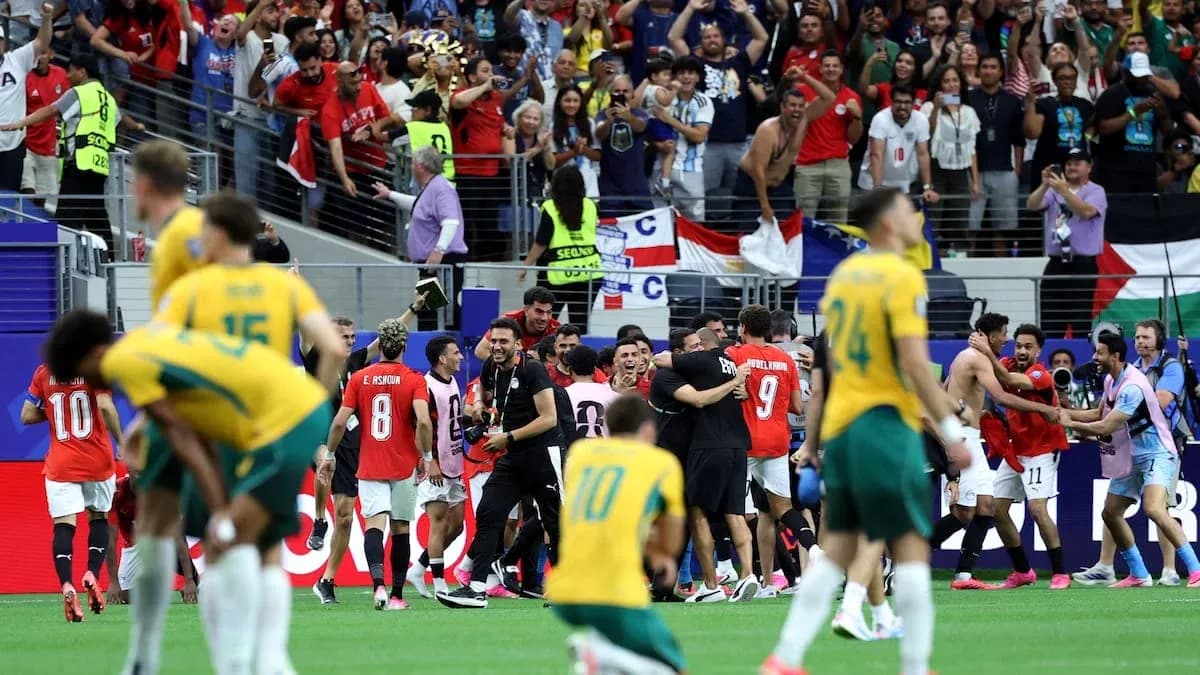
Then came Lucas Herrington. Just 18, a defender with barely any senior mileage, asked to keep his country alive. He went for height, for safety, for glory. The ball crashed against the bar and flew out. Egypt’s Abdelmaguid stepped up next and did what was needed, threading his kick past Ryan to send Egypt through and leave Salah in tears of joy, while Australian players dropped to the turf around him.
Australian hearts broke. Egyptian history was made.
Egypt strike first as Volpato rattles the bar
The drama of the shootout almost overshadowed what had gone before. Almost.
Australia had actually come out swinging. Within five minutes, Cristian Volpato – the playmaker who chose the green and gold over Italy on the eve of the tournament – whipped a vicious effort against the top of the crossbar. For a side that had scored only twice in the group stage, it was a statement. They weren’t here to sit back.
Egypt, who had tasted their first ever World Cup win in the group phase with a 3-1 victory over New Zealand, looked edgy at the back. Passes went astray, clearances lacked conviction. The Socceroos pressed, sensing vulnerability.
Then, almost out of nowhere, Hossam Hassan’s side struck.
Nestory Irankunda switched off for a moment, and that was all Emam Ashour needed. Karim Hafez delivered from the left, Ashour drifted to the back post unmarked and buried his header for his second goal of the tournament. Thirteen minutes in, the seven-time African champions led, and the game flipped.
For an Australia side short on goals and now forced to chase, the task grew heavier. Their first shot on target did not arrive until 10 minutes before half-time, Aziz Behich’s low effort comfortably gathered by Mostafa Shoubir. In the stands, Shoubir’s father Ahmed – who played in goal for Egypt at the 1990 World Cup – would have recognised the routine nature of the save.
Attrition, injury and a fragile star
The first half became a grind. Tackles flew in, rhythm shattered, and the match turned attritional.
Salah, 34 and still the talisman, was clearly managing his body after that hamstring strain in Egypt’s previous game. He drifted, he probed, but he did not dominate. For long spells he was a peripheral figure, more decoy than destroyer.
The half ended with another blow for Australia. Jordan Bos, one of the quickest players at this World Cup, was left in a heap after a fierce, flying challenge from Rabia. Bos tried to continue but could not; he was replaced at the interval by Kai Trewin, a substitution that stripped the Socceroos of a key outlet on the flank.
Seconds after the restart, Australia’s night almost unravelled completely. Omar Marmoush, the Manchester City forward on loan to Egypt’s cause, slid a golden chance wide from close range. It should have been 2-0. It wasn’t. The miss kept Australia alive.
Pressure, own goals and a familiar torment
Egypt’s coach had warned about Australia’s physical edge. He was right to be wary.
The Socceroos began to lean into that strength. They fought for every second ball, forced set-pieces, and from one of those dead balls they clawed their way back. An in-swinging free-kick arced into the Egyptian box, bodies crashed together, and Mohamed Hany – under intense pressure – could only glance the ball into his own net.
For Hany, it was a nightmare revisited. His second own goal of the tournament. For Australia, it was oxygen.
The equaliser came 10 minutes after half-time and changed the mood completely. Suddenly, it was Egypt retreating, Egypt hesitating. Both teams could feel what was at stake: a first ever knockout win on the world stage, a line in the record books.
Normal time ended with Egypt back on the front foot. Salah, still not at his explosive best, helped knit together a late surge. Patrick Beach, Australia’s starting goalkeeper before Ryan’s introduction for the shootout, produced an outstanding save deep into added time to deny Ramy and drag the contest into an extra 30 minutes.
Extra time and the long walk to destiny
Extra time belonged more to Egypt in territory than in chances. Legs tired, minds frayed, and the match inched towards the spot.
Salah did have one sight of goal early in the extra period, cutting onto his weaker right foot and blazing over. It summed up his night from open play – present, involved, but lacking his usual ruthless edge.
The clock ticked down. Neither side found the moment to settle it. With nothing to separate them, the game moved inexorably towards penalties, where reputations are either burnished or broken in the space of a few steps.
Popovic made his move, sending on Ryan to be the hero. Egypt trusted the players who had carried them this far. The rest was noise, nerve and the cold logic of a shootout.
Souttar’s miss, Salah’s ice, Herrington’s bar, Abdelmaguid’s winner.
Egypt, at last, know what it feels like to win a men’s World Cup knockout match. Australia, so close to their own breakthrough, are left to wonder how long it will be before they stand on this stage again – and whether next time, the crossbar might finally be on their side.