England's Tactical Masterclass in 2-1 Win Over Congo DR
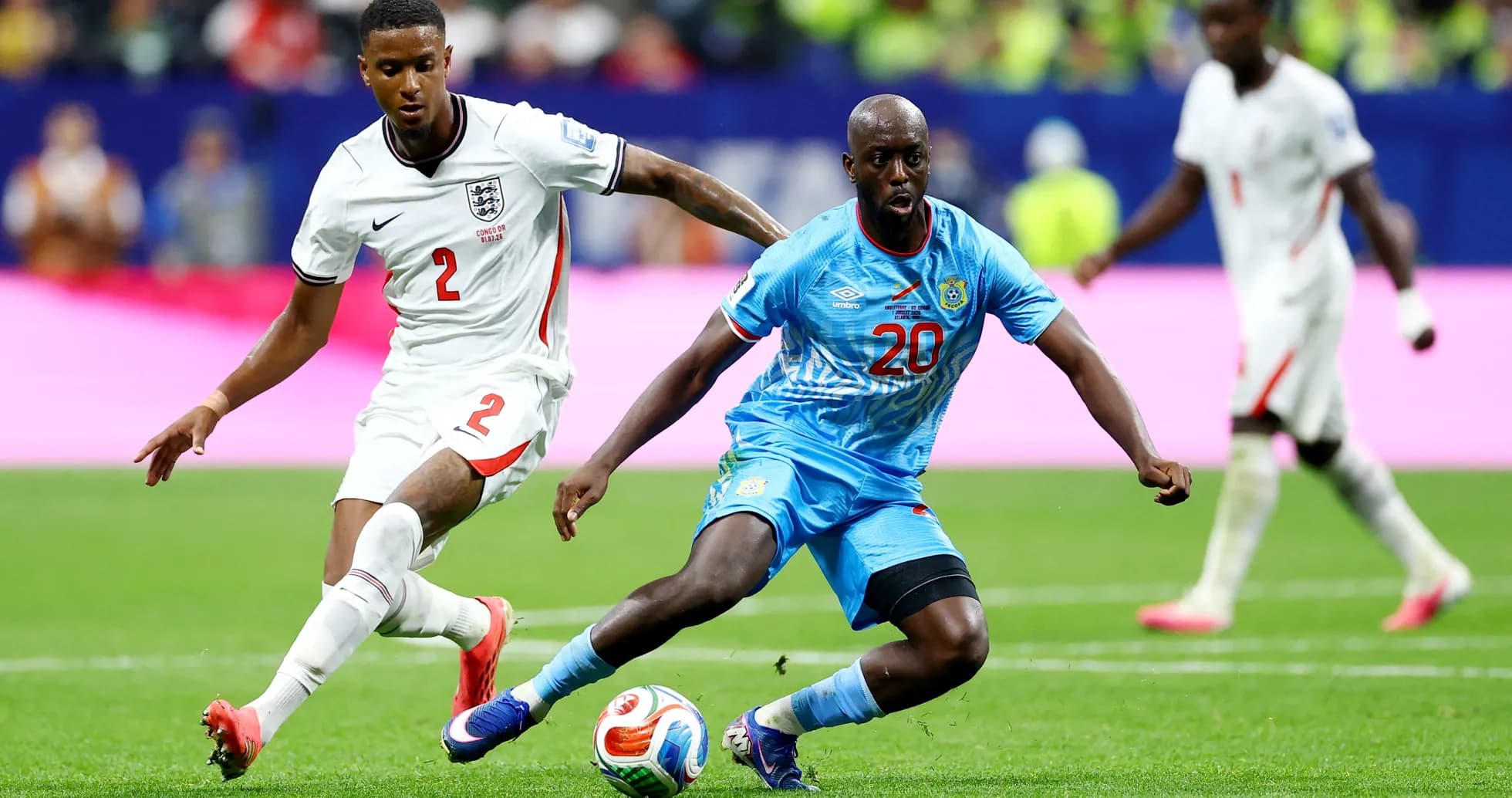
England’s 2-1 comeback win over Congo DR at Mercedes-Benz Stadium was built on territorial control, structural tweaks from Thomas Tuchel, and a decisive shift in wing dynamics after the hour. Congo DR’s early lead forced England to show more verticality and risk, but the underlying pattern remained clear: England’s 4-2-3-1 steadily suffocated a 4-3-3 that was set up to counter rather than dominate.
Out of possession, England’s shape was a classic Tuchel 4-2-3-1 press. Harry Kane screened Congo DR’s single pivot, with Jude Bellingham jumping from the No.10 slot to press the centre-backs. Marcus Rashford and Noni Madueke initially held narrow starting positions, inviting Congo DR’s full-backs to receive before springing diagonally to trap them. Declan Rice anchored alongside Elliot Anderson; Rice stayed central to protect the half-spaces, while Anderson stepped higher to support counter-pressing around the ball.
Despite this structure, Congo DR struck first. In the 4-3-3, Brian Cipenga and Nathanaël Mbuku stayed wide, while Yoane Wissa operated as a flexible central reference, often dropping between the lines to drag England’s centre-backs out. The opening goal at 7' from Brian Cipenga, assisted by Chancel Mbemba, came from Congo DR’s willingness to play quickly into wide channels once they broke the first press. It validated Sébastien Desabre’s plan: absorb, then attack the space behind England’s advanced full-backs.
From there, the game became about England’s ability to turn possession into penetration. They finished with 60% of the ball and a 16–7 shot advantage (7–2 on target), underlining their territorial dominance. Crucially, 13 of England’s 16 attempts came from inside the box, a reflection of sustained occupation of Congo DR’s penalty area rather than speculative efforts. Congo DR, by contrast, managed only 2 shots inside the box and relied heavily on long-range attempts (5 shots from outside), showing how rarely they were able to establish presence in England’s area after the early goal.
Jordan Pickford (England) had a relatively quiet but high-risk game: just 1 save, with Congo DR’s expected goals at 0.8. The negative goals prevented figure (-0.04) suggests the goal conceded roughly matched the quality of chance faced. England’s defensive line of Djed Spence, Ezri Konsa, Marc Guéhi and Nico O’Reilly was pushed high, which compressed the pitch but left space in behind. Once England settled after the early setback, Konsa and Guéhi defended aggressively on the front foot, stepping into midfield to intercept rather than retreating. That front-foot defending helped restrict Congo DR to low-volume, low-frequency box entries.
Lionel Mpasi Nzau (Congo DR) was under sustained pressure. He made 5 saves against an England xG of 2.04, with a goals prevented value of -0.04, indicating that England’s two goals were broadly in line with chance quality and that Mpasi Nzau did not significantly outperform the model. Congo DR’s back four, especially Arthur Masuaku and Aaron Wan-Bissaka, were forced into a deep block as England’s possession grew. The 40% possession and 365 passes (299 accurate, 82%) underline that Congo DR were not disorganised on the ball, but they were structurally second-best in terms of territory.
Tactical Changes
The key tactical inflection point came at 60'. Bukayo Saka (IN) came on for Noni Madueke (OUT), and Anthony Gordon (IN) came on for Marcus Rashford (OUT). These were not like-for-like in terms of behaviour. Saka’s tendency to hold width on the right and attack the outside of the full-back stretched Congo DR’s back line horizontally, while Gordon’s aggressive diagonal runs from the left into the left half-space created clearer passing lanes into Kane and Bellingham. England’s 4-2-3-1 began to resemble a 2-3-5 in sustained attacks: Spence and O’Reilly pushed high, Rice dropped between the centre-backs in build-up, and Bellingham roamed between the lines.
The payoff was direct. At 75', Harry Kane equalised, assisted by Anthony Gordon, a move emblematic of the new dynamic: Gordon attacking the inside channel, combining centrally, and Kane finishing from a higher average position than in the first half, when he often dropped too deep to connect play. The same combination repeated at 86', again Kane from Gordon, as Congo DR’s right side, now fatigued and repeatedly overloaded, failed to track late runs and second-phase movements.
Desabre tried to respond with changes of his own. Meschak Elia (IN) came on for Nathanaël Mbuku (OUT) at 64', adding fresh legs on the flank, while later substitutions such as Fiston Mayele (IN) for Samuel Moutoussamy (OUT) and Joris Kayembe (IN) for Arthur Masuaku (OUT) at 89' hinted at a late attempt to add directness and width. However, by then England’s control of tempo and spacing was entrenched. Congo DR’s 12 fouls and 1 yellow card (Noah Sadiki for Foul at 27') reflected a reactive, survival-mode defensive phase.
Passing Structure
England’s passing structure was the platform for their comeback. They completed 517 passes with 468 accurate (91%), a level of precision that allowed them to recycle possession around Congo DR’s block and patiently probe for openings. Rice and Anderson acted as the stabilising axis: Rice orchestrated from deeper zones, while Anderson’s positioning between the opposition midfield and defence helped maintain pressure on second balls and cut off Congo DR’s transition routes. Congo DR’s 365 passes, while respectable, were mostly in deeper zones; they lacked a stable route to progress beyond England’s second line once the initial counter-attacking threat waned.
Discipline played a subtle tactical role. Jude Bellingham’s yellow card for Foul at 19' did not significantly alter England’s pressing intensity, but it did see him manage his duels more carefully, focusing on blocking passing lanes rather than risky tackles. For Congo DR, Sadiki’s booking limited his aggression in stepping out from midfield, which further encouraged England to overload central zones with Bellingham and Gordon between the lines.
The disallowed penalty incident at 44', when a potential penalty involving Harry Kane was cancelled by VAR, also shaped the tactical narrative. It underlined England’s growing penalty-box presence even before the break and signalled that Congo DR’s defensive line was already under strain from England’s increased directness into Kane and late runs from midfield.
Statistically, England’s 2.04 xG against Congo DR’s 0.8 supports the visual impression: this was a controlled, territorially dominant performance that merited the 2-1 scoreline. England’s 5 corner kicks to Congo DR’s 3 and a 10–12 foul count show that, while Congo DR remained combative, they were increasingly pinned back and forced to defend in their own third. The shot profile, possession share, and passing accuracy all point to a match where Tuchel’s side imposed their structure and, once the wide changes were made, finally aligned their chance creation with the scoreboard.