Enzo Fernández and the Topo Gigio Gesture in Argentine Football
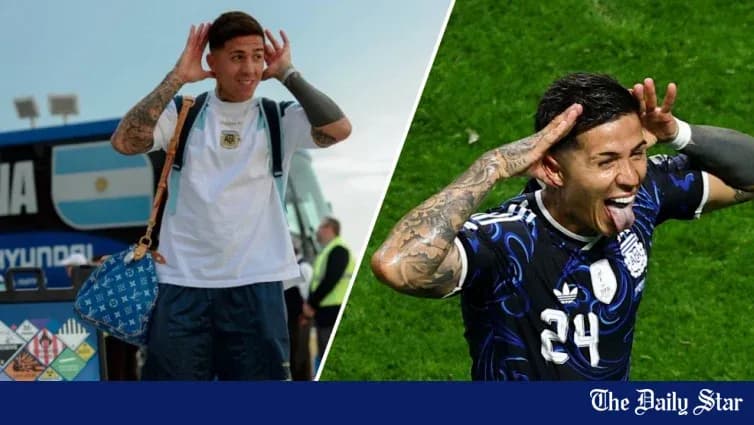
Enzo Fernández cupped his hands behind his ears again. No goal this time, no stadium roaring back at him, just the echo of cameras clicking on an airport runway in Kansas City as Argentina prepared to fly to New York.
The message was the same.
With a place in the FIFA World Cup 2026 final already secured and Spain waiting at MetLife Stadium in the early hours of Monday [1am, Bangladesh Time], the Chelsea midfielder chose once more to lean into the celebration that has followed him across this tournament: the “Topo Gigio”.
Thunderstorms meant Argentina’s charter didn’t touch down in New York until close to midnight, but the image had already travelled. Fernández, hands behind his ears, staring straight down the lens. A gesture that began as a cartoon mouse’s pose, reborn as a symbol of defiance in Argentine football, now wrapped around one of the most watched teams on the planet.
A children’s character that became a battle cry
To understand why this has become a storyline of its own, you have to go back long before Fernández, long before this World Cup.
Topo Gigio started life in 1958, created by Italian artist Maria Perego. A soft puppet mouse with big ears, wide eyes and a gentle manner, he became a television staple across Latin America in the 1980s and 1990s. For a generation of Argentines, he was bedtime comfort, not confrontation.
Yet his trademark pose – hands cupped behind those exaggerated ears – drifted from the TV screen to the terraces. It was simple. It was memorable. And in football, it was waiting for the right moment.
That moment arrived on April 8, 2001, in Buenos Aires.
Riquelme, Macri and a gesture that shook La Bombonera
Superclásico. Boca Juniors vs River Plate. La Bombonera vibrating under the weight of the occasion. Juan Román Riquelme, already a genius in blue and gold, stepped up and scored.
He didn’t sprint to the corner flag. He didn’t slide on his knees. He walked towards the presidential box, towards then-club president Mauricio Macri, and raised his hands behind his ears in the now-famous Topo Gigio pose.
At the time, Riquelme was locked in a tense contract dispute with Boca’s hierarchy. The celebration was instantly read as a pointed message: “Can you hear me now?” It was theatre as much as football, a silent argument played out in front of tens of thousands.
Riquelme later said it was for his daughter. The image had already taken on a life of its own.
From that night, Topo Gigio belonged to Argentine football as much as to children’s TV. It became a weapon as well as a wink.
Messi picks up the thread
The gesture resurfaced on the biggest stage again in Qatar in 2022.
After Argentina’s stormy World Cup quarter-final win over the Netherlands, Lionel Messi – usually restrained in his celebrations – turned to the Dutch bench and cupped his hands behind his ears. The tension with then-Netherlands coach Louis van Gaal had been simmering all week. In that split second, the Topo Gigio became the perfect answer.
It wasn’t subtle. It wasn’t meant to be. Argentina’s captain had reached back into the country’s footballing archive and pulled out a symbol that every fan recognised.
From Riquelme to Messi, the line was clear. Fernández is now writing the next chapter.
Fernández and England: a new twist on an old symbol
In the semi-final against England, with one of international football’s fiercest rivalries raging around him, Fernández found the net and didn’t hesitate. He went straight to the celebration that had been etched into Argentine folklore.
Hands behind his ears. Eyes burning in the glare. Topo Gigio again, but this time in a match that carried decades of sporting and cultural baggage.
It wasn’t just a celebration; it was a statement layered on top of history. For Argentina fans, it linked Fernández instantly to the tradition of Riquelme and Messi. For England, it was another reminder that this fixture rarely passes quietly.
By repeating the gesture on the tarmac in Kansas City, away from the heat of a knockout tie, Fernández stripped it of any claim to being a one-off reaction. This is now his signature. His way of answering noise with more noise.
Light session, heavy symbolism
Before leaving Kansas City, Lionel Scaloni kept things measured. Argentina went through a light training session, a final tune-up rather than a test, as the squad shifted from the physical demands of a semi-final to the mental weight of a World Cup final.
There were no grand declarations, no public dramatics from the coach. The drama came instead from a simple pose, repeated by a 23-year-old midfielder who has embraced the spotlight.
As Argentina land in New York, the stakes are obvious. Spain await at MetLife Stadium, a final that pits two footballing cultures with deep, competing histories. Tactics will matter. Form will matter. So will small details, like how a team carries itself into the biggest night of its cycle.
Fernández has chosen to carry a gesture that started with a puppet mouse, passed through one of Boca’s greatest idols, then through the greatest player Argentina has ever produced.
Now it belongs to him too. The only question left is whether the next time he cups his hands behind his ears, it will be with a World Cup winner’s medal around his neck.