Espanyol's Tactical Victory Over Athletic Club: Key Insights
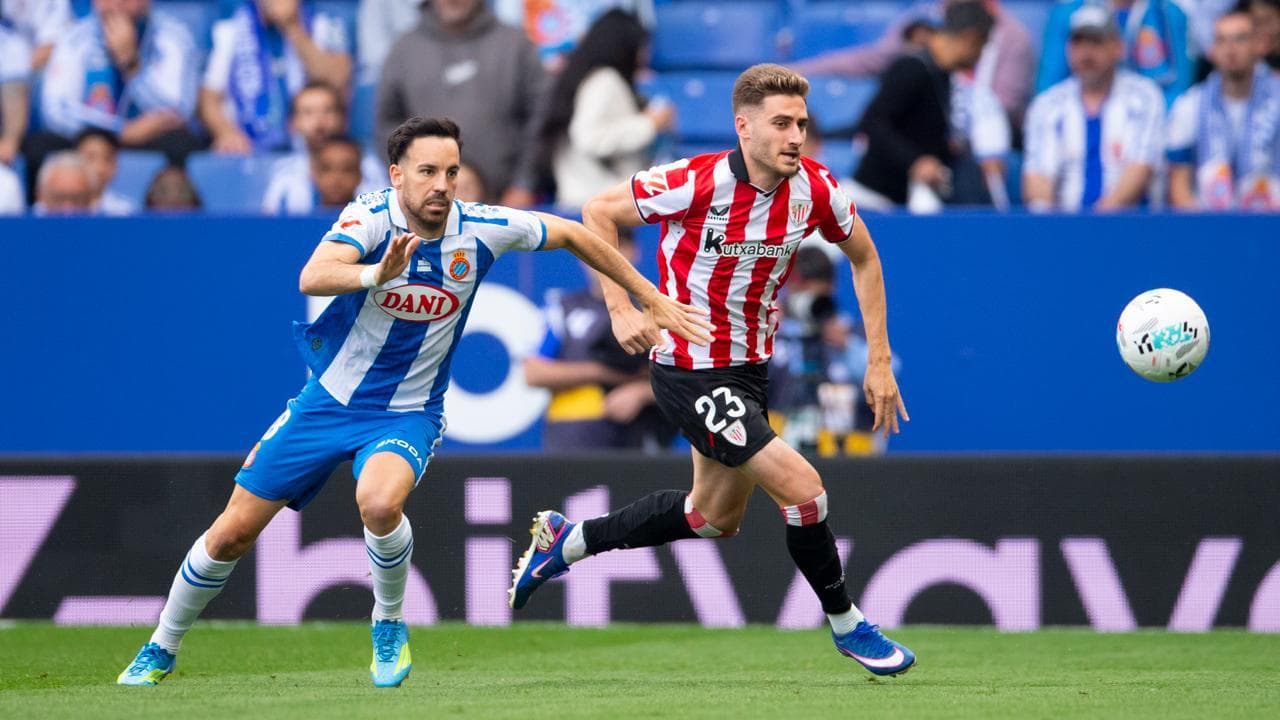
Espanyol’s 2-0 win over Athletic Club at RCDE Stadium was built on structural control rather than sheer chance creation, a match where Manolo Gonzalez’s 4-4-2 gradually suffocated Ernesto Valverde’s 4-2-3-1. Despite the xG balance (0.76 vs 0.82) suggesting near parity in shot quality, Espanyol’s command of territory, rhythm and substitutions turned a marginal contest into a clear tactical victory.
First Half
The opening hour was defined by Espanyol’s possession platform. Their 4-4-2, with Exposito and R. Fernandez Jaen up front, was not a classic direct pairing; instead, it functioned as a staggered front line that allowed the midfield four to dominate the ball. Espanyol finished with 63% possession, underpinned by 492 passes, 386 accurate (78%). The back four of O. El Hilali, C. Riedel, L. Cabrera and C. Romero circulated calmly, often using M. Dmitrovic as a reset point, forcing Athletic’s lone striker I. Williams to shuttle laterally and limiting his pressing impact.
Athletic’s 4-2-3-1 had a theoretically aggressive front four of R. Navarro, U. Gomez, A. Berenguer and Williams, but the double pivot of I. Ruiz de Galarreta and A. Rego spent much of the first half protecting space rather than launching transitions. With only 273 passes (180 accurate, 66%), Athletic struggled to connect their lines. They did manage 11 total shots to Espanyol’s 12 and actually produced slightly higher xG (0.82), largely because 10 of their 11 attempts came from inside the box, but those chances were sporadic rather than the product of sustained pressure.
Second Half
The game’s key tactical hinge came immediately after half-time and into the mid-second half, when both coaches leaned on their benches. At 46', Valverde replaced centre-back D. Vivian with Y. Alvarez (Y. Alvarez (IN) came on for D. Vivian (OUT)), a like-for-like change that kept the 4-2-3-1 shape but subtly altered Athletic’s build-up angles from the back. The real shift, however, arrived on 63', when Gonzalez and Valverde executed mirrored triple substitutions.
For Espanyol, A. Roca (OUT) made way for P. Milla (IN), and R. Sanchez (OUT) for Jofre (IN). These moves injected more verticality and directness into Espanyol’s right side and central lanes. Milla, nominally a midfielder, interpreted the role as a second striker or advanced eight, stepping into pockets between Athletic’s lines. Jofre offered fresh running from wide, stretching the previously compact Athletic block.
Athletic’s response at the same minute was more radical but less cohesive: I. Williams (OUT) was replaced by G. Guruzeta (IN), and I. Ruiz de Galarreta (OUT) by M. Jauregizar (IN). Removing Ruiz de Galarreta, the more stable distributor in the double pivot, weakened their ability to control central circulation. Guruzeta brought a different profile up front, more of a penalty-box forward than a channel runner, which meant Athletic became more reliant on wide service and second balls rather than dynamic counter-attacks.
The first goal, on 69', crystallised these trends. P. Milla, having just come on, scored for Espanyol, assisted by left-back C. Romero. The pattern fit the evolving structure: with Athletic’s midfield screen now less secure after Ruiz de Galarreta’s exit, Espanyol could push full-backs higher. Romero’s advanced positioning and delivery into Milla reflected a 4-4-2 that was morphing into a 2-4-4 in possession, with both full-backs stepping up and the wide midfielders tucking inside to overload central zones.
Valverde tried to rebalance on 71' by swapping right-back J. Areso (OUT) for A. Gorosabel (IN), and on 78' by introducing N. Serrano (IN) for U. Gomez (OUT), adding fresh legs and a more direct wide threat. Yet these changes came against an Espanyol side increasingly comfortable managing the game state. Gonzalez’s later substitutions were about energy preservation and control rather than structural change: Exposito (OUT) for R. Terrats (IN) and R. Fernandez Jaen (OUT) for K. Garcia (IN) at 84', followed by U. Gonzalez (OUT) for C. Pickel (IN) at 90+1'. With Terrats and Pickel, Espanyol effectively shifted towards a more robust, ball-winning and ball-retaining midfield, protecting their lead while keeping a counter-attacking outlet.
The second goal at 90' underlined the value of that bench management. K. Garcia, only just introduced, scored Espanyol’s second, assisted by R. Terrats. The sequence reflected fresh legs punishing a stretched Athletic side chasing an equaliser. Terrats, operating from a deeper midfield role, had time and space to pick the pass, while Garcia attacked the defensive line that had already been altered by multiple substitutions and 90 minutes of chasing the ball.
From a defensive perspective, both goalkeepers had mixed statistical stories. M. Dmitrovic made 4 saves, while U. Simon made 3. The goals prevented metric shows -0.9 for each, suggesting both conceded fewer than the model expected them to save, or that their shot-stopping underperformed relative to xG on target. However, context matters: Espanyol’s defensive line restricted Athletic mostly to crowded-box efforts, which, although logged as inside-box shots, were often under pressure. Espanyol’s 9 fouls compared to Athletic’s 14 also hint at a home side that defended more by positioning and interceptions than by constant physical duels.
Statistically, the match reads as a story of control versus bursts. Espanyol’s 12 shots (5 on goal) from a 63% possession base and 8 corners show sustained territorial advantage, even if their xG of 0.76 suggests they did not create a high volume of clear-cut chances. Athletic’s 11 shots, 4 on goal, and 9 corners with 37% possession paint a picture of a team reliant on set-pieces and occasional breaks rather than continuous pressure.
In synthesis, Espanyol’s win was less about overwhelming attacking numbers and more about structural superiority, timing of substitutions and late-game management. Gonzalez turned a balanced xG contest into a 2-0 scoreline by reinforcing the right zones at the right time, while Valverde’s mid-game reshuffle, particularly the removal of Ruiz de Galarreta, inadvertently opened the corridors Espanyol exploited for both goals.