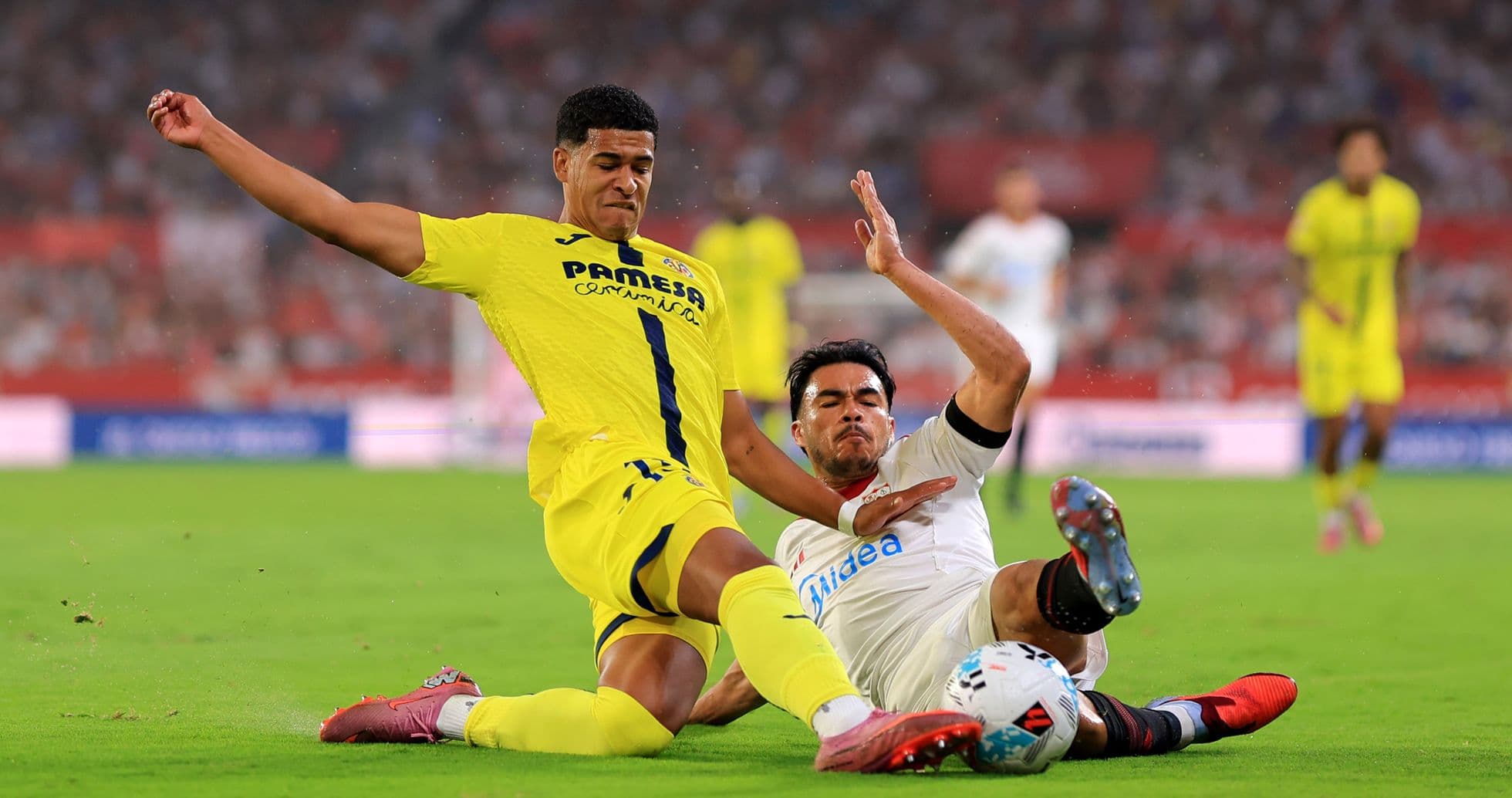
Villarreal vs Sevilla: Tactical Analysis of a 2-3 Defeat
Villarreal’s 2-3 home defeat to Sevilla at Estadio de la Ceramica unfolded as a tactical swing from early dominance in a 4-4-2 to structural vulnerability against a compact 5-3-2 that grew into the game. Despite controlling 63% possession and completing 554 passes to Sevilla’s 325, Marcelino’s side were repeatedly punished in transition and on set patterns into the box, while Luis Garcia Plaza’s Sevilla maximized their 13 shots and superior penalty-box presence to overturn a 2-0 deficit.
I. Executive Summary
Villarreal began on the front foot, using their 4-4-2 to stretch Sevilla’s back five horizontally and create central overloads around D. Parejo and P. Gueye. Two early goals from Gerard Moreno and Georges Mikautadze appeared to validate the plan. Yet Sevilla’s 5-3-2 gradually adjusted, with the back line stepping higher and the midfield three tightening distances. The visitors’ resilience, aided by more direct progression and better use of wing-backs, produced three unanswered goals and a decisive 2-3 scoreline in this La Liga Regular Season - 36 fixture.
II. Scoring Sequence & Disciplinary Log
The scoring opened on 13', when Gerard Moreno (Villarreal) finished a move assisted by Georges Mikautadze. Villarreal’s front two combined again on 20': Mikautadze (Villarreal) scored, assisted by Alberto Moleiro, capping a dominant first phase where Villarreal exploited gaps between Sevilla’s wide center-backs and wing-backs.
Sevilla’s response began on 36'. Oso (Sevilla), stepping out from the back five, struck with a Normal Goal assisted by Lucien Agoume, signaling Sevilla’s improved ability to break Villarreal’s first pressing line. On 45', the comeback was complete before the interval: Kike Salas (Sevilla) scored, assisted by Roberto Vargas, bringing the half-time score to 2-2.
The decisive moment came on 72'. After Sevilla had introduced A. Sanchez for Neal Maupay at 72' via substitution, it was already in motion that same minute that Alejo Adams (Sevilla) scored, assisted by Djibril Sow, completing the turnaround to 2-3. No VAR interventions or disallowed goals were recorded; all three Sevilla goals stood without review.
Disciplinary actions were limited but telling. The card chronology is as follows:
- 81' Ayoze Pérez (Villarreal) — Foul
- 90+2' Renato Veiga (Villarreal) — Foul
- 90+3' José Ángel Carmona (Sevilla) — Time wasting
Totals: Villarreal 2 yellow cards, Sevilla 1 yellow card, overall 3 cards. There were no red cards. The late Villarreal bookings reflected frustration and increasingly desperate attempts to recover the ball, while Carmona’s caution underlined Sevilla’s game-management phase in added time.
III. Tactical Breakdown & Personnel
Villarreal’s 4-4-2 structure was clear: A. Tenas in goal behind a back four of A. Freeman, P. Navarro, Renato Veiga, and Alfonso Pedraza; a midfield line of Nicolas Pepe, D. Parejo, Pape Gueye, and Alberto Moleiro; with Gerard Moreno and Georges Mikautadze as the front pair. In possession, Villarreal built with Tenas plus the two center-backs, with full-backs pushing to pin Sevilla’s wing-backs. Parejo and Gueye operated as a double pivot, with Moleiro tucking inside from the left to create a three-versus-two against Sevilla’s central midfield.
This structure delivered early: Villarreal’s 63% possession and 554 passes, with 499 accurate (90%), show a team comfortable circulating the ball and progressing through short combinations. Six total shots, however, is modest for such control, even if four were on target. The xG of 0.81 underlines that many of Villarreal’s attacks ended in sub-optimal shooting positions or were blocked (one blocked shot recorded), suggesting sterile dominance once Sevilla adjusted their block.
Sevilla’s 5-3-2, with Odisseas Vlachodimos in goal; a back five of J. A. Carmona, Cesar Azpilicueta, Kike Salas, Gabriel Suazo, and Oso; a midfield of Roberto Vargas, Lucien Agoume, and Djibril Sow; and a front pair of Alejo Adams and Neal Maupay, was initially pinned deep. But as the match progressed, Sevilla’s wing-backs began stepping higher in possession, and the outside center-backs (notably Oso) carried the ball forward to break Villarreal’s first line. Their 37% possession, 325 passes with 276 accurate (85%), and 13 total shots (5 on goal, 5 blocked) highlight a direct, vertical approach that prioritized getting the ball into advanced zones quickly.
The turning point tactically came after the hour. Villarreal’s substitutions at 60' and 70' reshaped their midfield and attack:
- 60' T. Partey (IN) came on for Pape Gueye (OUT)
- 60' Tajon Buchanan (IN) came on for Nicolas Pepe (OUT)
- 70' S. Comesana (IN) came on for D. Parejo (OUT)
- 70' Ayoze Pérez (IN) came on for Georges Mikautadze (OUT)
These changes aimed to refresh central control (Partey, Comesana) and add directness wide (Buchanan) plus penalty-box craft (Ayoze). Yet removing both original central midfield anchors (Gueye, Parejo) and the link-forward Mikautadze reduced Villarreal’s continuity between lines. The team became more stretched: possession remained high, but Sevilla found larger spaces to counter into, particularly around the half-spaces vacated when Villarreal’s full-backs advanced.
Sevilla’s substitutions were more conservative and game-state driven:
- 68' J. Sanchez (IN) came on for Roberto Vargas (OUT)
- 72' A. Sanchez (IN) came on for Neal Maupay (OUT)
- 86' N. Gudelj (IN) came on for Djibril Sow (OUT)
- 86' Castrin (IN) came on for Alejo Adams (OUT)
Each change either refreshed legs in midfield and defense or introduced profiles better suited to defending a lead. After Adams’ 72' goal, Sevilla’s block dropped a few meters and narrowed, forcing Villarreal to circulate around rather than through them. Villarreal’s six corners reflected territorial dominance but not structural superiority in the box; Sevilla’s five blocked shots for Villarreal and the visitors’ own four corners show that they defended their area robustly and remained a threat on restarts.
In goal, A. Tenas made 2 saves for Villarreal, with goals prevented at -0.22, indicating that he conceded slightly more than xG would predict; the three goals against from an xG of 0.88 for Sevilla suggest finishing quality and some defensive breakdowns ahead of him. Vlachodimos, with just 1 save and goals prevented at -0.22, was beaten twice from Villarreal’s 0.81 xG, but spent long stretches largely protected by his back five and compact midfield.
IV. The Statistical Verdict
The raw numbers sharpen the tactical picture. Villarreal’s 63% possession, 554 passes (499 accurate, 90%), and 6 shots (4 on target) point to a team that controlled tempo but lacked penetration once Sevilla settled. Their xG of 0.81 aligns with this: they scored twice from relatively low-quality chances, then struggled to generate further clear openings despite territorial dominance.
Sevilla, by contrast, produced 13 shots, with 7 inside the box and 5 on target, from only 37% possession and 325 passes (276 accurate, 85%). Their xG of 0.88 closely matches Villarreal’s, yet they converted three times, reflecting both clinical finishing and perhaps slight underperformance from Tenas relative to the model. Defensively, Villarreal committed 11 Fouls to Sevilla’s 9, with 2 yellow cards to Sevilla’s 1, mirroring their increasing defensive strain as they chased the game. Sevilla’s 4 corners to Villarreal’s 6 show that the hosts had more sustained pressure, but the visitors’ superior Defensive Index in terms of shot suppression quality and box protection ultimately decided the contest. Villarreal’s overall form with the ball was strong, but Sevilla’s structural resilience and efficiency in key moments delivered the 2-3 away win.