Fenerbahçe Dominates Sturm Graz in Champions League Qualifier
Fenerbahçe’s 2–0 win over Sturm Graz at Chobani Stadium was a clinic in territorial domination and structural control. Ismail Kartal’s 4‑2‑3‑1 pinned Sturm deep for long stretches, turning 72% possession and a 17–5 shot advantage into a largely stress‑free Champions League 3rd Qualifying Round first leg. The Turkish side established a 2–0 lead by half-time and then managed the rhythm with mature game control, while Fabio Ingolitsch’s 4‑4‑2 block struggled to turn rare transitions into real pressure.
The tactical story began with the double pivot. N. Kante and M. Guendouzi gave Fenerbahçe a secure platform in front of the back four, constantly recycling possession and closing counter lanes. With 578 total passes at 90% accuracy (520 accurate), the home side used short, patient circulation to drag Sturm’s 4‑4‑2 out of shape. Kante often dropped between or beside the centre-backs, allowing full-backs N. Semedo and J. Oosterwolde to advance high and wide, which in turn pinned Sturm’s wingers into a back six at times.
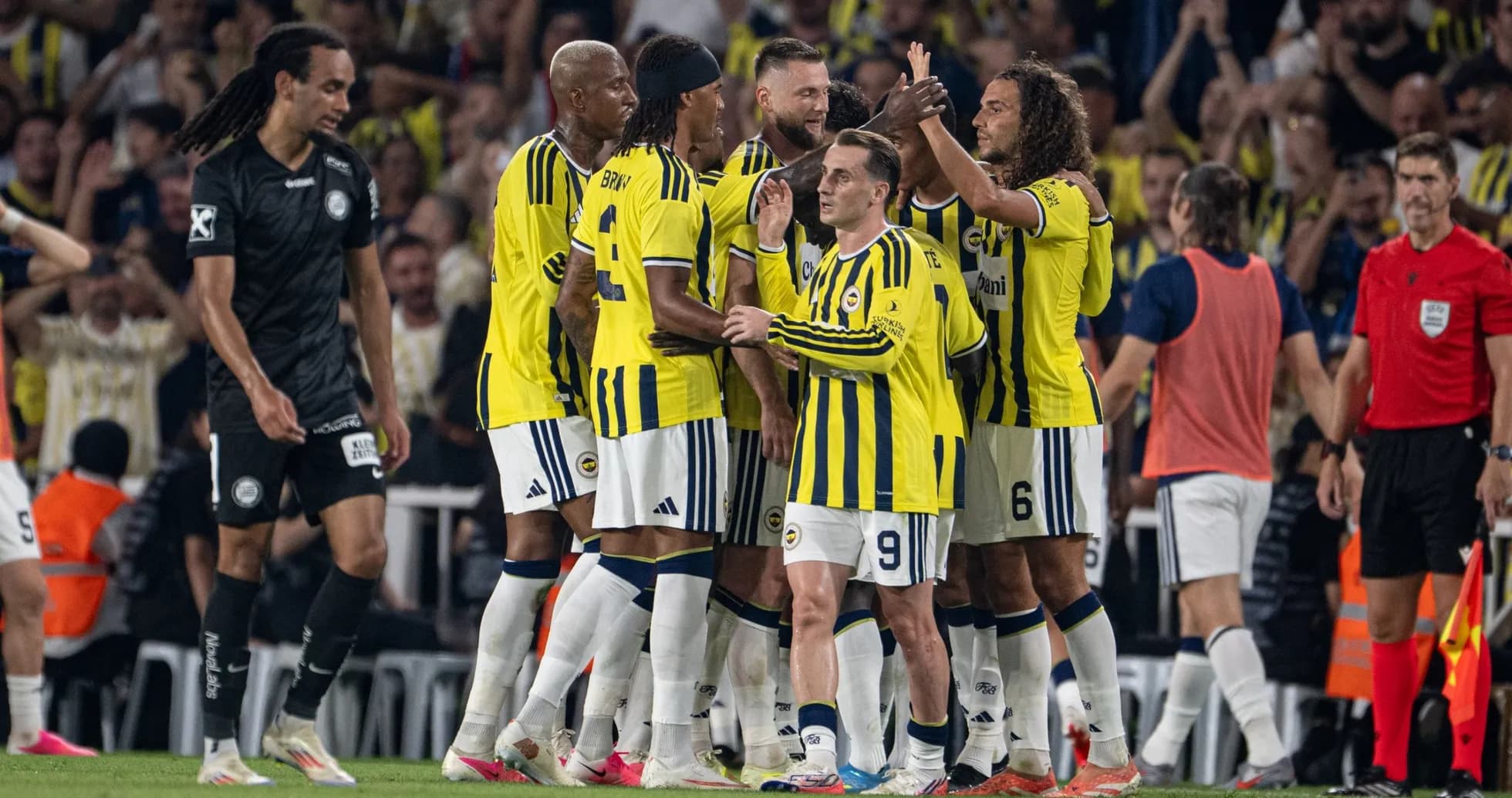
Ahead of them, the 3‑band of M. Greenwood, M. Asensio and K. Akturkoglu operated very fluidly. Greenwood and Akturkoglu frequently tucked inside, creating interior overloads, while Asensio drifted between lines to receive on the half-turn. The first goal on 9 minutes encapsulated this structure: Fenerbahçe had already established camp in Sturm’s half, and the combination between Talisca and Akturkoglu came from that sustained pressure and positional superiority in the right half-space. Talisca’s role as a lone forward was less about traditional hold-up and more about linking play and attacking the box late; he benefited from the constant service, as shown by Fenerbahçe’s 12 shots inside the box.
Out of possession, Fenerbahçe’s pressing was selective rather than frenetic. With only 10 fouls committed, they defended more by positioning than by duels. The first line – Talisca supported by the three attacking midfielders – curved their press to force Sturm Graz into predictable wide build-up, where the full-backs and double pivot could compress. When possession was lost, the immediate counter-press from Kante and Guendouzi stopped most transitions at source, limiting Sturm to just 5 total shots and 3 inside the box.
Sturm Graz’s 4‑4‑2 was clearly designed to be compact and reactive. The front two, S. Wlodarczyk and S. Jatta, were often isolated, asked to chase long diagonals or contest second balls rather than build through the thirds. With only 222 passes at 74% accuracy (164 accurate), Sturm rarely strung together long sequences. Instead, they focused on verticality when they did win the ball, but Fenerbahçe’s rest defence – with both centre-backs and at least one pivot always behind the ball – reduced those counters to hopeful forays.
Defensively, Sturm’s double pivot of J. Gorenc Stankovic and L. Weinhandl (before the changes) tried to screen central spaces, but the numbers tell the story of the pressure they faced: 10 shots on goal conceded, 17 total shots, and 5 blocked shots. The back four spent most of the night defending their own box, and the 19 fouls and 3 yellow cards underline how often they were forced into last-ditch interventions or tactical infringements to halt Fenerbahçe’s rotations between the lines.
Between the posts, both goalkeepers had very different evenings in terms of workload. M. Gunok (Fenerbahçe) was largely protected by the structure in front of him, needing to make just 1 save across the 90 minutes. His main tasks were sweeping behind a high line and recycling possession. In contrast, D. Khudyakov (Sturm Graz) was central to keeping the scoreline respectable. He registered 8 saves, facing 10 shots on target amid almost constant pressure, and had to deal with a high volume of deliveries and cutbacks as Fenerbahçe repeatedly attacked the penalty area.
The substitution patterns reinforced the tactical narratives rather than changing them. Kartal’s first change, A. Brown (IN) for J. Oosterwolde (OUT) at 30', was an early adjustment at left-back, but it did not alter the 4‑2‑3‑1 structure. Later, Fred (IN) for M. Greenwood (OUT) and I. Kahveci (IN) for M. Asensio (OUT) at 69' freshened the midfield and attacking lines while preserving the same positional map: two pivots, three advanced midfielders, one striker. The late introductions of M. Muldur (IN) for N. Semedo (OUT) and O. Aydin (IN) for K. Akturkoglu (OUT) at 85' further underlined a priority on game management and defensive solidity down the flanks as the match closed out.
Ingolitsch’s response was more about energy and directness than structural change. A. Kayombo (IN) replaced S. Wlodarczyk (OUT) at 46', adding pace in behind but keeping the 4‑4‑2 front two. The triple change on 64' – G. Mamageishvili (IN) for S. Seidl (OUT), R. Fosso (IN) for L. Weinhandl (OUT), and N. Weiper (IN) for S. Jatta (OUT) – injected fresh legs into midfield and attack but did not fundamentally improve Sturm’s ability to progress the ball through Fenerbahçe’s compact mid-block. B. Beganovic (IN) for J. Hodl (OUT) at 87' was a late attacking roll of the dice, again without altering the underlying territorial pattern.
Statistically, the match was one-way traffic. Fenerbahçe’s 72% possession, 578 passes and 90% pass accuracy speak to their control of tempo and territory. Their 17 total shots, 10 on goal and 12 from inside the box show that this possession was turned into sustained penalty-area presence rather than sterile circulation. Sturm Graz, by contrast, managed only 5 shots (1 on goal), with just 2 corner kicks and no offsides – a sign that they rarely threatened the space behind Fenerbahçe’s line with well-timed runs.
Discipline also mirrored the tactical flow. Sturm’s 19 fouls and 3 yellow cards reflected the strain of defending for long stretches and chasing without the ball. Fenerbahçe, with just 10 fouls and no bookings, controlled not only the ball but also the rhythm of contact and duels, stepping in when needed but rarely being dragged into chaotic phases.
In sum, this was a structurally dominant performance from Fenerbahçe: a stable double pivot, high and aggressive full-backs, and an interchanging line of three behind Talisca suffocated Sturm Graz. The Austrian side defended bravely and relied heavily on D. Khudyakov to keep the tie alive, but tactically they were outplayed across every major phase – build-up, pressing, and transition – in a first leg that could have ended with a wider margin.