Fenerbahçe's Tactical Mastery Secures 1-0 Win Over Sturm Graz
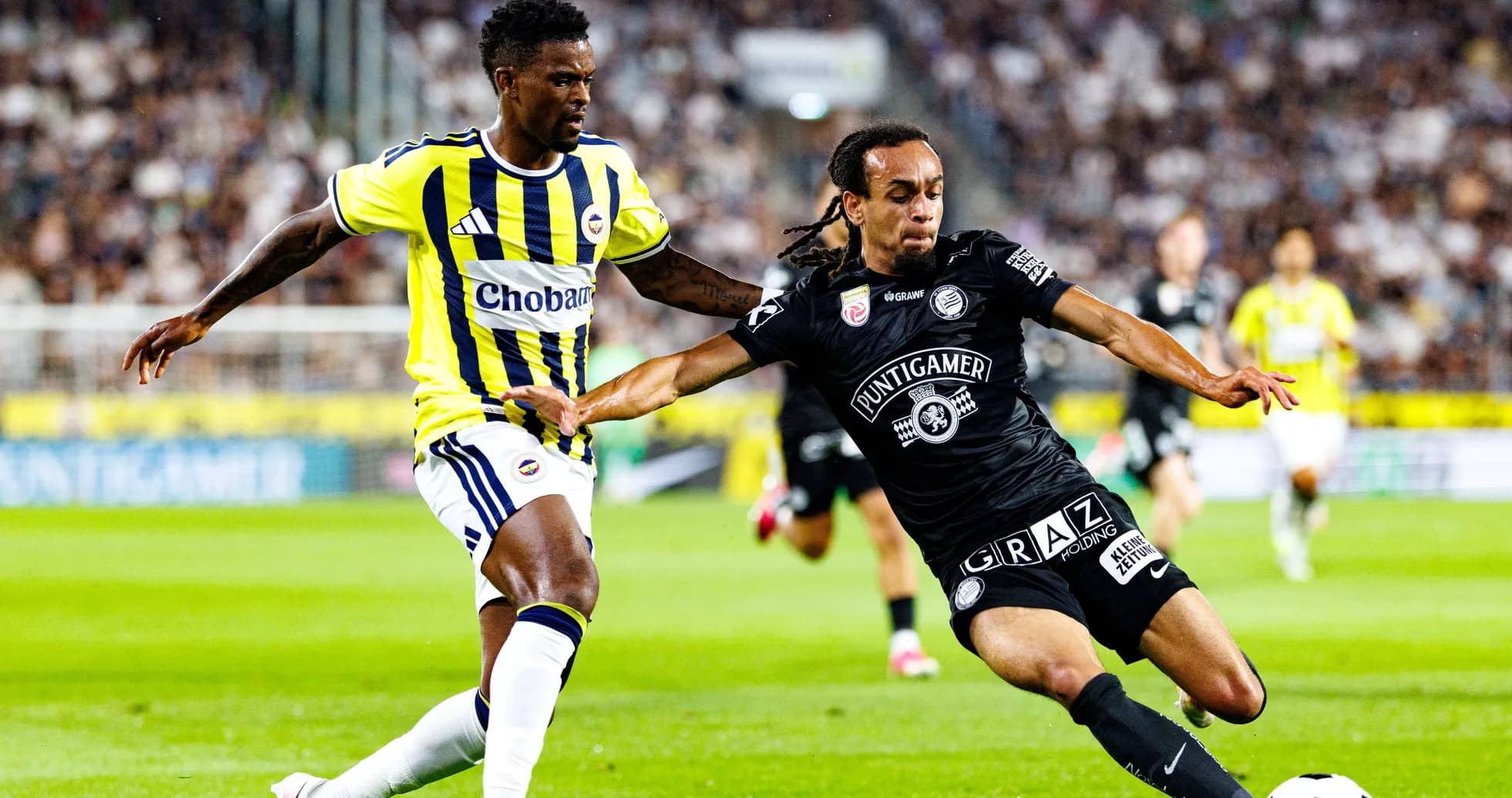
Sturm Graz’s 4-4-2 at Merkur Arena was built around territorial pressure and volume shooting, but it was Fenerbahçe’s more controlled 4-2-3-1 that imposed the decisive structure on the game and converted that into a 1-0 away win in the UEFA Champions League 3rd Qualifying Round.
Sturm’s shape was classic: a flat back four, two central midfielders, wide midfielders who had to double as outlets, and a mobile front two of A. Kayombo and S. Jatta. The statistical profile – 19 total shots to Fenerbahçe’s 11, with 9 of those Sturm efforts blocked – underlines how often they were forced to shoot under heavy pressure. The Austrian side did manage 6 shots inside the box, but the final execution was rushed; only 2 of those 19 attempts were on target. That imbalance between volume and quality is the defining tactical story of their attack.
Fenerbahçe’s Structure
Fenerbahçe’s 4-2-3-1, by contrast, was built on the double pivot of M. Guendouzi and N. Kante screening a back four of N. Semedo, M. Skriniar, N. Ake and Archie Brown. In front, the line of three – M. Greenwood on the right, M. Asensio centrally and K. Akturkoglu left – operated narrowly, closing central lanes and forcing Sturm to the outside. With Talisca as a single striker, Fenerbahçe could press situationally but mostly preferred a compact mid-block. The 50%-50% split in ball possession and near-identical passing numbers (Sturm Graz 383 passes, 311 accurate, 81%; Fenerbahçe 397 passes, 318 accurate, 80%) show this was not a low-block rearguard; instead, Fenerbahçe accepted shared control but dictated where on the pitch that control occurred.
The penalty goal on 66 minutes, converted by Talisca, was the culmination of this structure. By that point, Fenerbahçe had already carved out the more dangerous looks: 6 shots on goal from 11 attempts, with 8 of those 11 coming inside the box. That ratio contrasts sharply with Sturm’s 13 efforts from distance. The Turkish side consistently managed to access the half-spaces around Sturm’s central midfield pair, drawing defenders out and forcing last-ditch interventions that eventually produced the decisive spot-kick situation.
Defensive Performances
In terms of defensive performance, the two back lines tell different stories. Sturm Graz’s central pairing of J. Mitchell and P. Petrovic (before his late substitution) were extremely active in front of their own box, contributing to those 9 blocked shots. The lone yellow card for Jeyland Mitchell at 84’ for “Foul” encapsulates how often he had to step out aggressively to manage Fenerbahçe’s attacking midfielders between the lines. Full-backs A. Malic and E. Soglo were pinned back for long stretches by Greenwood and Akturkoglu, limiting Sturm’s ability to use them as overlapping outlets.
Fenerbahçe’s defensive line, anchored by M. Skriniar and N. Ake, played a more controlled game. They allowed shots, but mostly from low-probability zones. The 2 blocked shots recorded for Fenerbahçe, against 19 total Sturm attempts, indicate that the visitors’ first line of defense was their positional play: forcing hurried strikes from range rather than needing constant emergency blocks. The three yellow cards – Nélson Semedo at 40’ for “Foul”, Archie Brown at 45’ for “Foul”, and Kerem Aktürkoğlu at 89’ for “Foul” – show that when Fenerbahçe were exposed, it was often in wide areas where full-backs and wingers had to break Sturm’s transitions with tactical fouls.
Tactical Evolution
The substitution pattern underlines the tactical evolution. Fabio Ingolitsch went for a triple attacking change at 61’: B. Beganovic (IN) came on for S. Jatta (OUT), J. Heil (IN) came on for A. Malic (OUT), and N. Weiper (IN) came on for A. Kayombo (OUT). This effectively shifted Sturm toward a more aggressive, risk-taking posture: fresh legs up front and in wide areas to chase the game. Later, R. Fosso (IN) for J. Gorenc Stankovic (OUT) at 70’ and P. Koller (IN) for P. Petrovic (OUT) at 79’ further tilted the side toward attacking impetus, sacrificing some of the original defensive stability in central zones.
Ismail Kartal’s response was calculated. As soon as Nélson Semedo, on a yellow, began to look vulnerable, M. Muldur (IN) came on for him (OUT) at 62’, stabilizing the right side. Fred (IN) for M. Asensio (OUT) and O. Aydin (IN) for M. Greenwood (OUT) at 63’ injected fresh ball retention and work rate in the attacking midfield line, helping Fenerbahçe manage the game after taking the lead. Later, I. Yuksek (IN) for N. Kante (OUT) at 73’ and V. Muriqi (IN) for Talisca (OUT) at 77’ signaled a shift toward protecting the advantage: more legs in midfield and a physically robust outlet up front to hold clearances and relieve pressure.
Goalkeeping Contrast
In goal, D. Khudyakov (Sturm Graz) and M. Gunok (Fenerbahçe) had contrasting workloads in terms of quality rather than quantity. Khudyakov made 5 saves, reflecting Fenerbahçe’s 6 shots on goal and their ability to reach dangerous central areas. Gunok, by contrast, faced only 2 shots on goal despite Sturm’s 19 total attempts, underlining how effectively Fenerbahçe’s structure kept Sturm at arm’s length and limited clean looks on target.
Statistical Verdict
The overall statistical verdict supports the tactical reading. Sturm Graz matched Fenerbahçe in possession and passing accuracy, generated more total shots, and earned one more corner (7 to 6). Yet Fenerbahçe produced three times as many shots on goal (6 to 2) and significantly more efforts from inside the box (8 to 6 out of far fewer total attempts). The foul count (Sturm 12, Fenerbahçe 13) and card distribution (Sturm 1 yellow, Fenerbahçe 3 yellows, total 4) show a combative but controlled contest, with the visitors willing to absorb disciplinary risk to disrupt transitions.
In strategic terms, Sturm’s 4-4-2 provided volume but not precision; their attacks ended too often in blocked or long-range shots. Fenerbahçe’s 4-2-3-1, anchored by a disciplined double pivot and compact lines, translated comparable possession into superior chance quality and a single, carefully managed goal – enough to leave Graz with a narrow but tactically deserved 1-0 advantage.