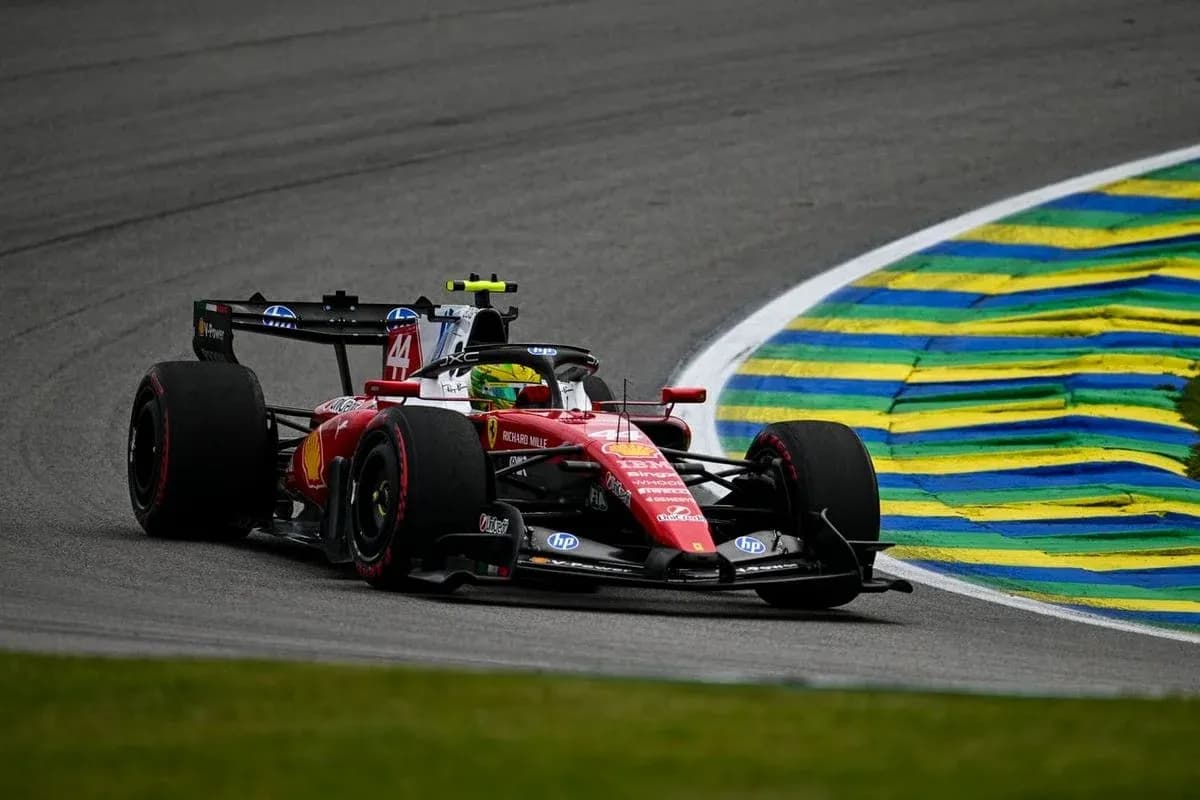
Ferrari Vulnerable as Hamilton Faces Grid Penalty in Brazil
Lewis Hamilton faces a grid penalty for this weekend’s Brazilian Grand Prix, on a Friday that exposed Ferrari at its most vulnerable so far in 2026.
At a circuit where Hamilton has produced some of the defining drives of his career, the numbers told a stark story. He was the quicker of the two Ferraris in FP2, yet still 0.450s adrift of world champion Kimi Antonelli’s benchmark. Charles Leclerc sat almost three tenths further back, the deficit pinned largely on a deployment issue along the start/finish straight that left the red cars gasping where Interlagos demands the most.
Ferrari slow where it hurts most
The stopwatch was brutal over the long runs as well. On comparable fuel, Ferrari looked only the fourth-best package.
Antonelli set the tone with a 1m15.331s on softs, backed up by Lando Norris at 1m15.497s on hards and Max Verstappen at 1m15.501s on mediums. Oscar Piastri’s 1m15.520s on softs and Isack Hadjar’s 1m15.569s underlined just how crowded the sharp end has become.
Then came George Russell at 1m15.657s, also on softs.
Only after that did the Ferraris appear: Leclerc at 1m15.872s on softs, Hamilton at 1m16.027s on mediums. On identical tyres, Leclerc was more than half a second per lap slower than Antonelli. Over a race distance, that kind of gap is ruinous.
The GPS traces showed why. From Juncao all the way up the hill to the timing line, Hamilton’s Ferrari bled time. In that single, full-throttle blast, he lost three tenths to Antonelli. On the run to Turn 4, Descida de Lago, Hamilton was clocked 11km/h slower than the Mercedes, surrendering over a tenth and a half before he even hit the brakes.
This is exactly where Ferrari expected to be weak. What they did not expect was to be short in the corners too.
Leclerc did not sugarcoat it after FP2, describing the “car in the corners” as giving “probably one of the worst Friday feelings of the season”. The team’s usual strength – a planted, confident front end in the twisty stuff – simply never appeared.
Team principal Fred Vasseur was equally blunt, conceding there was “a lot of work to do on the balance” overnight. Balance, straightline speed, tyre life: on Friday, Ferrari were chasing all of it.
Penalties pile on the pressure
As if that wasn’t enough, the team now has to dig itself out from under the weight of penalties.
Hamilton is set for a grid drop after Ferrari opted to change engine components following FP2. The move is strategic rather than reactive, but the timing hurts. He already knows what it takes to win here with a penalty – his 2021 charge from 20th to fifth in the sprint and then from 10th on the grid to victory on Sunday remains one of Interlagos’s great modern stories.
He may need something close to that level again.
George Russell already carries a confirmed five-place grid penalty, adding another twist to Mercedes’ tactical picture. Leclerc, meanwhile, is expected to take his own hit at the next round in Las Vegas once Ferrari completes its engine pool reshuffle.
The stakes in Brazil are clear. Ferrari must avoid being outscored by Mercedes by three points or more to keep the constructors’ championship alive beyond this weekend. On the evidence of Friday, that target looks fragile.
Antonelli’s Mercedes sat on top of the times in both headline pace and long-run rhythm. The reigning champion looked comfortable, quick on every compound, and ruthless where Ferrari faltered – on the straights, in traffic, and over the long haul.
Interlagos has seen Hamilton rip up scripts before. This time, the script is harsher: a misfiring Ferrari, a looming grid penalty, and a Mercedes led by Antonelli threatening to slam the door on the title race.
If Ferrari cannot find answers overnight, Brazil may not just be another race. It could be the weekend the championship slips out of their hands for good.