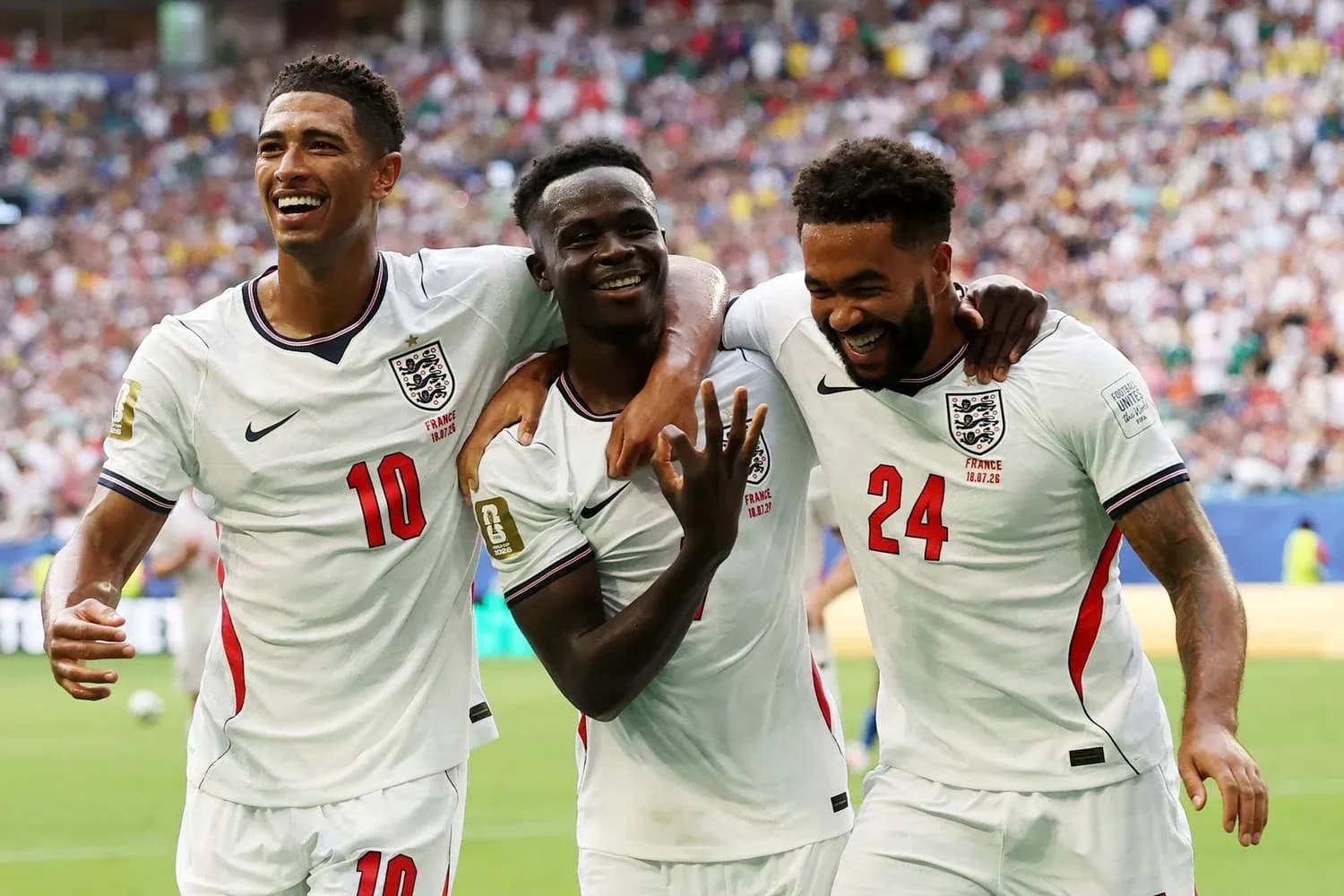
France vs England: Tactical Battle in 6-4 Thriller
France’s 6-4 defeat to England at Hard Rock Stadium, Miami Garden unfolded as a wild, structurally complex game in which the tactical story flipped completely after half-time. England’s 4-0 interval lead reflected a ruthless exploitation of France’s midfield spacing and defensive rest defence; the second half, however, saw France reconfigure their attacking structure and almost drag the match back through sheer volume of pressure and superior chance quality.
England’s early control was built on a compact, possession-oriented 4‑3‑3/4‑2‑3‑1 hybrid, reflected in their 54% of the ball and 515 total passes, 467 accurate (91%). Declan Rice operated as the deep pivot, constantly offering a short option and setting the rhythm. With 19 total shots, 16 of them inside the box, England repeatedly managed to arrive in central finishing zones, not just shoot from range. That box occupation – supported by Marcus Rashford and Bukayo Saka attacking the half-spaces around Ivan Toney – explains how they turned an xG of 2.58 into six goals: they maximised the value of their entries rather than simply the quantity.
France’s first-half structure was looser. Without a defined formation in the data, the personnel suggests a single-pivot or double-pivot base (Warren Zaïre-Emery and Adrien Rabiot) behind a line of technically gifted attacking midfielders (Michael Olise, Rayan Cherki, Désiré Doué) supporting Kylian Mbappé. In practice, the spacing left too much exposure in defensive transition. England were able to progress quickly through Rice and Morgan Rogers, finding Saka and Rashford isolated against full-backs, and the early 3-0 then 4-0 scoreline before the break was a direct outcome of France’s inability to protect the central lanes and win second balls.
Out of possession, France’s press lacked cohesion. They conceded 19 shots, including 11 on goal, with England’s shot profile skewed heavily towards the penalty area. The French back line, with Ibrahima Konaté and Maxence Lacroix, was repeatedly dragged wide by England’s wingers, leaving gaps for late runners like Rice or defenders attacking set pieces. England’s 4 corner kicks to France’s 3 further underline their territorial advantage in the first phase of the match.
Second Half Tactical Reset
The second half was a tactical reset by Didier Deschamps. A flurry of substitutions right at 46' – Bradley Barcola, Ousmane Dembélé, Dayot Upamecano and Lucas Digne entering for Désiré Doué, Rayan Cherki, Ibrahima Konaté and Theo Hernández – radically altered France’s attacking dynamics. Barcola and Dembélé provided true width and depth, stretching England’s back four horizontally and vertically. That stretching effect opened central channels for Mbappé to attack more directly, as reflected in France’s eventual 19 total shots and 12 from inside the box.
France’s possession share (46%) understates their second-half dominance. They matched England’s 19 total shots and finished with 9 shots on goal, forcing Dean Henderson (England) into 4 saves. The French passing game remained extremely clean – 445 total passes, 405 accurate (91%) – which indicates that their issues were not in ball retention but in early structure and defensive balance. Once the attacking cast changed, those same technical qualities translated into penetration and goals, backed by an xG of 2.87 that aligned closely with the four goals scored.
In terms of defensive work, England’s back line had to absorb sustained pressure after the break. They finished with 6 blocked shots, compared to France’s 4, a sign of last-ditch defending inside their own box. The late introduction of Jude Bellingham and Elliot Anderson for Eberechi Eze and Ivan Toney at 79', and Reece James for Jarell Quansah at 83', was a clear attempt by Thomas Tuchel to regain midfield control and freshen the right flank against France’s renewed width. Even so, England continued to concede high-quality looks, which is consistent with France’s xG edge.
Discipline and duels subtly framed the tactical battle. France committed 14 fouls to England’s 8, a gap that points to more reactive defending from Deschamps’ side, especially as they chased the game and tried to halt English counters. England, by contrast, used their superior structure to defend more by positioning than by repeated fouling. Both sides were disciplined in terms of bookings, with no recorded yellow or red cards, which allowed the match to flow and further favoured the more transition-ready side in the first half.
From a goalkeeper perspective, both shot-stoppers were heavily involved. Mike Maignan (France) faced 11 shots on goal and made 4 saves, with goals prevented measured at 0.05 – a number that suggests England’s finishing was in line with expectation and that he was largely exposed by the quality of chances conceded rather than individual errors. Dean Henderson (England) made 5 saves from France’s 9 shots on target and also posted 0.05 goals prevented, indicating that while he was busier after the interval, the model viewed most of those efforts as broadly “saveable” and that France’s comeback owed as much to volume and persistence as to outrageous shot difficulty.
Statistically, the match reads as a high-variance, attack-dominated contest where both sides created roughly similar expected goals but England’s early-phase tactical superiority and clinical edge built a decisive cushion. France’s second-half resurgence – driven by structural changes, improved wing play, and sustained box occupation – turned the game into a shootout, but the defensive damage from the opening 45 minutes was too great to repair. In a 3rd Place Final context, the numbers underline two narratives: England’s evolving capacity to control games with the ball while remaining devastating in transition, and France’s extraordinary attacking ceiling offset by vulnerabilities in rest defence and initial game plan balance.