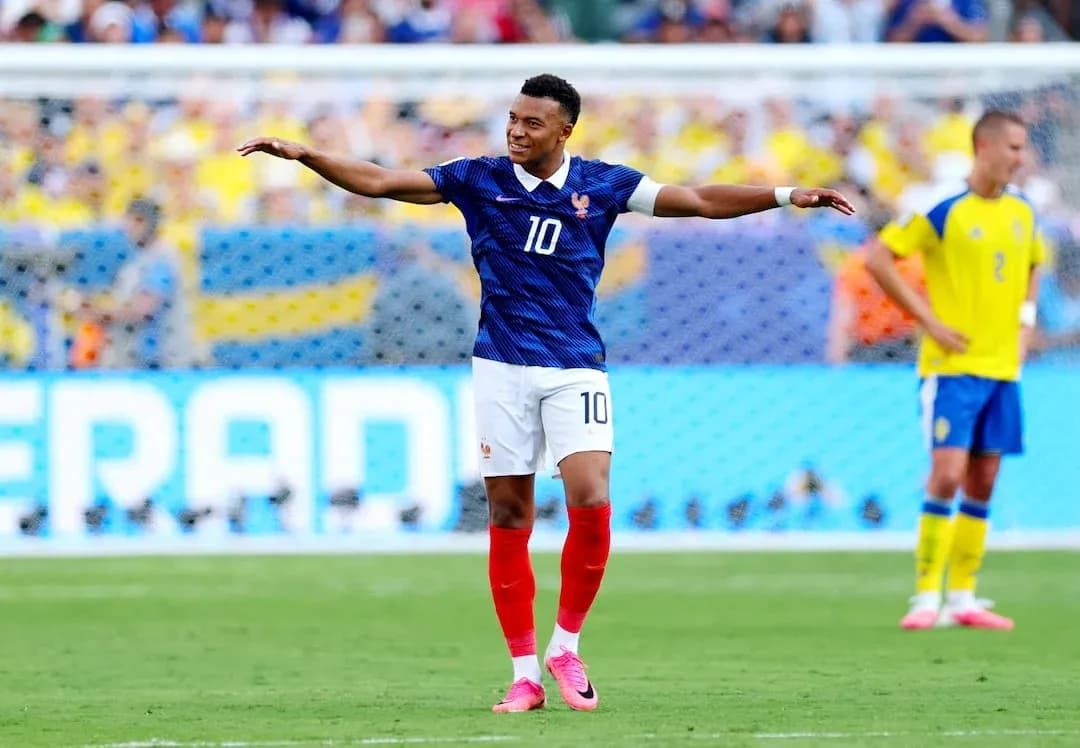
France Dominates Sweden in Round of 32
MetLife Stadium in New York staged a Round of 32 that felt more like a statement of intent from a tournament favourite. France arrived as the dominant force of Group I, top of their section with 9 points from 3 matches, a goal difference of 8 built on 10 goals for and 2 against. Sweden, second in their group with 4 points and a neutral goal difference of 0 (7 scored, 7 conceded), came in as dangerous underdogs. By full time, the scoreboard read France 3–0 Sweden, and the performance underlined the structural gap between a side at full throttle and one still searching for balance.
Didier Deschamps kept faith with his core blueprint: a 4-2-3-1 that has been his only system all tournament, used in all 4 of France’s matches. It is a shape that reflects their seasonal DNA. Heading into this game, France had played 4 fixtures overall, winning all 4. At home they had played 3, winning all 3; on their travels they had played 1 and won it as well. The numbers are ruthless: overall, they averaged 3.3 goals scored per match and 0.5 conceded. At home, that attacking output sat at 3.0 goals per game, with just 0.3 allowed. Even away, they were scoring 4.0 and conceding 1.0. They had yet to lose, yet to draw, and had failed to score in none of their matches.
Sweden’s path had been more volatile. Across 4 fixtures overall they had only 1 win, 1 draw and 2 defeats. At home they had played 1, winning it, scoring 5 and conceding 1; on their travels they had played 3, drawing 1 and losing 2, with only 2 goals scored and 9 conceded. That translated to an overall attacking average of 1.8 goals per match, but it was brutally split: 5.0 at home, only 0.7 on their travels. Defensively, they were shipping 2.5 goals per game overall, including 3.0 away. There were no clean sheets at home, away, or overall, and they had already failed to score once on their travels.
Lineups and Tactical Approaches
Against that backdrop, the lineups told a clear tactical story. France’s back four of Jules Kounde, Dayot Upamecano, William Saliba and Lucas Digne screened Mike Maignan in goal. Ahead, Aurelien Tchouameni and Adrien Rabiot formed the double pivot, freeing a devastating band of three: Ousmane Dembele from the right, Michael Olise centrally, Bradley Barcola from the left, all funnelling service into Kylian Mbappe as the lone forward.
On the opposite side, Graham Potter opted for a 4-4-2 rather than the back-three variants Sweden had used in earlier matches (they had lined up 3-1-4-2 twice and 3-4-3 once before this). Jesper Widell Zetterstrom started in goal behind a line of Dejan Svensson, Gustaf Lagerbielke, Victor Lindelof and Gabriel Gudmundsson. The midfield four of Anthony Elanga, Lucas Bergvall, Yasin Ayari and Elliot Stroud supported a front pair of Viktor Gyokeres and Alexander Isak.
The tactical voids were less about absentees and more about structural mismatches. France’s squad list was complete; Deschamps could rotate from a deep bench that included N’Golo Kante, Marcus Thuram, Rayan Cherki and Warren Zaire-Emery. Sweden’s depth was thinner, and their defensive record on their travels suggested fragility once the first line was broken. Disciplinary trends added another layer: France had been remarkably clean, with only a single yellow card all tournament, and that one caution arriving between minutes 61 and 75. Sweden, by contrast, had a pronounced late-game disciplinary spike. Heading into this game, 40.00% of their yellow cards came between minutes 76 and 90, with the remaining cautions evenly spread across the 31–45, 46–60 and 61–75 windows at 20.00% each.
Key Matchups
Those patterns fed directly into the key matchups. The “Hunter vs Shield” duel centred on Mbappe against a Sweden defence that, on their travels, was conceding 3.0 goals per match. Mbappe arrived as the competition’s most devastating forward: 6 goals and 2 assists in 4 appearances, with 19 shots (13 on target), a passing accuracy of 88 and 10 key passes. He had not missed from the spot because France had not taken a single penalty; their penalty record stood at 0 taken, 0 scored, 0 missed. Flanking him, Dembele had 4 goals and 2 assists from midfield, while Olise led the tournament for assists with 5, plus 9 key passes and 8 successful dribbles from 11 attempts.
Sweden’s answer lay in their own front two. Isak, with 1 goal and 3 assists and 7 shots (6 on target), had been their creative fulcrum, while Gyokeres contributed 1 goal and 2 assists, 9 shots (6 on target) and a physically imposing duel profile, winning 16 of 40 contests. But their influence was always going to be limited if Sweden’s midfield could not secure a foothold. That responsibility fell partly on Bergvall, who arrived with 1 yellow card already and a combative record of 7 fouls committed and 3 tackles, plus 2 interceptions. His tendency to engage aggressively in duels risked feeding France set pieces in dangerous zones, especially as fatigue set in.
In the engine room, Tchouameni and Rabiot were tasked with choking off supply to Isak between the lines. With Olise dropping into pockets to overload central zones, France often formed a 4-3-3 in possession, dragging Sweden’s double pivot of Bergvall and Ayari into uncomfortable decisions: step out and leave space behind, or sit off and allow Olise to dictate. Sweden’s wide midfielders, Elanga and Stroud, had to track France’s full-backs as well as Dembele and Barcola, a workload that risked pinning them deep and isolating Gyokeres and Isak from service.
Statistical Overview
The statistical prognosis always leaned heavily towards France. Overall, they had kept 2 clean sheets from 4 matches, both at home, and had yet to taste defeat. Sweden, meanwhile, had no clean sheets in any context and had already suffered a 5-1 defeat on their travels, their heaviest away loss and a stark warning of what happens when their defensive block is stretched.
Overlay the disciplinary curve and the picture sharpens. Sweden’s late-game yellow-card spike between minutes 76 and 90 suggested tired legs and desperate challenges just as France’s attacking depth—Thuram, Cherki, and others—could be introduced. France’s own caution profile, with only a single yellow and none in the final quarter of matches, pointed to control rather than chaos.
At MetLife Stadium, that logic played out on the grass. France’s 3-0 win was not an outlier but a continuation of a trend: a side averaging 3.3 goals per match overall and conceding just 0.5 imposing its structure on an opponent whose away record was built on vulnerability. The Round of 32 thus became less a contest of equals and more a showcase of a fully formed contender dismantling a still-evolving challenger—clinical, controlled, and ominously sustainable as the tournament moves into its deeper rounds.