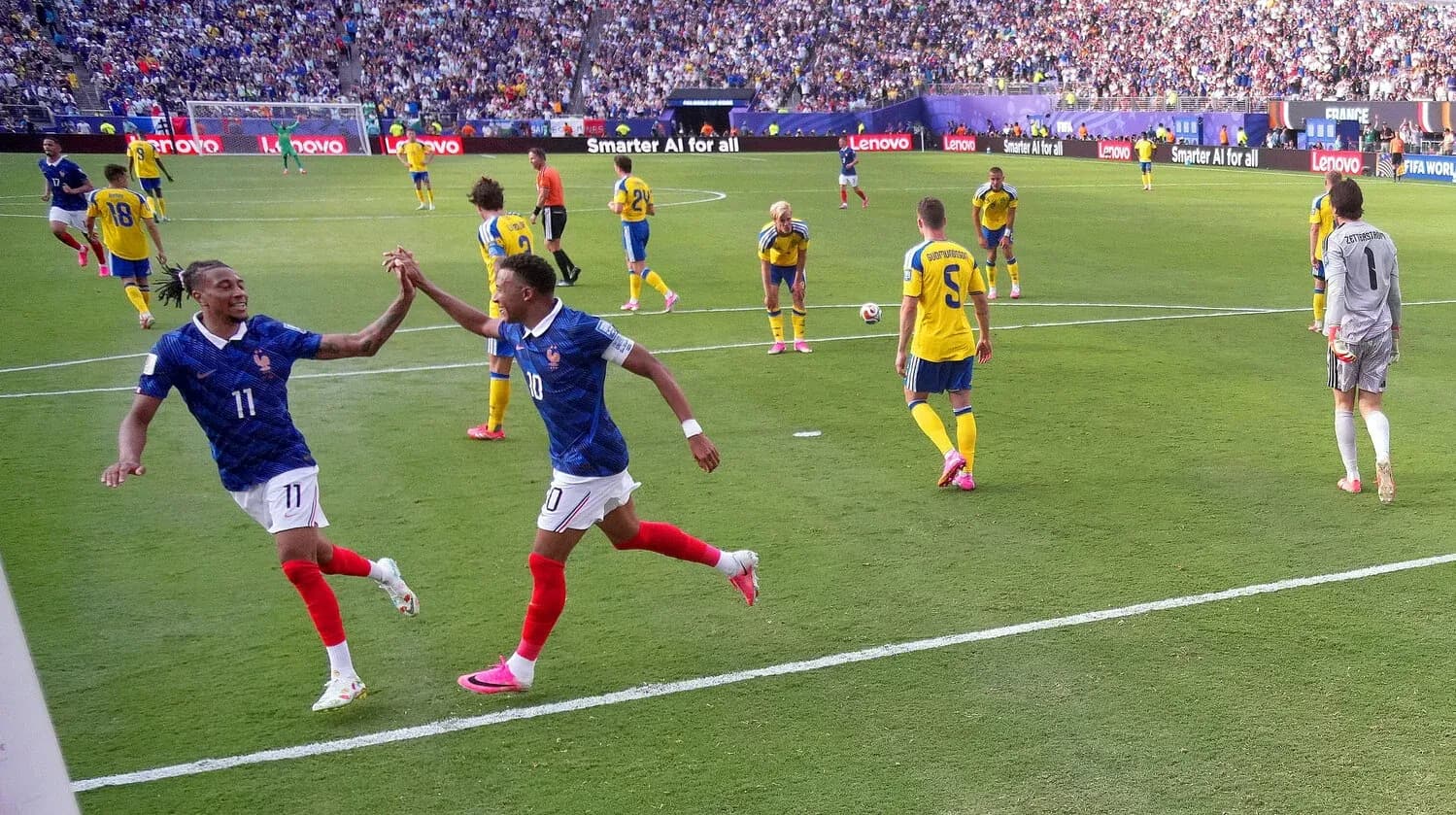
France’s Tactical Masterclass in 3-0 Victory Over Sweden
France’s 3-0 win over Sweden at MetLife Stadium was a methodical, system-driven performance built on structural superiority in and out of possession. Didier Deschamps’ 4-2-3-1 controlled the tempo, the zones, and the scoreboard, while Graham Potter’s 4-4-2 struggled to cope with France’s overloads between the lines and wide isolations.
France’s shape was classic Deschamps but with a distinctly aggressive attacking tilt. Aurélien Tchouaméni and Adrien Rabiot formed a double pivot that gave the side a stable rest-defense platform, allowing both full-backs, particularly Lucas Digne, to advance and pin Sweden’s wide midfielders. Ahead of them, Ousmane Dembélé, Michael Olise and Bradley Barcola operated as a fluid band of three behind Kylian Mbappé, constantly rotating positions to unbalance Sweden’s back four.
The statistical picture underlines France’s control: 61% possession, 551 passes with 485 accurate (88%), and 25 total shots, 12 of them on target.
This wasn’t sterile dominance; the expected goals figure of 3.17 closely mirrors the 3-0 scoreline, confirming that France’s volume of chances was matched by their quality. The 16 shots inside the box show how consistently they managed to penetrate Sweden’s defensive block rather than settling for speculative efforts.
A key tactical feature was the way France attacked Sweden’s 4-4-2 in the half-spaces. With Viktor Gyökeres and Alexander Isak unable to screen both pivots, Tchouaméni often received freely and could play vertical passes into Olise between Sweden’s midfield and defensive lines. From there, the wide players inverted: Dembélé and Barcola frequently came inside, dragging full-backs with them and opening corridors for overlapping runs from Jules Koundé and Digne. The first-half pattern was clear: recycle through the double pivot, find Olise between the lines, then accelerate play into the channels.
Goals
The opening goal on 45 minutes, finished by Mbappé from a Dembélé assist, was the culmination of this pressure. Sweden’s midfield, forced to shift laterally all half, eventually left gaps for France’s front line to exploit. Once ahead at the break (1-0), France did not retreat; instead, they used the lead to be even more deliberate in their positional play, continuing to pin Sweden back.
Bradley Barcola’s goal at 53 minutes, assisted by Olise, highlighted the threat of France’s left side. With Sweden’s right flank stretched by Digne’s high starting position, Barcola could attack the inside channel, combining with Olise’s central presence. This sequence epitomised France’s capacity to create 2v1s on the outside while maintaining a free man between the lines.
Mbappé’s second goal on 74 minutes, again with Olise involved as provider, underlined how Sweden never solved the problem of France’s central-vertical passing. By then, Potter had already turned to his bench, but the structural issues remained: the 4-4-2 front line could not consistently shut down France’s build-up, and the midfield four were repeatedly forced to choose between protecting the half-spaces and tracking overlapping full-backs.
Defensively, France were largely untroubled. Sweden managed only 8 total shots, 3 on target, and generated an xG of 0.65, indicating that most of their looks were either from poor angles or under heavy pressure. The double pivot shielded the central defenders Dayot Upamecano and William Saliba effectively, allowing them to defend aggressively on the front foot against Gyökeres and Isak. When Sweden tried to progress via wide areas through Anthony Elanga and Elliot Stroud, France’s wingers diligently tracked back, turning Sweden’s flanks into low-yield zones.
In goal, Mike Maignan (France) faced those 3 shots on target and made 3 saves. The goals prevented metric of 1.16 for France underscores that when Sweden did create, Maignan’s interventions were significant in preserving the clean sheet. On the other side, Jacob Widell Zetterström (Sweden) was under siege: France put 12 shots on goal, and he made 9 saves. Sweden’s own goals prevented figure of 1.16 reflects that, despite the 3-0 scoreline, their goalkeeper limited the damage against a barrage of high-quality chances.
Potter’s substitutions were aimed at injecting energy and creativity into a tiring side. Besfort Zeneli and Taha Abdi Ali entered for Elliot Stroud and Lucas Bergvall on 66 minutes, a clear attempt to add ball-carrying and pressing intensity in wide and central zones. Later, Benjamin Nygren replaced Yasin Ayari and Mattias Svanberg came on for Daniel Svensson at 82 minutes, subtly shifting Sweden towards a more attack-minded profile on the ball. Finally, Gustaf Nilsson replaced Alexander Isak on 89 minutes, adding aerial presence and a more direct reference point. However, these changes came against a France side already in full control, and without a structural tweak to the base 4-4-2, Sweden remained second-best in central areas.
Deschamps’ substitutions were more about load management and preserving the tactical framework than changing it. Malo Gusto (IN) came on for Jules Koundé (OUT) and Désiré Doué (IN) for Dembélé (OUT) on 75 minutes, with Theo Hernández (IN) replacing Digne (OUT) at 78 minutes. Each like-for-like change maintained the aggressive full-back play and vertical threat from the wings. At 85 minutes, Jean-Philippe Mateta (IN) replaced Olise (OUT) and Rayan Cherki (IN) came on for Mbappé (OUT), giving France fresh legs up front while locking in the result.
From a disciplinary and control standpoint, France committed 14 fouls to Sweden’s 10, a reflection of their proactive counter-press and willingness to stop transitions early rather than a lack of composure. The absence of recorded yellow or red cards suggests that these interventions were generally well-timed and within acceptable tactical-foul boundaries.
The statistical verdict reinforces the eye test: France married territorial dominance with chance creation efficiency. Their 9 corner kicks to Sweden’s 1 show sustained pressure, while the passing accuracy gap (88% vs 80%) speaks to a superior technical baseline and better structure in possession. Sweden’s 39% possession and limited shot volume underline how rarely they were able to impose their own attacking patterns.
In World Cup Round of 32 terms, this was a statement of control rather than chaos. France’s 4-2-3-1, with its double pivot security and fluid attacking quartet, systematically dismantled Sweden’s 4-4-2. The combination of high xG, strong defensive protection, and excellent goalkeeping from Maignan (France) suggests a side not only advancing, but doing so with a repeatable, tactically robust blueprint.