Gabriel: The 15-Year-Old Prodigy Manchester United Must Keep
Gabriel, the 15-year-old forward Manchester United believe could light up Old Trafford for a decade, is already at the centre of a storm that says as much about the modern game as it does about his talent.
Real Madrid want him. Barcelona want him. Paris Saint-Germain and Bayern Munich are circling too. United, though, are digging in. They have no intention of letting him go without a fight – and they’re now scrambling behind the scenes to convince him his future should be in red.
For Sir Jim Ratcliffe, the stakes are brutal. The INEOS chairman has already felt the sting of supporter anger after a string of unpopular calls in his short spell fronting football operations. Lose a once-in-a-generation academy talent on his watch and the protests will only grow louder.
A contract, a passport and a ticking clock
Gabriel is under contract until next summer, but the deal is flimsy protection. He isn’t a full-time scholar, nor part of United’s full-time model, which means that when he turns 16 on October 16, he could technically walk away – provided he holds a European passport.
United are now poring over that detail. His father, Joe O’Cearuill, is a former professional who represented Ireland twice, and his mother is of Greek Cypriot descent. Under post-Brexit rules, that heritage could allow Gabriel to move to a club in the European Union before he turns 18 as a dual national.
United already fended off Manchester City to keep him last year. This time, the battle feels far more precarious. The signs are worrying. Gabriel was due to join first-team training on Saturday. He didn’t show. He hasn’t been seen at Carrington all week.
Michael Carrick had planned to name him in the squad for Wednesday night’s Carabao Cup third-round tie against Brighton at Old Trafford. Had he stepped onto the pitch, Gabriel would have become the youngest player ever to feature for United’s senior side. That landmark has now been taken off the table.
The prodigy United can’t afford to lose
United’s academy has not produced a genuine global superstar since Marcus Rashford. Gabriel has carried that burden of hope since he walked into the club’s youth system as an 11-year-old.
He’s a two-footed forward, slippery and sharp, able to twist out of impossible spaces and punish defenders the moment he sees goal. Comparisons to Lionel Messi are both lazy and unhelpful, but stylistically he looks closer to Neymar – one of the Barcelona icon’s former team-mates. He even laces up in the same model of Nike boots, having penned a lucrative extension with the brand in March 2025.
The numbers back up the hype. At 14, he broke into United’s Under-18s, another age record chalked off, and promptly scored 20 goals in 21 league games. He walked away with the first-ever Premier League U18s Player of the Year award and became the youngest winner of United’s prestigious Jimmy Murphy Young Player of the Year prize.
By August he was with the U21s. On debut against Ipswich, he delivered two assists and a deft chip in a 5-0 rout. A week later, he scored again as United hammered Leicester City 4-1. This isn’t a kid making up the numbers. This is a teenager operating two steps ahead of his age group.
So the clamour is inevitable. United’s first team is crying out for spark in the final third, and fans have seen what happens when a club backs a special youngster early. They only have to look to north London.
The Dowman effect – and the danger of shortcuts
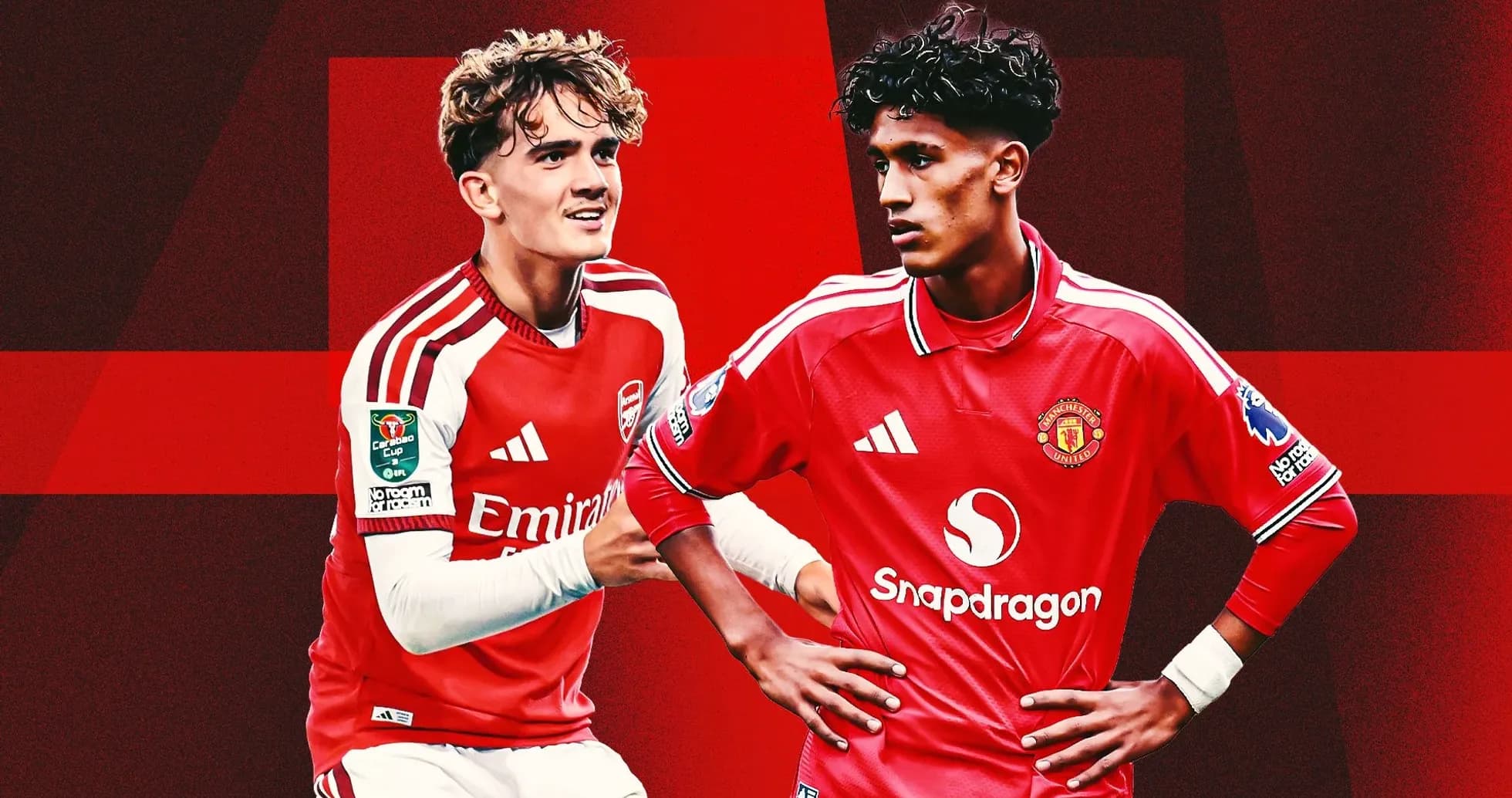
Arsenal have turned “if you’re good enough, you’re old enough” into a live experiment. Ethan Nwaneri became the youngest player in Premier League history at 15 years and 181 days when he appeared against Brentford in 2022. His career hasn’t exploded in a straight line – loans to Marseille and Borussia Dortmund have tested him – but he already has over 50 appearances for the Gunners at just 19.
Now Max Dowman has taken the baton. The midfielder became the Premier League’s second-youngest player when Mikel Arteta threw him on against Leeds in August 2025. In March, he broke James Vaughan’s record as the league’s youngest scorer with a brilliant solo goal against Everton at 16 years and 139 days.
He didn’t stop there. In May, Dowman became the youngest title-winner in Premier League history. This week, he joined Wayne Rooney in an exclusive club: only the second 16-year-old to score a brace for a Premier League side in a major competition, firing Arsenal to a 4-2 Carabao Cup win over Ipswich.
Fourteen senior games in, Dowman has forced Arteta’s hand with a mix of flair and physical presence that demands selection. Arteta has even mentioned him in the same breath as Messi – a dangerous comparison, but one that underlines the scale of Arsenal’s belief – while still insisting on careful management.
“We have to look after him. He’s 16 years old. You don’t see that in this league,” Arteta said after the Ipswich tie, stressing the Premier League’s physical and mental demands. Dowman plays, then he rests. He starts, then he disappears from the teamsheet for a spell. Arsenal can afford that kind of rhythm.
United cannot. And that is where Gabriel’s situation diverges sharply.
Too slight, too soon?
Physically, Gabriel is not Dowman. He’s slight, often the smallest player on the pitch. His bravery and determination help close the gap, but they don’t erase it. Throwing him into the Premier League pressure cooker too early could blow up in United’s face – especially if he dazzles immediately.
If he comes in and transforms United’s attack, the pressure to play him every week will be relentless. That’s a dangerous workload for a body still growing. Arteta can rotate Dowman because Arsenal’s squad is stacked and winning. United’s is not. Performances swing wildly. Confidence is fragile.
If Carrick then pulls Gabriel out of the firing line, he’ll be accused of being too cautious while the team stutters. If Gabriel struggles instead, the narrative will flip: overhyped, overrated, another academy myth.
So far, Carrick has resisted the noise. Former United academy product Danny Simpson, who broke through under Sir Alex Ferguson, believes that restraint is exactly what the situation demands.
Speaking to GOAL via Free Bets, Simpson pointed to Dowman’s environment as a crucial difference. At Arsenal, Dowman steps into a side “flying in confidence, full of top, top talent, winning games,” with a second XI “just as good” as the first. Simpson contrasted that with the current United, where youngsters can’t simply be eased in for 10 minutes at 2-0 or 3-0 up, as he once was.
“I know we all want to see Gabriel play and it’s exciting, but it’s just a very different situation to Max Dowman at Arsenal,” Simpson said. His message was simple: let Gabriel train, let him be around the group, and trust Carrick to pick the right moment.
The pull of Europe’s giants
Patience, though, is a hard sell to a teenager watching his peers become headline acts. Even if Gabriel accepts that his path cannot mirror Dowman’s, he only has to glance at Barcelona to feel the itch.
Lamine Yamal was even skinnier when he made his Barca debut at 15 years, nine months and 16 days in 2023. He was a target for heavy challenges, but his pace and football intelligence allowed him to survive and then thrive.
La Liga, with its emphasis on tactical structure and possession, offers a kinder landing than the Premier League’s frantic transitions and constant duels. In Spain, a technician like Yamal can breathe. In England, time on the ball is a luxury.
It’s easy to see why Gabriel might believe Barcelona or Real Madrid could fast-track him to superstardom. The reality is more complicated. Timing is everything.
When Yamal emerged, Barca were on their way to the La Liga title under Xavi, but their Champions League campaign had collapsed in the group stage. Raphinha, Ousmane Dembele and Ferran Torres were not yet the forces they are now. There was space in the hierarchy.
That space has shrunk. Today, Barca boast Yamal, a peak Raphinha, Anthony Gordon, Karim Adeyemi and Gabriel Jesus across the frontline. At Madrid, Jose Mourinho has Kylian Mbappe, Vinicius Junior, Jude Bellingham and Yan Diomande among his attacking options. At PSG and Bayern, the competition is no softer.
Wherever Gabriel goes, he will have to wait. The clearest route to regular senior football still runs through Old Trafford.
United’s line in the sand
And that is the crux. United cannot allow themselves to be bent out of shape by a 15-year-old who is still 18 months away from sitting his GCSEs, however gifted he is.
Carrick and the academy staff have handled Gabriel sensibly so far. If he recalibrates, they will continue to do so. If he doesn’t, there is little point in clinging on to a player whose head is elsewhere, especially with the season already wobbling.
A drawn-out saga would only distract from United’s attempts to recover from a poor start. Whether pushed by family, advisers or his own ambition, Gabriel is currently acting with a sense of entitlement that jars with the club’s history.
George Best, Sir Bobby Charlton, Ryan Giggs, David Beckham, Paul Scholes, Gary Neville – none of them were handed anything. They clawed their way to the top, meeting ruthless standards on and off the pitch.
Former manager Ruben Amorim, heavily criticised and ultimately sacked in January, still cut to the heart of the issue before he left. “There is a feeling of entitlement we have in our club,” he said. “Sometimes, difficult moments is not a bad thing for the kids. We don’t always need accolades in everything. We are not helping.
“Nowadays, they speak and go against the club because they feel entitled. Let’s stay. Let’s fight. Let’s overcome. That is the way we can solve things.”
Amorim failed in many areas, but on that point he was right. No player is bigger than Manchester United. If Gabriel cannot accept that now, at 15, the question is no longer whether United can keep him – but whether they should even try.