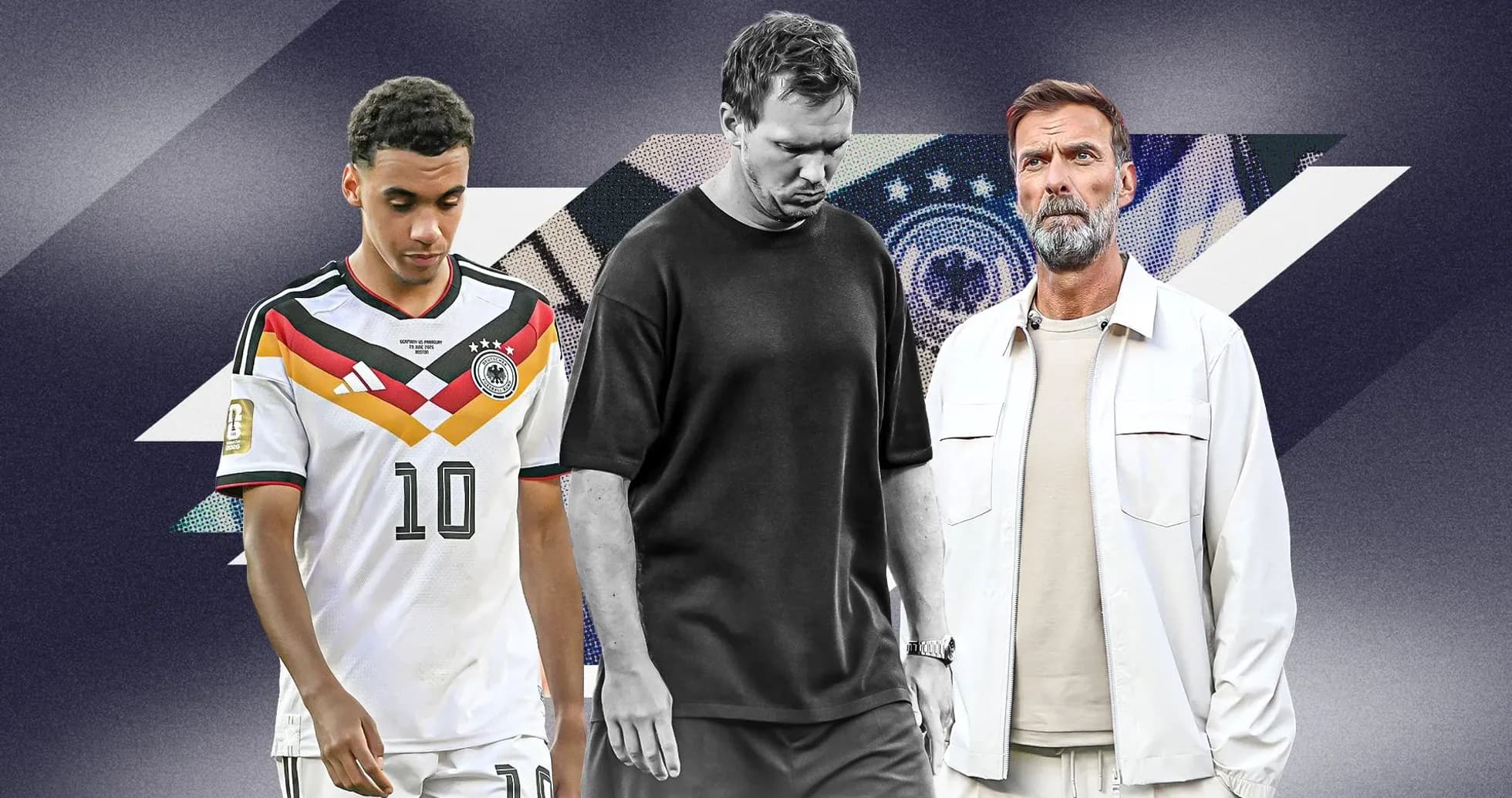
Germany's Coaching Crisis: The Fall of Nagelsmann
Germany have been here before. That is precisely the problem.
When Joachim Löw’s world champions crashed out of the 2018 World Cup in the group stage, beaten by Mexico and South Korea, the diagnosis was brutal and unanimous: an era had ended. Twelve years in charge, a team at the summit of the game only four years earlier, and now a shambles. It should have been the moment for a clean break.
Instead, the DFB hesitated. Löw stayed. He limped on to Euro 2020, a team still drifting, and Germany duly went out in the last 16 to England. Only then did he walk away.
Hansi Flick arrived as the great reset. The former Bayern coach carried Germany towards Qatar 2022 on a wave of optimism. It lasted one game. A calamitous defeat to Japan, after taking the lead, set the tone. Germany were out in the groups again. Many expected Flick to be sacked. Once more, the federation waited. Only in autumn 2023, after a string of poor results, did they finally pull the plug and turn to Julian Nagelsmann.
The pattern is now painfully familiar. The DFB fall in love with a project, cling to it too long, and only act when the damage is done.
Nagelsmann’s rise – and rapid fall
When Nagelsmann took over in September 2023, he looked like the perfect antidote. Young, sharp, tactically inventive, with a track record at RB Leipzig and Bayern Munich. His early squad choices felt bold and modern. The mood around Die Mannschaft changed almost overnight.
Euro 2024 on home soil seemed to confirm the shift. Germany played with purpose, the connection between team and supporters returned, and the country rediscovered a version of itself it had missed since 2014. A quarter-final exit to eventual champions Spain hurt, but it was framed as a starting point, not an end. Nagelsmann talked openly, almost immediately, about winning the 2026 World Cup.
At that moment, he was the most popular Germany coach since peak Löw. Now that feels like a different lifetime.
Over the last two years, Nagelsmann has burned through his credit at astonishing speed. The football has regressed. The atmosphere around the team has soured. What began as a refreshing, modern regime has ended in Foxborough with a World Cup campaign that was, in sporting terms, even more disappointing than 2022.
A coach who could not get out of his own way
The collapse has not been purely tactical. Nagelsmann repeatedly chose to use press conferences and interviews as a stage for detailed, often harsh, individual assessments of his players. Every few weeks, another critique. Some of his comments were simply clumsy. Others were flatly untrue. Promises about roles and status within the squad were made, then broken.
When journalists pushed back, he did not steady the ship. He bristled. He came across as patronising, short-tempered, and thin-skinned – a dangerous combination for a national coach under scrutiny at a World Cup.
His decisions off the pitch fed directly into problems on it. Toni Kroos’ return for the Euros worked. It gave Germany control and authority in midfield. That success seemed to embolden Nagelsmann. For this World Cup, he dragged Manuel Neuer, now 40, out of international retirement, despite previously insisting he would not.
The cost was obvious. Oliver Baumann, outstanding and reliable throughout qualifying, lost his place. The handling was clumsy, the logic questionable. Neuer did nothing in this tournament that Baumann could not have done. The move unsettled more than it solved.
Joshua Kimmich became another symbol of the confusion. Once again, Nagelsmann could not settle on his role. Right-back one minute, central midfielder the next – sometimes within the same match, as in the defeat to Paraguay. A captain should anchor a system. Instead, Kimmich was shuffled like a spare part.
A World Cup without a plan
Germany’s World Cup performance did not implode in one night. The warning signs were there from the start. Apart from a brief second-half surge against minnows Curaçao, this was a team that looked short of ideas in attack and brittle in defence.
Ivory Coast exposed them. Ecuador asked questions they could not answer. Paraguay punished them.
The defeat to Paraguay, which sealed their fate, was not a freak result. It was the logical endpoint of a campaign without a coherent plan. Germany lacked creativity in the final third, rarely carved open organised defences, and looked vulnerable whenever opponents attacked with any conviction.
In Qatar, there had at least been a defiant draw against Spain to cling to. This time there was nothing of that calibre. Just a string of underwhelming performances and an early flight home.
To their credit, the players did not turn on their coach. After the exit, they took collective responsibility and explicitly shielded Nagelsmann from blame. That reflects well on the dressing room. It does not change the reality.
It is the coach’s job to build a structure that allows talent to flourish. Germany have plenty of that. Nagelsmann did not find the right balance. His in-game management only deepened the doubts: questionable substitutions against Ecuador, and the decision to start super-sub Deniz Undav against Paraguay, blunting his impact and upsetting the rhythm of the attack.
Klopp in the studio, Klopp in the air
The most painful twist for Nagelsmann came not on the pitch, but on television. Every misstep, every structural flaw, was dissected in real time by the man many see as his ideal successor: Jürgen Klopp.
Sitting in the Magenta TV studio after Germany’s elimination, Klopp cut straight to the heart of the problem.
"You have to attack down the wings. There's no alternative," he said. "We all know how well these guys can play, but they didn't bring that to the pitch. In three months, we'll be raving about [Florian] Wirtz and [Jamal] Musiala again about how great they are, but not now.
"Paraguay had the opportunity to achieve something, Germany was under pressure to achieve something. Everyone in the stadium thought: Now they'll turn it around! But we didn't. We let them off the hook... We can talk about the DFB. We absolutely have to change a few things."
Those words landed with force because they came from a coach who has built entire careers on intensity, clarity and conviction. They also came from a man whose name has been echoing around German football ever since Nagelsmann’s stock began to fall.
For many supporters, the solution is obvious: Klopp must leave his role as Red Bull’s head of soccer, step into the national-team dugout and lead Germany into Euro 2028 and the 2030 World Cup. The idea alone sends a jolt of electricity through the game in Germany.
Klopp, for now, is keeping his distance.
"I haven't thought about that yet," he said in Boston when asked directly. "I understand that when the national coach position is discussed, my name is mentioned in some form. But it's not the moment to really talk about it. There's nothing to say about it. I have a job that I enjoy very much. As far as I know, it's not a part-time job."
The decision the DFB can no longer dodge
Inside the camp, Nagelsmann still has allies. The squad have backed him publicly. Sporting director Rudi Völler has done the same. Loyalty is admirable. Indecision is not.
The DFB have already lived through the consequences of waiting too long with Löw. They repeated the error with Flick. They cannot afford a third act of the same play.
Germany have a core of elite talent in Wirtz, Musiala and others who should define the next decade. They have a fanbase desperate to believe again. What they do not have is time to waste on a project that is clearly stalling.
First, they must make the hard call: cut ties with Nagelsmann, and do it quickly. Then they must pick up the phone.
Because if Klopp really is the hope of a brighter future, the DFB cannot assume he will wait forever.