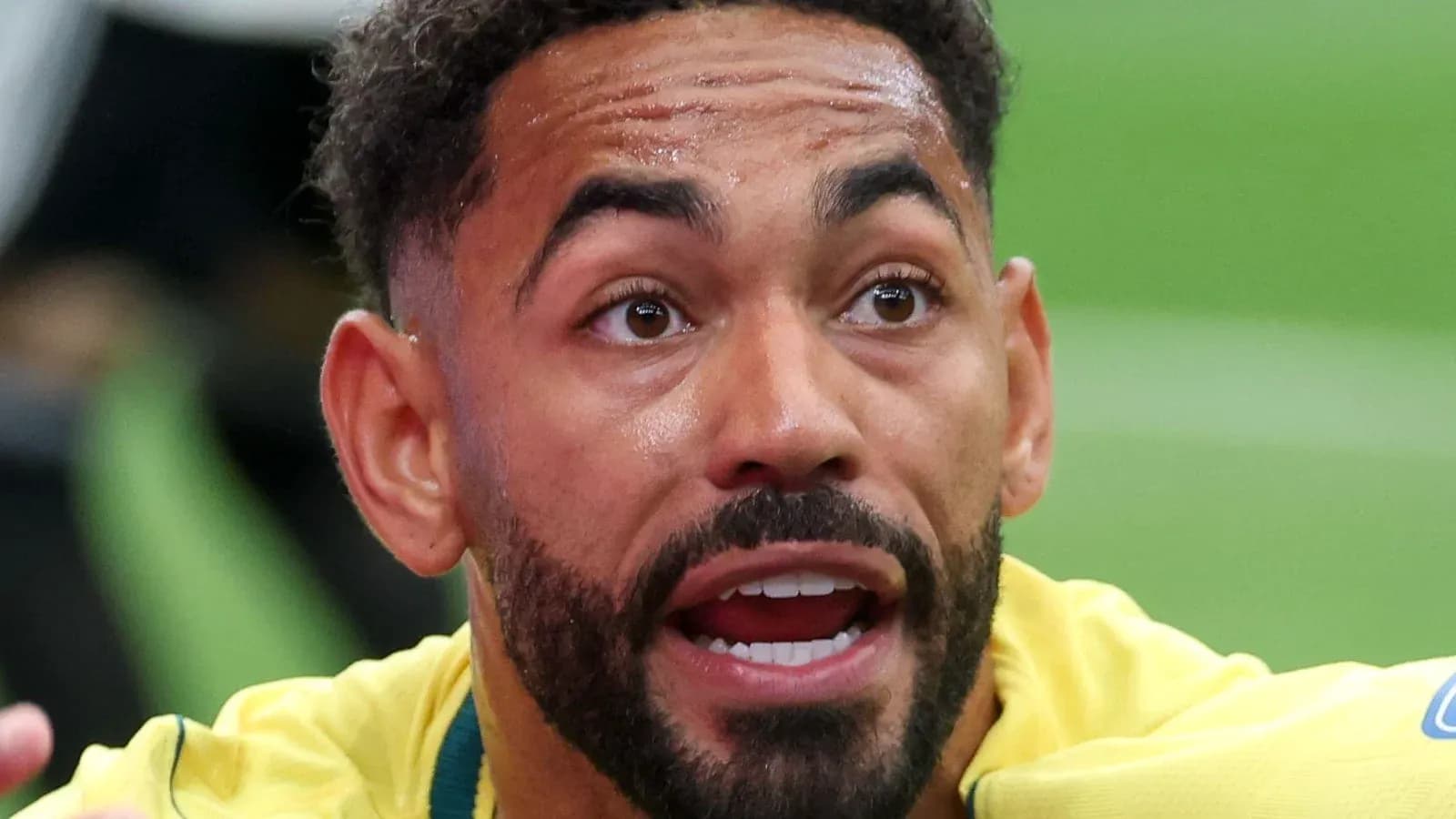
Matheus Cunha and the Narrative of Being 'Too Nice'
Somewhere between Brazil’s narrow escape against Japan and Germany’s exit on penalties to Paraguay, a curious narrative has taken hold: Matheus Cunha is apparently too nice to be truly great. Too soft for Brazil. Presumably doomed at Manchester United.
All because he stopped, for a brief moment, to console a distraught opponent.
The “Nice Guy” Problem That Isn’t
Jeremy Cross, writing for the Daily Mirror, framed Cunha’s gesture towards Japan’s Ao Tanaka as part of a wider “uncomfortable truth” about the Brazilian forward – that there is a “general feeling” he lacks the grit to match his guile, that he risks remaining a good footballer rather than a great one.
It’s a neat storyline. It’s also built on sand.
Cunha, remember, once served a ban after an incident involving an Ipswich security guard and a removed pair of glasses during what was, by any reasonable description, a fracas. You don’t have to celebrate that to recognise it doesn’t exactly scream “lacks grit”.
And the leap from a small act of sportsmanship in a World Cup match to a grand theory about his ceiling as a footballer is just that – a leap. Consoling Tanaka before joining in Brazil’s celebrations is not evidence of a fatal flaw; it’s evidence of a professional with a sense of empathy in a high‑pressure moment.
Then comes the supposed hammer blow: when Neymar eventually steps away from the Seleção, the “baton” will almost certainly go to Vinicius Jr, not Cunha. Of course it will. Vinicius is already one of the best players in the world, the face of Real Madrid, the focal point of Brazil’s attack. That succession plan has nothing to do with Cunha’s character and everything to do with Vinicius’ level.
Nice has never been the problem. Not being quite as good as Vinicius Jr is.
England, Japan and Selective Memory
The same Mirror piece on Brazil’s win over Japan also served up another odd angle: that Japan taking the lead “looked as though the Three Lions were going to be given a major boost,” with Brazil at risk of going out.
This, about a Japan side that beat England just three months ago.
England have beaten Brazil more recently than they have beaten Japan, which makes the notion of Japan as some kind of soft touch a hard sell. Calling their early lead a “major boost” for Gareth Southgate’s side ignores both recent history and Japan’s growing reputation as a serious tournament team.
The story of that game was Brazil surviving a scare and eventually advancing. Instead, it became another platform for a character study of Cunha that doesn’t really stand up to scrutiny.
Kane, Bellingham and the Language of Ego
The Daily Mail’s Craig Hope took the narrative baton in a different direction, with a line on Harry Kane that deserves a second read:
“Kane does not have an ego in a traditional sense – he is the humblest of superstars – but he does not score the goals he does without a stubborn streak of high self-regard.”
That single sentence tries to have it every way. Kane apparently has no ego “in a traditional sense”, yet possesses a “stubborn streak of high self-regard”. He is both the “humblest of superstars” and driven by the very self-belief that usually gets labelled as ego in others.
It also jars when set against the language previously aimed at Jude Bellingham from the same writer – “divisive soloist”, “poster boy for moodiness”, “brand ambassador for petulance”, “an angry young man”.
Kane’s self-regard becomes admirable resolve. Bellingham’s edge becomes a character flaw. The contrast is stark, not just in description but in tone. One is framed as endearing, the other as problematic. The behaviour is not wildly different. The framing is.
Bayern, Barça and a Geography Lesson
Hope also ventured into Kane’s club situation, explaining why Barcelona might appeal more than Bayern Munich.
“But Bayern is not Barca and the Bundesliga is not LaLiga. Der Klassiker is not El Clasico. Der Klassiker is Bayern versus Dortmund, by the way.”
The clarification of what Der Klassiker actually is lands somewhere between helpful and oddly patronising, as if readers might never have heard of the biggest game in German football.
More to the point, Bayern are painted as merely “stable”, “familiar” and “logical” in comparison to the “irresistible” allure of Camp Nou, despite the German champions having gone further in the Champions League last season and having won more trophies in recent years.
Barcelona may be more romantic in the imagination, more dramatic, more chaotic. But shrinking Bayern down to a sensible option, a safe harbour, ignores their own heavyweight status in the European game. This isn’t a choice between a juggernaut and a stepping stone.
Nagelsmann, a “Snap” and a Headline
Over in Germany’s camp, the MailOnline led on Julian Nagelsmann “snapping” at a “female reporter” after the World Cup exit to Paraguay, while Jurgen Klopp is said to be eyeing his job.
The first word that jars is “female”. Lili Engels is a reporter. The gender tag appears in the headline, then disappears in the body of the piece. It feels less like vital context and more like a device to justify putting a picture of a young woman at the top of the story.
Then there is the word “snaps”.
The footage shows a slightly tense exchange between a coach under huge pressure and a journalist doing her job. It is pointed, uncomfortable at moments, but far from an explosion. No shouting match. No meltdown. Just a manager bristling after a high-profile failure.
Dress that up as an “infuriated” Nagelsmann “snapping” and the tone shifts dramatically. The implication changes again when the word “female” is attached. The same interaction, with a male reporter and a less loaded verb, would read very differently.
This is where language matters. It shapes the viewer’s expectation before they even see the clip.
FIFA, Algeria–Austria and Suspicion in the Air
The Daily Mirror also reported that FIFA have taken a decision on whether to investigate Algeria’s clash with Austria following match-fixing claims. The mere suggestion of such an allegation is enough to stain a fixture, even when the governing body steps in to address it.
Once that word – fixing – is attached to a match, it lingers. The decision over whether to investigate is no longer just administrative; it becomes a test of trust in the competition itself.
The Real Story Beneath the Narratives
Across these threads runs a common theme: the power of framing. Cunha’s empathy becomes weakness. Kane’s ego becomes endearing. Bellingham’s edge becomes a problem. Nagelsmann’s tense interview becomes a “snap” at a “female reporter”. Bayern become the sensible option, Barça the irresistible dream.
The football itself – Brazil surviving Japan, Germany falling to Paraguay, Kane’s future, FIFA’s disciplinary decisions – risks getting buried under the weight of these narratives.
Cunha will succeed or fail at Manchester United based on his movement, his finishing, his decision-making in the final third, his ability to adapt to the Premier League and the demands of a club of that size. Not because he put an arm around Ao Tanaka.
Nice doesn’t kill careers. Misjudgements on the pitch do. And in a sport increasingly shaped by how stories are told, the sharper question is no longer whether players are too soft – but whether the language around them is.