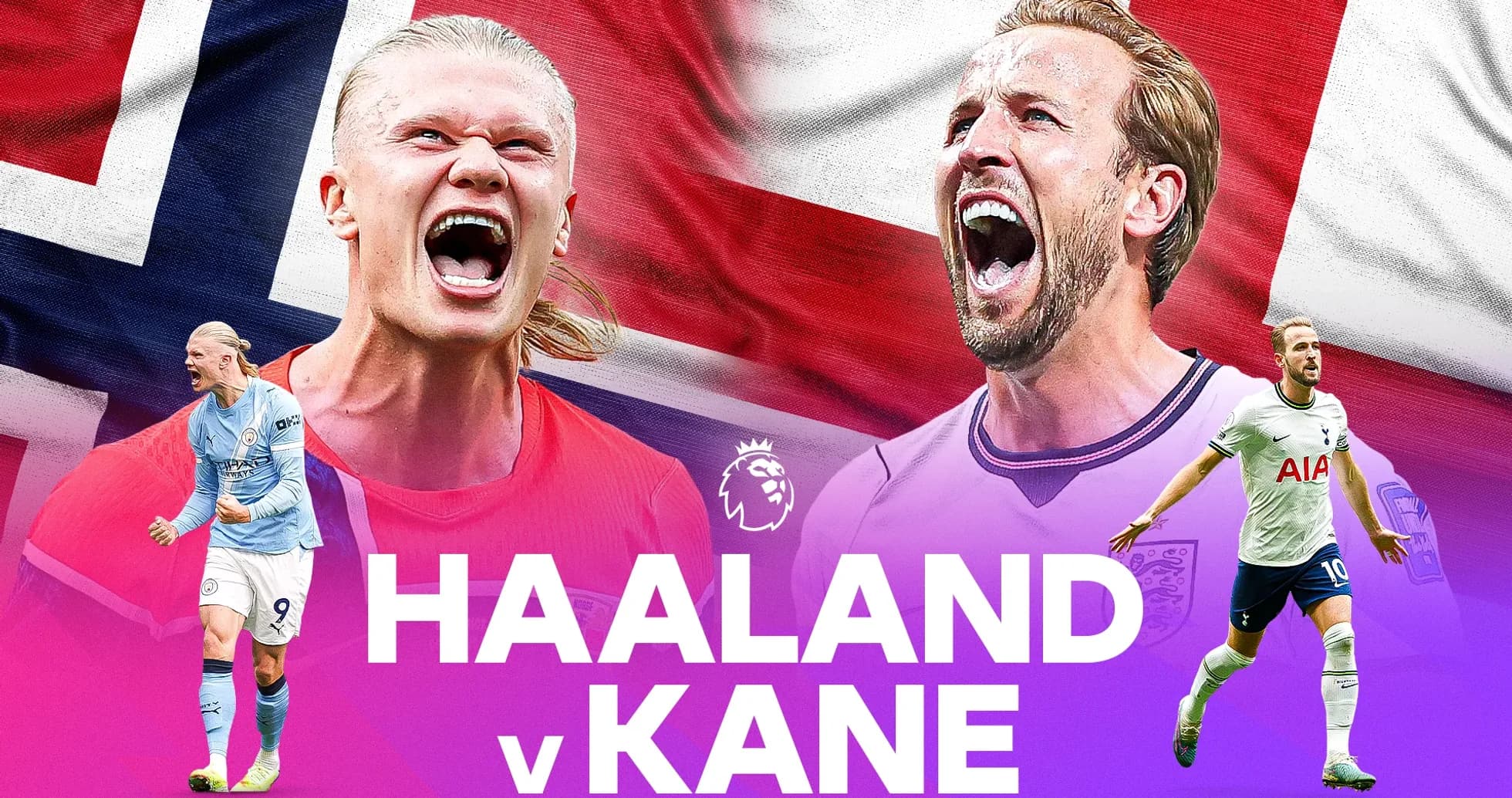
Harry Kane vs Erling Haaland: Premier League's Best Strikers
Harry Kane and Erling Haaland are cut from the same rare cloth: relentless, era-defining Premier League goalscorers who bend seasons around their finishing. Yet they could hardly be more different.
One is a conductor. The other is a weapon.
Haaland moves like a storm front. He lurks, then explodes, a ruthless, almost mechanical presence whose entire game narrows to one brutal outcome: the ball in the net. Kane, by contrast, is the heartbeat. A creator, a schemer, a scorer of every type of goal. He wore the number 10 shirt at Tottenham Hotspur because he has always seen himself as more than a finisher. He is the system as much as he is the spear.
For a long time their rivalry has been more theoretical than direct. They overlapped in the Premier League for just one season, 2022/23, before Kane left for Bayern Munich. Parallel careers. Parallel records. No real collision.
That changes on Saturday.
England v Norway. 2026 FIFA World Cup quarter-final. Kane against Haaland, not just in numbers and narratives, but for real, with a place in the semi-finals on the line.
The numbers: Haaland’s insane rate, Kane’s towering total
Strip it back and the raw figures are outrageous on both sides.
In the Premier League, Haaland has 112 goals, already 25th on the all-time list. His goals-per-90 rate? An astonishing 0.91 – the best in the competition’s history.
Kane stands on 213 Premier League goals, second only to Alan Shearer’s 260. His rate is 0.71 goals per 90, fourth all-time. Not as explosive as Haaland, but sustained over nine full seasons as a first-team regular at Spurs.
Context matters. Kane is only 47 goals behind Shearer. At his familiar 25-goal-a-season pace, he would need roughly a season and a half back in England to become the Premier League’s record scorer. Haaland, meanwhile, has only four Premier League campaigns behind him.
Project Haaland’s current rate forward and the picture shifts. At 0.91 goals per 90, he needs 113 more league games – roughly four seasons at his current average of 33 matches – to score the 102 goals required to move past Kane into second place on the all-time chart. From there, another 52 matches at that clip would take him beyond Shearer’s 260.
He has eight years left on his current contract. On paper, he needs half of that to catch Kane, then a little more than a season to chase down Shearer. Give him time and the numbers suggest he will end as the Premier League’s most prolific scorer.
For now, though, Kane’s body of work in England still towers over him.
Peak seasons and early explosions
Their entry points into the Premier League tell you plenty about their different paths.
Kane’s rise was gradual. He was 21 when he finally erupted under Mauricio Pochettino in 2014/15. From there he became a metronome of elite output, grinding out season after season of high-end returns.
Haaland arrived like a meteor. In his debut season in English football, 2022/23, he smashed the single-season Premier League record with 36 goals. That was the year City bent the league to his will.
Kane, in his final Spurs campaign that same season, scored 30 league goals. It was the second time he had hit that mark in the Premier League. Haaland has not matched his own 36-goal peak since, topping out at 27 in a single season after that.
Look at their top Premier League scoring seasons and the pattern is clear:
- Haaland: 36 goals (2022/23)
- Kane: 30 goals (2022/23)
- Kane: 30 goals (2017/18)
- Kane: 29 goals (2016/17)
- Haaland: 27 goals (2025/26)
Haaland owns the single greatest season of the lot. Kane, though, appears more often in that top-five bracket. Longevity and consistency against explosive peaks. Again, the caveat is time: Haaland simply hasn’t been in the division as long.
Records, awards, and the weight of trophies
On the record front, they are already tangled together.
Haaland is the fastest player ever to reach 100 Premier League goals. He holds the record for most goals in a single season and, crucially, that extraordinary per-90 strike rate. Kane counters with the most goals for a single Premier League club – 213 for Spurs – and the most goals in London derbies with 51.
Individual honours are finely balanced, especially when you remember Haaland is seven years younger.
Haaland owns five Golden Boots across competitions: three in the Premier League and two in the UEFA Champions League. He has three Player of the Year awards – one each in the Premier League, Bundesliga, and from UEFA. Kane’s personal trophy cabinet is even more crowded in pure count: nine Golden Boots (three Premier League, three Bundesliga, one Champions League, one World Cup, one Euros) and one Player of the Year award in the Bundesliga. He also has two European Golden Shoes to Haaland’s one.
Then come the team honours, where the Norwegian’s choice of club has paid off.
Haaland has three league titles – two Premier League crowns and one Austrian Bundesliga – plus a Champions League. He has five domestic cups: two FA Cups, one EFL Cup, one DFB-Pokal, and one Austrian Cup.
Kane, by contrast, has two Bundesliga titles and a single domestic cup, the DFB-Pokal.
Haaland’s camp would argue that trophies are the point of the game and that his record at the sharp end of title-winning machines speaks for itself. Kane’s supporters will counter that his numbers, compiled for long stretches outside the superclub bubble, are all the more remarkable for it.
Kane in Germany, Haaland with Norway: elite in different worlds
Kane’s move to Bayern Munich has added a new layer to the debate.
In Germany, his numbers have gone from elite to absurd: 98 goals in 94 Bundesliga matches. That is Messi-Ronaldo territory, a level of output that raises the tantalising question of what his Premier League tally might look like had he spent his prime years under Pep Guardiola at Manchester City.
Haaland, though, hits back on the international stage.
Playing for Norway, a side outside the traditional elite, he has scored 62 goals in 54 caps. His goals-per-90 rate stands at a staggering 1.26, and he has found the net in each of his last 14 internationals. That is a better ratio than Kane’s for England, even if Kane’s record is also historic: 85 goals in 119 caps, at 0.83 goals per 90, and already established as his country’s record scorer.
So the picture stays finely poised. Kane’s club career shows breadth and depth across two major leagues. Haaland’s international record shows what happens when a generational finisher refuses to be limited by the level around him.
The decisive edge – for now
By July 2026, the argument is still alive on both sides of the ledger.
Kane leads many metrics because he has simply been around longer. Haaland has more trophies because he has spent more of his career inside title-winning machines. Project the Norwegian’s numbers forward and he looks destined to rewrite the record books. Imagine Kane’s goals if he had spent his twenties in sky blue instead of lilywhite and you can make a different kind of case.
Yet one detail tilts the scales, at least in this moment.
In the 2025/26 season, no one in Europe scored more goals in all club competitions than Harry Kane. He finished with 61. Kylian Mbappé was next with 42. Haaland, by his own ridiculous standards, trailed on 38.
That gap is not marginal. It is emphatic.
Right now, heading into that World Cup quarter-final, Kane stands as the best striker in the world. Haaland, staring across the pitch in Norway’s colours, has 90 minutes – or maybe 120 – to argue otherwise.