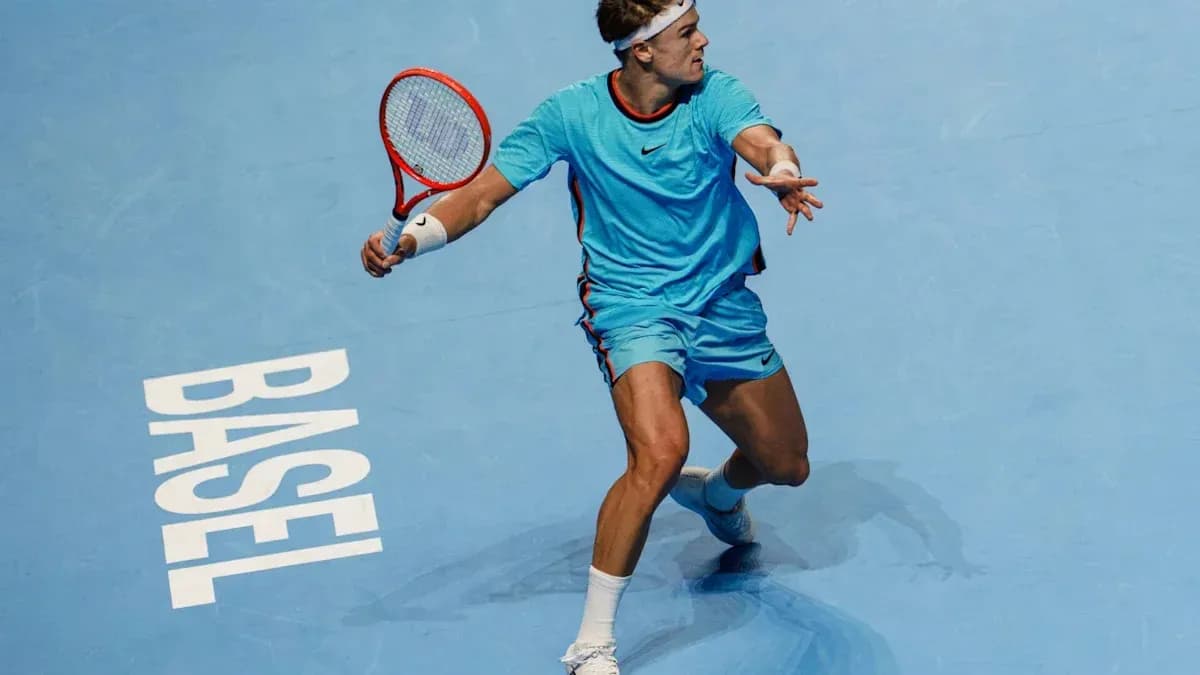
Holger Rune's Comeback: Signs of Resilience in Basel
Holger Rune is not all the way back yet. But in Basel, for the first time in almost a year, he finally looks like a player on his way somewhere again.
The numbers alone tell you how long the road has been. An Achilles injury on 18 October 2025 in the Stockholm Open semi-final, suffered while leading Ugo Humbert by a set. A Davis Cup cameo to test the body. Then, at ATP Tour level, nothing until 1 October this year. From injury to official return: 348 days. From his last tour-level win to his next one: 373 days.
That is not a blip. That is a career put on pause.
From rust to resistance
The restart was always going to be ugly. Rune’s first real step back came in Japan, where Kyrian Jacquet brushed him aside with uncomfortable ease. The timing was off, the explosiveness missing, the confidence nowhere to be seen. Rune knew it, too, and apologised for the level he had shown.
Shanghai brought another first-round exit, and nobody inside his camp could realistically have been surprised. Eleven months out with a serious Achilles problem does not dissolve in a couple of matches. What mattered more was that the second loss looked different from the first: more bite in the rallies, more willingness to stay in the fight, a hint of the old competitive edge.
Those were only fragments. Basel has turned them into something more solid.
Basel brings a breakthrough
Rune arrived in Switzerland with his decision to withdraw from Brussels still fresh and widely understood. He needed to listen to his body, not his impatience. That call now looks like the right one.
His first match in Basel delivered what he had been chasing for over a year: a tour-level win. It did not come easily. Quentin Halys pushed him into a deciding-set tiebreak, and this is where the old Rune resurfaced. He hung on, absorbed pressure, then edged clear when it mattered. For a player feeling his way back from a long lay-off, the physical and mental demands of a third-set breaker are a serious test. He passed it.
The real statement came next. Hubert Hurkacz, one of the form players on tour, stood across the net. Rune dragged him into another three-set scrap and again refused to fold in the tiebreak. Beating an in-form top opponent in that manner is not a fluke. It is evidence that the fitness work, the rehab, the endless drills away from the spotlight have rebuilt a base sturdy enough for high-level tennis.
His run ended against Valentin Vacherot in a battling three-set defeat, but that result does not puncture the optimism. If anything, it reinforces the pattern: Rune is staying in long matches, pushing his body, testing the Achilles under real stress. He is not fading away physically, not shrinking from tight scorelines.
A long road, a clear horizon
To understand why Basel feels significant, you have to stack Rune’s journey against the broader landscape of men’s tennis this season. Carlos Alcaraz’s five-month absence has been dissected in detail. Jannik Sinner’s early shutdown has drawn sympathy and concern. Rune’s ordeal has stretched even longer, with almost a full year carved out of a crucial phase in his development.
This is why each step now matters. The apologetic performance in Japan. The signs of life in Shanghai. The decision to skip Brussels. The grind of back-to-back three-set wins in Basel. They form a line, and that line is finally pointing in the right direction.
What comes next is almost as important as what has just happened. A proper off-season now awaits him, the first chance since the injury to build rather than simply repair. Time to strengthen the Achilles further, to restore the explosive movement that underpins his aggressive game, to arrive in Australia not just hoping to compete, but expecting to contend.
Rune is not yet the finished product after injury. But the hesitation has gone. The results in Basel are not a fairy-tale comeback, they are something more valuable for a 23-year-old who has spent 11 months and 13 days in limbo: proof that the player he was has not disappeared, only been delayed.
If this is what he looks like at the end of a stop-start year, how dangerous might he be when he hits Melbourne with a full off-season behind him?