India’s Under-19s Secure Asia Cup in Dramatic Last-Ball Finish
India’s next generation chose chaos as their stage.
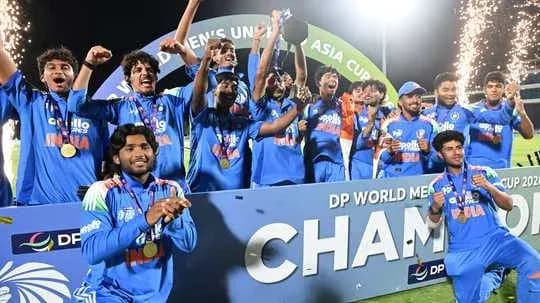
Staring at defeat in Al Amerat, nine wickets down and 29 still needed off fewer than three overs in a chase of 338, India’s Under-19s pulled off a heist that will live long in age‑group folklore. The last pair refused to blink, dragged the game into the final delivery, and then watched Mohit Ulva carve a boundary with three needed off one ball to snatch the Asia Cup out of Pakistan’s hands.
The Indian dugout exploded. Players sprinted onto the outfield, staff followed, and a match that had seemed to be sliding inexorably towards Pakistan ended in a blur of blue shirts and disbelief.
A chase that kept fraying at the edges
India did not begin this pursuit like a side chasing 338. The openers took their time, prodding and leaving, feeling their way into the surface. Then Aaryavir Sehwag changed the mood.
The right-hander, who would finish the tournament as its standout performer and Player of the Tournament, shifted gears and began to dictate terms. He drove on the up, picked off anything short, and rattled to his fourth fifty-plus score of the competition. For a while, Pakistan’s new-ball burst looked blunted.
He could not turn that platform into a defining hundred, though, and with his dismissal the chase never quite settled. Lakshaya Raichandani anchored from the other end, but his half-century took 72 balls. Useful, steady, but as the asking rate crept, India needed more than steadiness.
Pakistan sensed it. They kept chipping away, refusing to allow any partnership to run unchecked. Every time India tried to build, a wicket cut them back down. The required rate nudged, then surged.
Then came a surge of Indian intent. Raichandani and Anvay Dravid finally broke loose, threading gaps and finding the rope in a burst of boundaries that briefly tilted the game back towards the chase. The field spread, the bowlers searched for answers, and the scoreboard began to tick at the pace India had been craving.
Just as it looked like the decisive stand, Pakistan slammed the door. Both batters fell off successive deliveries, and with that double strike the equation turned brutal. The body language told its own story: Pakistan upright and loud in the field, India suddenly quiet, the chase apparently broken.
Chauhan lights the fuse
Into that tension walked Manal Chauhan, and he refused to accept the script.
He counterpunched. Anything with width disappeared square, anything too full went straight. While wickets continued to tumble around him, Chauhan kept India alive, shredding the gap between runs required and balls remaining with bold, uncluttered hitting.
The chase, once orderly, had become a knife-edge thriller.
When Chauhan and Ulva came together for the final wicket, Pakistan still held the cards. India needed too many, with too little batting left. Yet the pair swung hard at those odds.
They went after the death bowling with clear intent, turning the last overs into a boundary hunt. The fielders on the rope suddenly had work to do. Every clean strike shifted the pressure, every scrambled two dragged the game back from the brink.
Then, another twist. The ninth wicket fell in the 48th over. Pakistan, at that point, would have backed themselves all day. One more mistake, one mistimed swing, and they would be Asia Cup champions.
Ulva had other plans.
He opened the penultimate over with a four and a six, ripping open the equation and rattling Pakistan’s composure. By the time the over ended, India needed just eight from the final six balls. Achievable, but with a single wicket in hand, still fraught with risk.
Ahmed Hussain took the ball and almost pulled it back. He nailed his lines, dragged the contest deep, and forced it to the final delivery with India still needing three. One ball, one shot, one trophy.
Ulva found his moment. He connected sweetly, the ball sped to the rope, and the Asia Cup was India’s in the most dramatic fashion imaginable.
Pakistan’s dominance, and the collapse that lingered
All of this drama came only because Pakistan had bossed the first half of the day.
Usman Khan once again delivered at the top of the order, compiling a composed, well-crafted century that set the tone for a huge total. He read the surface, picked his moments, and gave Pakistan exactly the base they wanted for a final.
Abdul Qadir then tore into India’s attack. His 80 off just 54 balls was a statement of intent, a whirlwind innings built on pure power and clean ball-striking. Eight times he cleared the ropes, each blow widening the gulf between the sides and forcing India’s bowlers into damage control.
When Qadir fell, Pakistan were already well placed. Captain Farhan Yousuf ensured the momentum did not stall, launching his own half-century to keep the pressure relentless. At 299 for 3 after 44 overs, Pakistan stood on the brink of a monstrous total and, realistically, one hand on the trophy.
Then came the slide.
In the space of six overs, a commanding position frayed into something far more vulnerable. Wickets began to tumble, the fluency vanished, and the final acceleration never arrived. From 299 for 3, Pakistan closed on 337, losing six wickets while adding only 38 runs.
At the time, it felt like a missed chance. By the end of the night, it looked like the turning point.
Those 15, 20, 25 runs left on the table grew heavier with every boundary from Chauhan and Ulva. A few more at the death, and that last over might never have mattered.
Instead, it became the stage for a finale that will follow this group of Indian youngsters for years. A last-ball boundary, a title wrestled from the brink, and a reminder that at Under-19 level, with careers just beginning, the game has a habit of revealing who truly wants the big moment.