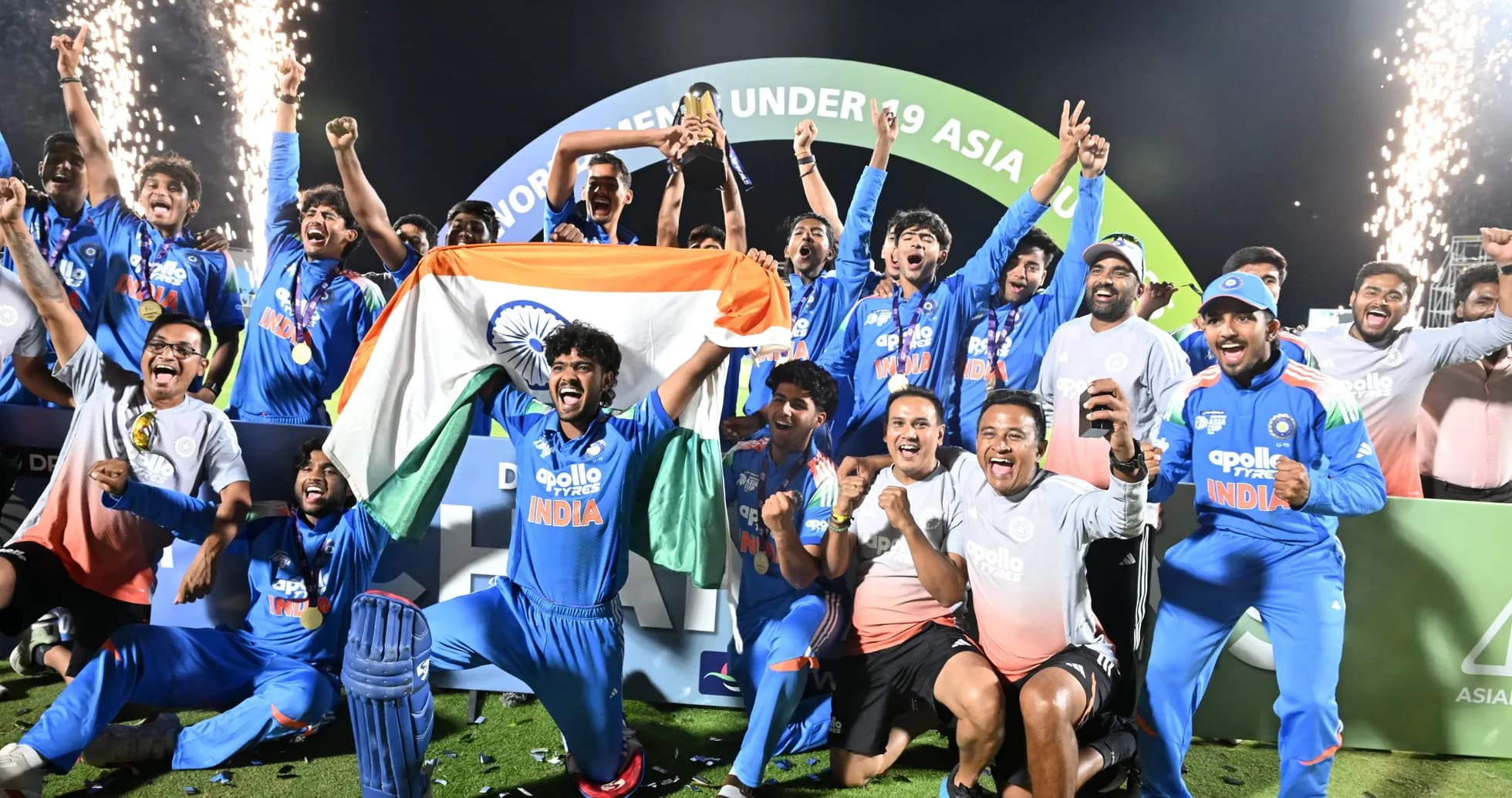
India U19 Win Asia Cup in Thrilling Last-Ball Finish Against Pakistan
Under the Omani lights at Al Amerat, with the equation boiled down to three runs from one ball and a continental title on the line, a No. 10 batter wrote himself into youth-cricket folklore.
Mohit Ulva, 18 years old and batting with the last man, skipped down the track to the final delivery of the 2026 ACC Men’s U19 Asia Cup, swung hard, and threaded the ball to the boundary. India U19, dead and buried more than once in this chase, surged past Pakistan by one wicket to claim the trophy with 339 for 9, hunting down 338 in a final that will sit in the memory for a long time.
The scoreboard will show Ulva unbeaten on 49 from 26 balls. It will not show the nerves, the pauses, the deep breaths between deliveries of that last over.
Eight needed. One wicket in hand. A Pakistan attack circling.
Ulva did not blink.
A chase that twisted and turned
India’s pursuit began with none of the chaos that would come later. Captain Lakshya Raichandani and Aaryavir Sehwag walked out with clarity and purpose, and for 95 runs they gave Pakistan nothing.
Sehwag was the early aggressor, threading gaps and forcing the pace in a 58 from 61 balls that set the tone. At the other end, Raichandani played the grown-up’s hand in a teenager’s game. His 80 off 101 deliveries was measured, almost understated, the kind of innings that holds a chase together even as it frays at the edges.
For a while, India looked in control.
Then the final turned.
Pakistan’s bowlers chipped away. A wicket, then another. The run rate nudged up; the dressing room grew tense. From comfort, India stumbled into crisis. At 252 for 8, with the top order back in the pavilion and the target still distant, the Asia Cup seemed to be slipping away.
The pressure, this time, came from the scoreboard as much as from the opposition.
Manal Chauhan lights the spark
India needed a disruptor, someone to punch back against the tide. Manal Chauhan stepped into that role.
Batting at the death with little margin for error, he counter-attacked with 47 off 32 balls, refusing to let the game drift. Boundaries came, the required rate eased, and belief crept back into Indian minds.
Crucially, Chauhan found support in Ulva. The pair stitched together 57 invaluable runs for the ninth wicket, transforming a near-hopeless equation into something just about manageable. Every run felt loaded; every misfield, every single stolen, carried weight.
When Chauhan finally fell, India were still short and still vulnerable. But the contest had changed. Pakistan no longer had a stranglehold. They had a problem: Ulva was set, swinging freely, and running out of partners.
Last-wicket stand, last-over drama
Chigurupati Venkata, playing his first match of the tournament, walked in at No. 11 into a cauldron, not a debut. He finished with an unbeaten 11 from 8 balls, but those numbers barely hint at his composure.
He blocked when he had to. He ran hard. He trusted Ulva.
Together, they put on an unbroken 30 for the final wicket, inching India towards the line while Pakistan hunted that one, decisive mistake. Every dot ball tightened the tension; every run was cheered like a boundary.
Then came the final over. Eight required. One wicket in hand.
Pakistan sensed their moment. India, having already lost to the same opponents in the group stage, stared at the possibility of heartbreak.
The over swung back and forth until it came down to the last ball: three runs needed. Tie on the cards, Super Over looming, nerves shredded on both sides.
Ulva chose clarity over caution. Down the track he charged, meeting the ball with a clean swing and sending it racing to the rope. No need to run. No need for a Super Over. India were champions.
Pakistan’s imposing total
That India even had a target to chase of 338 spoke to the dominance of Pakistan’s top order earlier in the day.
Given first use of a true batting surface, they made it count. Usman Khan anchored the innings with a superb 107 from 111 deliveries, the kind of century that gives everyone else the freedom to attack. Around him, Abdul Qadir cut loose with a blistering 80 off just 54 balls, seizing the middle overs and driving Pakistan towards a towering total.
Captain Farhan Yousaf added 63 from 60, ensuring the momentum never dipped. Pakistan kept the board moving, found the boundary regularly, and at 337 for 9, walked off with a total that looked, for long stretches, match-winning.
India, though, found heroes with the ball too. Kavya Patel’s 4 for 68 stood out on a tough day for bowlers, his breakthroughs preventing Pakistan from pushing beyond reach. Venkata, before his calm with the bat, had already impressed with the ball, taking 3 for 40 and checking Pakistan’s late surge.
Those wickets, as it turned out, mattered. Every run Pakistan didn’t get was one less India needed at the death.
Revenge, redemption, and a new set of names
This was not just a final. It was a rematch.
Pakistan had beaten India in the group stage, a result that stung and lingered. India carried that defeat into the knockout rounds, then into this title clash, and finally into those fraught closing overs when the game could have gone either way.
By the time Ulva’s last stroke pierced the field, the arc was complete. India had chased 338, overturned their earlier loss, and lifted the U19 Asia Cup with a one-wicket win that will be replayed and retold for years.
Ulva, fittingly, walked away with the Player of the Match award for his unbeaten 49 from 26 balls. Yet this was a victory built on layers: Raichandani’s calm 80, Sehwag’s brisk 58, Chauhan’s fearless 47, Patel and Venkata’s spells, and Venkata’s nerveless 11 not out at the very end.
A youth tournament is supposed to offer a glimpse of the future. In Al Amerat, it did more than that. It asked a tantalising question: when these names return in senior colours, how many more nights like this will they shape?