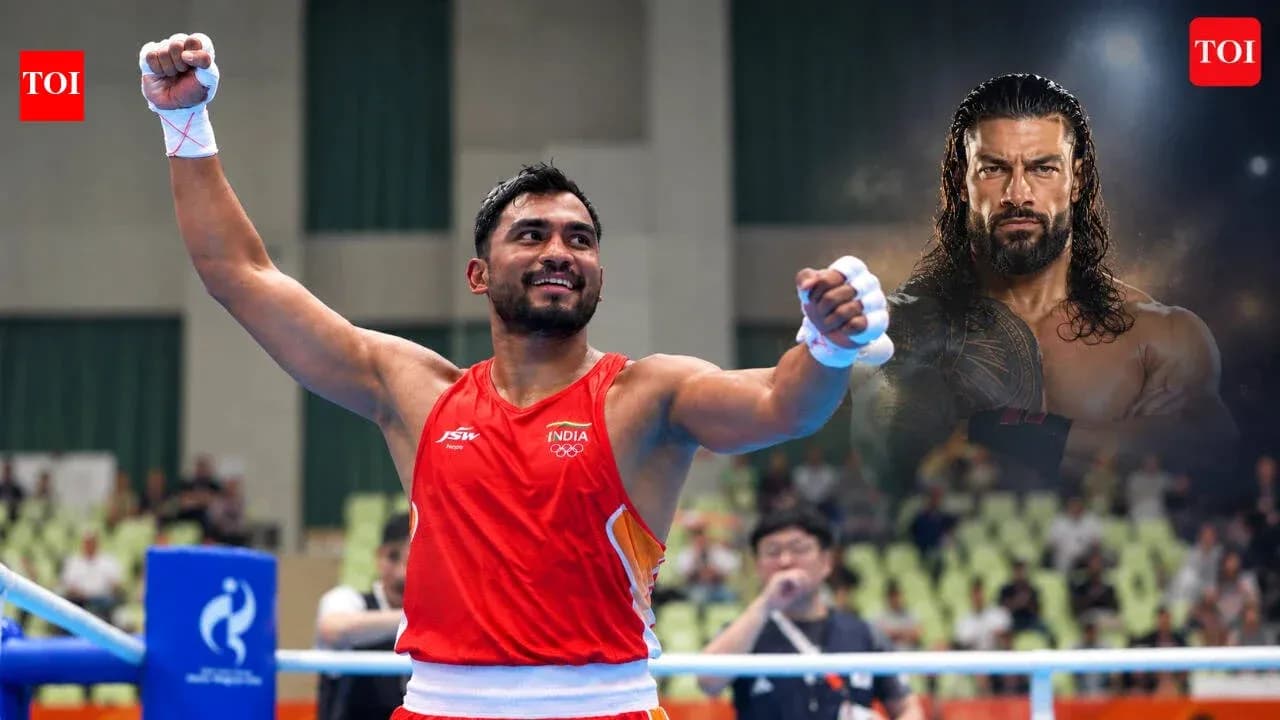
Kapil Pokhariya: From WWE Dreams to Asian Games Bronze
In a small house in Chakarpur village, the furniture never stood a chance.
Mattresses were launching pads. Pillows were sparring partners. A sack stuffed with mountain soil swung from a makeshift rope, taking punch after punch from a boy who had no idea where those wild swings might one day land him.
That boy, Kapil Pokhariya, is now an Asian Games medallist.
From Roman Reigns to real punches
Long before he climbed into a proper boxing ring, Kapil’s world revolved around WWE on television. Roman Reigns wasn’t just a favourite; he was an obsession. Kapil would skip meals, skip playtime, skip outings, just to watch him perform. The moment the show ended, the living room turned into his arena.
He leapt onto cotton-filled mattresses. He hammered pillows. He hurled them over walls. Then he took it a step further, filling a sack with soil from the hills and battering it like a pro’s heavy bag.
“I never knew that copying Roman Reigns and practising those punches would bring me this far,” he told TimesofIndia.com. He saved recordings of Reigns’ matches. He still has them. WrestleMania and Money in the Bank were his holy nights.
Those copied punches have now carried him to the podium at the 2026 Asian Games in Aichi-Nagoya, Japan, where the Indian Army havaldar claimed bronze in the men’s 90kg boxing event.
From Khatima’s bylanes to the Asian Games podium
Chakarpur, in Khatima, Uttarakhand, is a long way from India’s established boxing hotbeds. There were no famous champions on the walls. No big-name academies. Just a father with a simple dream.
Narendra Singh Pokhariya, an Indian Army man himself, wanted his son to study hard and join the forces as a commissioned officer. Boxing wasn’t in the plan. It wasn’t even on the fringes.
So when he saw young Kapil slamming into furniture, copying WWE stars, his reaction was instinctive. First came the scoldings. Then the beatings. Things were getting broken around the house, and to a father who had walked the straight Army line, this all looked like a distraction.
The turning point came quietly.
One day, Narendra watched his son come home from school, drag out a thick sack, fill it with sand, and start punching it with everything he had. No TV cameras. No crowd. Just a boy and his stubbornness.
Nearby, a teacher was conducting boxing classes at a local school. Kapil had seen the students punching a proper bag and decided to make his own. That homemade bag, and that relentless routine, forced his father to look again.
“My father scolded me in the beginning,” Kapil recalled. “But later he took me to a training centre and got me admitted there. That is how I got into boxing.”
A tiny training ground, a big first fall
There was no glittering academy waiting for him. Kapil’s first steps came on a small training ground, surrounded by boys his age and older, all trying to learn the basics in limited hours.
The sessions were short. The group was small. The man in charge, coach Pooran Bohra, would come in only on selected days of the week. For many, it was casual sport. For Kapil, it became something else.
“I listened to him carefully and repeated everything he taught me when I returned home,” he said. Every instruction from Bohra was replayed later on that sack of sand.
By 2015, he was ready for his first state-level competition. Or so he thought.
The crowd was bigger than anything he had seen. The lights felt harsher. The nerves kicked in. His first competitive bout ended almost as soon as it began — a loss in the opening round.
“I was really disappointed,” he admitted. The stage overwhelmed him. The defeat stung. But something else happened that day. Instead of shrinking, his interest in boxing deepened. The setback hardened his resolve.
He went back to work.
National gold and an Army uniform
When he returned at the national level, he was a different fighter. The raw enthusiasm remained, but the edges were sharper. This time, he didn’t just win bouts. He won the gold medal.
The medal changed his career. The prize money came first. Then came the life-altering call — a job with the Indian Army.
In April 2017, Kapil joined the force and was appointed as a havaldar. The ring that once existed only in his imagination now became his workplace.
The Army opened doors: better facilities, stronger sparring partners, regular Services competitions. He grabbed the chance, winning medals and steadily growing into a serious contender in the 90kg category.
His father, who had joined the Army as a sepoy and retired as a havaldar, had always wanted his son to climb higher in rank. Boxing gave Kapil a different route to that dream.
“The day I won a national medal, he hugged me,” Kapil said. “That was when I realised that I had achieved something big in my life.”
The Asian Games bronze has taken that pride to another level. With the medal comes a promotion to naib subedar.
“Papa said, ‘Ab tu mera senior ho gaya hai’,” Kapil recalled, smiling. The boy who once got scolded for breaking things at home now outranks the man who first wore the uniform.
‘Khatima ka Russell’
Boxing wasn’t his only love growing up. Like countless Indian kids, Kapil spent long days with a bat in hand, playing gully cricket and inter-village matches across Uttarakhand.
He was hard to miss. Tall. Muscular. And when he swung the bat, the ball disappeared. Big sixes flew off his blade, and with them came a nickname that stuck — “Khatima ka Russell”.
“I loved Andre Russell. I also liked Hardik Pandya,” he said. Local captains wanted him in their team for one simple reason: he could clear the boundary with ease. The power that would one day drive his right hand in the ring first made its name on dusty cricket grounds.
The bat is gone now. The punch remains.
Eyes on Astana, heart set on Los Angeles
The Asian Games bronze is not the destination. For Kapil, it is a marker on a much longer road.
Under the Boxing Federation of India’s selection criteria, Asian Games medallists become the main entries in their weight categories for the 2027 World Boxing Championships in Astana, Kazakhstan. That tournament, scheduled for April, will be the first qualifying event for the Los Angeles 2028 Olympic Games.
The stakes could not be higher. Nor could his focus.
“Rukna nahi hai ab, bas aage dekhna hai,” he said. There is no talk of slowing down. No temptation to bask in what he has already done.
“The Olympics is the ultimate dream. I want to go there, represent my country and win a medal. That is the only thing on my mind right now. I am preparing for the World Championships in April.”
From a homemade sandbag in Khatima to the bright lights of Aichi-Nagoya, his punches have already travelled a long way. The next question is simple, and it will define the next two years of his life: can the boy who once copied Roman Reigns now punch his own name into Olympic history in Los Angeles?