Kauno Žalgiris vs Dinamo Zagreb: Tactical Analysis of 4-1-4-1 and 4-3-3
Kauno Žalgiris’ 4-1-4-1 against Dinamo Zagreb’s 4-3-3 produced a clear stylistic contrast at Steponas Darius and Stasys Girenas: territorial control and volume from the hosts versus structural efficiency and early incision from the visitors. The statistical profile is stark: Kauno Žalgiris had 61% possession, 7 shots on goal and 8 corners, yet trailed 0-2 by half-time and ultimately lost 1-2. Dinamo Zagreb, with only 39% of the ball and 5 shots on goal, converted their early dominance into a lead they then managed through shape, game-state control and, after the red card, disciplined compactness.
Kauno Žalgiris’ 4-1-4-1, with F. Baldassarra as the single pivot ahead of a back four, was built to progress through the thirds and flood the second line with M. Burba, A. Benchaib, V. Slivka and L. Krekovic supporting Renan Oliveira. The early pattern, however, showed structural vulnerability in defensive transition. Two quick bookings – Anton Tolordava at 10' and Joris Moutachy at 11', both for “Foul” – signalled a back line struggling to cope with Dinamo’s first-wave movements. With the full-backs high and the pivot often occupied by Dinamo’s interior rotations, the channels either side of Tolordava and R. Lekiatas were repeatedly exposed.
Dinamo Zagreb’s Approach
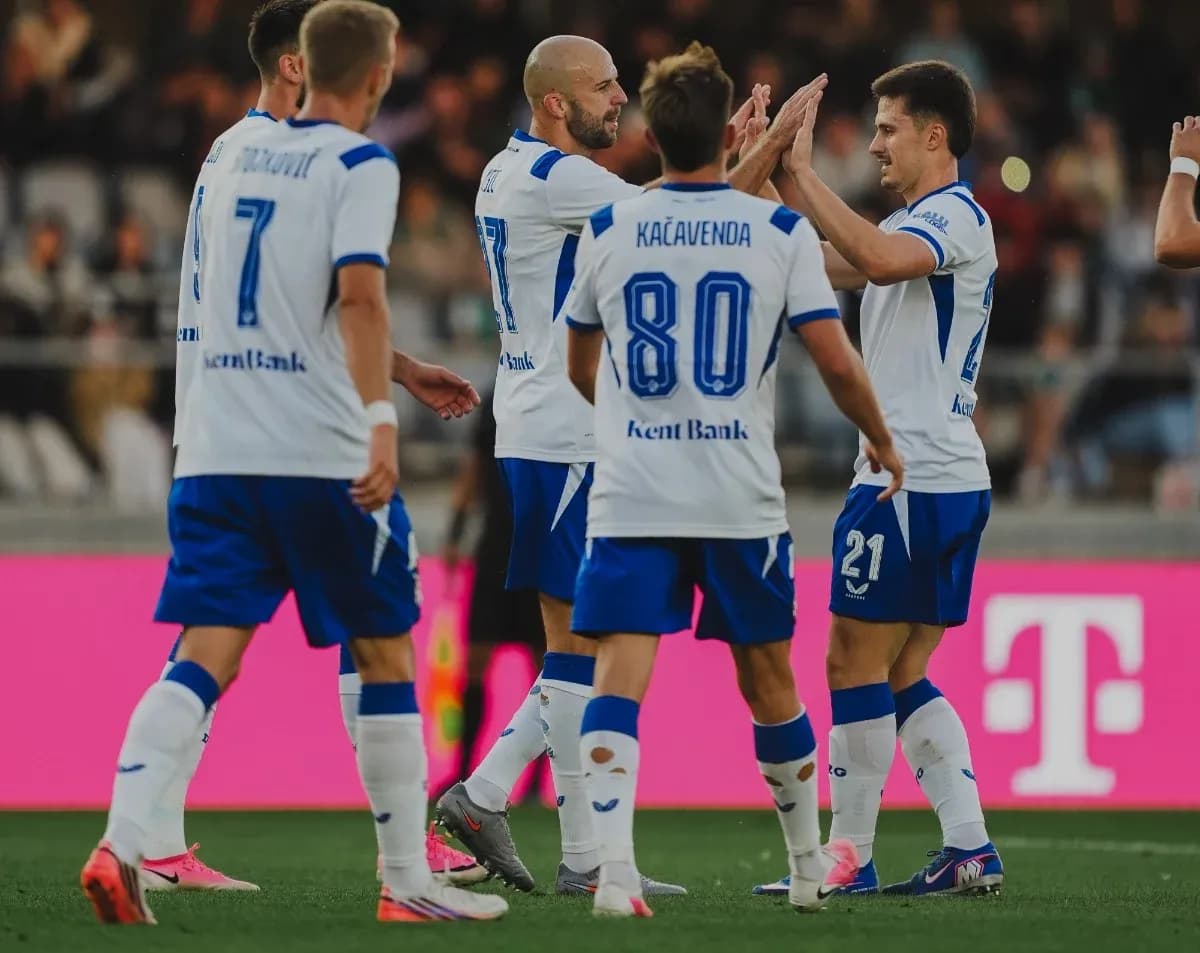
Dinamo Zagreb’s 4-3-3 under Mario Kovacevic was aggressive without the ball in the opening phase. J. Misic sat as the central controller, with L. Kacavenda and L. Stojkovic stepping higher to press Baldassarra and the centre-backs, while the front line – M. Orsic tucking in from the left and D. Beljo leading – targeted direct runs into the inside channels. The first goal at 19' encapsulated that plan: L. Kacavenda’s forward run from midfield, assisted by D. Beljo, exploited the space between Kauno Žalgiris’ lines, punishing a structure that had not yet settled into a compact mid-block.
The second goal at 30', scored by J. Misic, underlined Dinamo’s superiority in verticality rather than volume. Despite being under-dog in possession, Dinamo generated 5 shots on goal from just 1 corner and fewer overall attacks, showing that their 4-3-3 was calibrated to reach high-quality shooting zones quickly rather than sustain long sequences. Misic’s strike, coming from midfield, also reflected the freedom afforded to Dinamo’s interiors whenever Kauno Žalgiris’ double line of four was stretched horizontally.
Tactical Adjustments
The game’s tactical hinge came at 32' when Ivan Filipović (Dinamo Zagreb) was sent off for “Foul”. Reduced to ten men and forced into a goalkeeper reshuffle, Dinamo immediately adjusted their structure. At 34', M. Lisica (OUT) made way for I. Nevistic (IN), with the visitors effectively shifting from a proactive 4-3-3 to a more conservative, compact 4-4-1 out of possession. The wide midfielders dropped deeper to protect the full-backs, and the block narrowed considerably, prioritising central protection and forcing Kauno Žalgiris to circulate around the outside.
From that point, the statistical story flipped: Kauno Žalgiris dominated the ball, piling up 61% possession, 7 shots on goal, 7 shots off goal and 8 corners. However, their attacking structure often lacked vertical penetration. With Dinamo’s block deep and narrow, Kauno Žalgiris’ full-backs – Moutachy and M. Konatar – pushed high, but the timing of runs into the box was inconsistent. The hosts matched Dinamo’s 4 blocked shots, but too many of their attempts came from crowded zones, reflecting predictable crossing patterns rather than dynamic third-man combinations.
Eivinas Cerniauskas’ in-game management sought to correct that. The 46' substitution – Renan Oliveira (OUT), G. Debeljuh (IN) – reprofiled the front line with a more penalty-box-oriented forward. Shortly after the break, Dinamo also reshaped: M. Perez Vinlof (OUT), B. Goda (IN) and L. Stojkovic (OUT), G. Vidovic (IN) at 46' indicated a shift toward fresh legs in wide and midfield areas to sustain the defensive workload with ten men.
The payoff for Kauno Žalgiris came at 56', when G. Debeljuh scored to make it 1-2. The goal symbolised the value of a true reference point in the box against a deep block; with Debeljuh occupying centre-backs and attacking crosses more aggressively, Kauno Žalgiris finally translated their territorial dominance into a breakthrough. Cerniauskas doubled down on attacking intent at 57', with L. Krekovic (OUT), Leo Ribeiro (IN) and M. Burba (OUT), I. Fiolic (IN), adding fresh creativity and ball-carrying between the lines.
Further changes at 66' – F. Baldassarra (OUT), A. Kalik (IN) – pushed Kauno Žalgiris towards a more attacking double pivot profile, sacrificing some screening in front of the defence to maintain pressure. At 79', A. Benchaib (OUT), F. Ourega (IN) refreshed the wide attacking lane, but by then Dinamo’s low block was deeply entrenched. Despite Kauno Žalgiris’ volume of shots and corners, Dinamo’s compactness and disciplined line management restricted the hosts to largely manageable situations.
Game-State Management
Dinamo’s substitutions were almost entirely game-state driven. At 61', D. Beljo (OUT), F. Topic (IN) allowed Kovacevic to maintain a central outlet for clearances and counter-pressure, while at 72' L. Kacavenda (OUT), N. Galesic (IN) added defensive solidity in midfield, prioritising legs and duelling capacity over creative output. The 54' yellow card to Dion Drena Beljo for “Foul” was an isolated disciplinary event within an otherwise controlled defensive performance: Dinamo finished with 8 fouls, 1 yellow and 1 red, compared to Kauno Žalgiris’ 14 fouls and 2 yellows.
Statistically, the match reads as a classic case of efficiency versus volume. Kauno Žalgiris’ higher foul count and early bookings point to structural stress in the first half, while their later shot and corner dominance reflect the numerical advantage and territorial siege after the red card. Dinamo Zagreb, with fewer shots and far less possession, maximised the early phase of their 4-3-3, then executed a disciplined, compact defensive strategy with ten men, leveraging shape and substitutions to protect the 1-2 scoreline through to full time in this 3rd Qualifying Round tie.