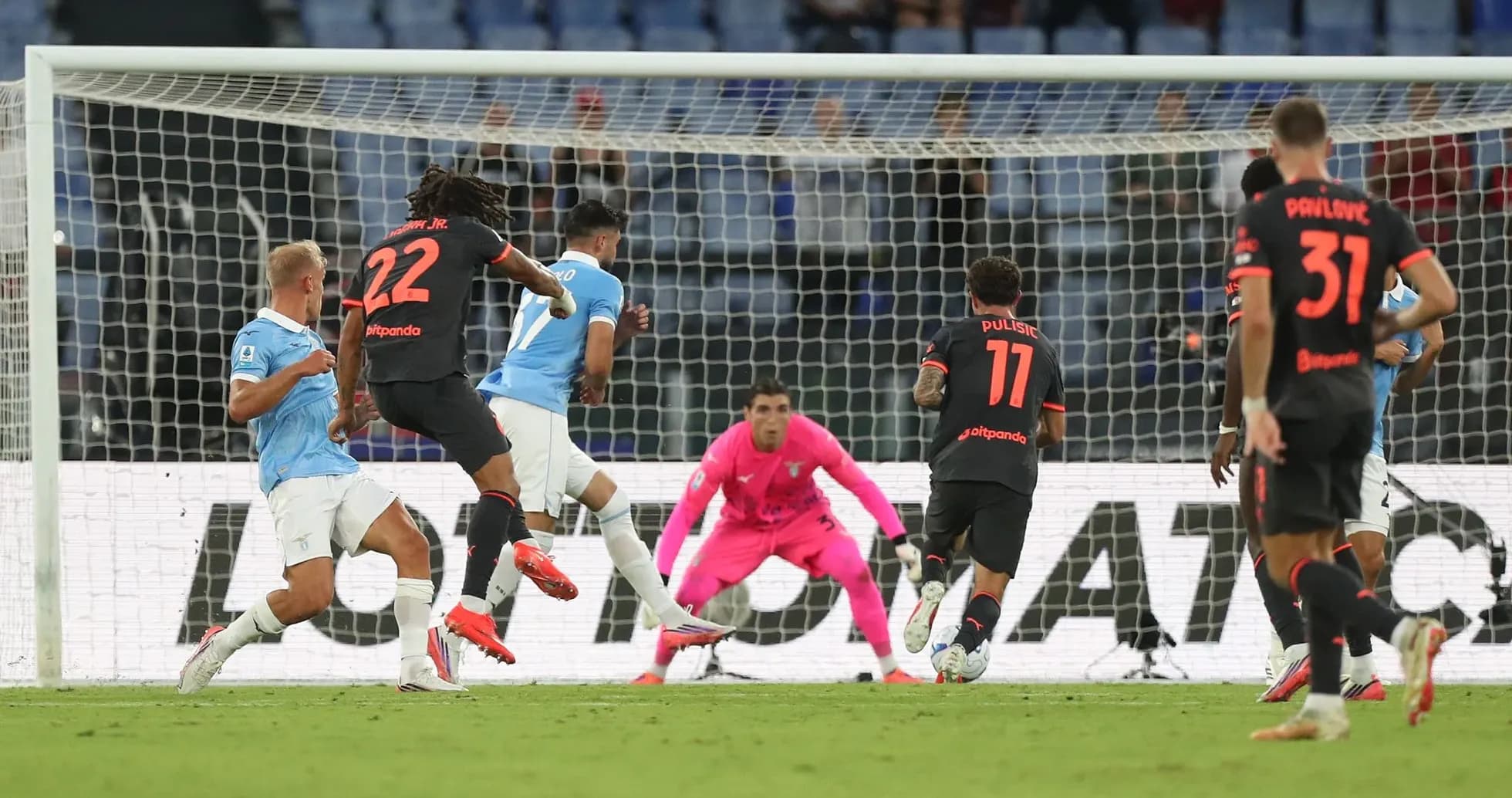
Lazio and AC Milan: A Tactical Analysis of Their Serie A Clash
The Stadio Olimpico had already told its story: a 2–0 lead surrendered, a 2–2 full‑time draw, and yet both Lazio and AC Milan walked off the pitch looking very much like sides built for the long haul of a Serie A season. This was Round 4, and the table underlined it. Following this result, Lazio sat 4th on 10 points with a goal difference of +3 (6 scored, 3 conceded), Milan 6th on 8 points, also with a goal difference of +3 (7 scored, 4 conceded). Two unbeaten teams, two distinct identities, and one match that exposed both their strengths and their structural doubts.
I. The Big Picture – Structures, streaks, and seasonal DNA
Lazio’s campaign has been defined by control and efficiency. Overall this season they have played 4 league matches, winning 3 and drawing 1, with no defeats. At home, they have played 2, winning 1 and drawing 1, scoring 3 and conceding 2. On their travels they have been perfect: 2 wins from 2, 3 goals for and just 1 against. Their attacking profile is remarkably symmetrical – 3 goals at home and 3 away – with an overall scoring average of 1.5 goals per match in total, mirrored exactly at home and away. Defensively, they have conceded 2 at home and 1 away, for 3 in total, an overall average of 0.8 goals against per match, with 1.0 at home and 0.5 on their travels. Two clean sheets in 4 underline a team that generally keeps things under control.
AC Milan’s unbeaten run is cut from a slightly different cloth. They have also played 4 in total, winning 2 and drawing 2, with no losses. At San Siro they have only played once so far, winning 2–0. Away, they have played 3 times, with 1 win and 2 draws, scoring 5 and conceding 4. Their attack is a touch more explosive: 7 goals in total, with an overall average of 1.8 goals per match, split into 2.0 at home and 1.7 on their travels. Defensively, they have conceded 4 in total – none at home, 4 away – for an overall average of 1.0 goals against, 0.0 at home and 1.3 away. Just one clean sheet, that home win, hints at a side that can be opened up when forced to defend higher and wider.
II. Tactical Voids – Absences and discipline
Lazio’s squad for this fixture was stretched in key defensive and midfield zones. F. Dele‑Bashiru (muscle injury), D. Doekhi (hand injury), A. Furlanetto (knee injury), A. Marusic (muscle injury), Patric (ankle injury), L. Pellegrini and N. Rovella (both listed simply as injured) were all missing. That is a significant chunk of defensive depth and rotational control removed from Gennaro Gattuso’s options. It explains why the back four of R. Floriani, J. Sutalo, O. Provstgaard and N. Tavares had to carry heavy minutes, with little like‑for‑like cover beyond D. Leite, A. Pedraza and R. Bordon on the bench.
Disciplinary trends sharpen the picture. Lazio’s yellow cards this season are spread but with clear hot zones: 25.00% between 16–30 minutes, another 25.00% between 31–45, 12.50% between 61–75, 12.50% between 76–90, and another 25.00% in added time between 91–105. This is a side that increasingly lives on the edge as halves close, particularly late in games when fatigue and game‑state pressure rise.
Milan, by contrast, have concentrated their cautions in the second half and stoppage time: 25.00% of their yellows between 46–60 minutes, 25.00% between 61–75, 25.00% between 76–90, and 25.00% between 91–105. They tend to grow more aggressive as they chase or protect results after the interval. Notably, neither side has seen a red card in the league so far, but two of the protagonists here, M. Zaccagni and S. Pavlovic, already sit on 2 yellows each this season and shape the game’s disciplinary edge.
III. Key Matchups – Hunter vs Shield, Engine Room battles
The “Hunter vs Shield” duel is personified by Lazio’s Davide Frattesi against Milan’s back three. Frattesi, operating as the right‑sided central midfielder in the 4‑3‑3, has been one of Serie A’s early standout scorers: 3 goals in 4 appearances, from just 5 shots and 3 on target. He is not a volume shooter, but his timing is lethal. Add 78 passes with 82% accuracy and 3 key passes, plus 6 tackles and 3 successful blocks, and you get a box‑to‑box presence who arrives late into the area and then works furiously to counter‑press.
His runs collide with the “Shield” of Milan’s central defence, led by S. Pavlovic, flanked by M. Gila and K. De Winter in Ruben Amorim’s 3‑4‑2‑1. Pavlovic has been immense: 268 completed passes at 92% accuracy, 12 tackles, 1 block and 1 interception, and 29 duels won out of 40. He is aggressive stepping out of the line, but his 2 yellow cards show the cost of that front‑foot style. If Frattesi can drag him into wider channels or force him to defend the edge of the box against third‑man runs, Lazio can destabilise Milan’s structure.
On the flanks, the creative duel is just as compelling. For Milan, Samuel Chukwueze has 2 assists in 4 appearances, 150 completed passes with 10 key passes and 6 successful dribbles from 9 attempts. As a right‑sided midfielder in the line of four, he stretches play, then cuts inside to combine with A. Rabiot and the dual 10s, R. Loftus‑Cheek and A. Cisse. Chukwueze’s ability to carry the ball at speed into half‑spaces is Milan’s primary tool for prising open compact blocks.
Lazio’s reply comes from Mattia Zaccagni on the left of the front three. He also has 2 assists, with 10 shots (6 on target), 8 key passes and 10 dribbles attempted, 4 successful. He is both creator and agitator: 7 fouls drawn, 3 committed, 2 yellow cards. He repeatedly drives at the space outside the right centre‑back and wing‑back, an area where Milan’s 3‑4‑2‑1 can be vulnerable if the wide midfielder is caught high. The direct confrontation between Zaccagni and Milan’s right‑side defensive pair – often K. De Winter plus the nearest midfielder – is a pressure point that Lazio exploited in building their two‑goal first‑half advantage.
In the “Engine Room”, Rabiot’s presence is crucial for Milan. With 1 goal and 2 assists, 133 passes at 84% accuracy and 3 key passes, he links Modric’s orchestration with the front three. He also offers height and physicality in duels (21 contested, 8 won) and can drop into the back line when Milan morph into a back four in possession. Opposite him, R. Belahyane and K. Taylor must manage the balance between supporting Frattesi’s surges and screening counters when possession is lost.
IV. Statistical Prognosis – Trends beneath the 2–2
Following this result, the numbers still favour both sides as top‑six material. Lazio’s overall average of 1.5 goals scored and 0.8 conceded per match suggests a team whose xG profile should be positive: they do not need a flood of chances to win games, and their defensive record – 2 clean sheets in 4 – supports that. Milan’s overall 1.8 goals scored and 1.0 conceded per match paints a slightly more volatile picture, especially away where they average 1.7 scored and 1.3 conceded. Their away matches tend to be open, high‑event affairs, which this 2–2 draw neatly fits.
Card distributions hint at late‑game drama in future meetings. Lazio’s tendency to collect 25.00% of their yellows in stoppage time, and Milan’s even split of second‑half cautions, suggest that rematches could tilt on who manages emotional control in the final quarter‑hour and beyond.
From a tactical lens, Lazio’s 4‑3‑3 remains stable – it has been their only formation in all 4 league games – while Milan’s 3‑4‑2‑1 is equally entrenched, also used in all 4. This structural consistency, allied to efficient finishing from Frattesi and the creative weight of Zaccagni for Lazio, and the combined threat of Chukwueze, Rabiot and Cisse for Milan, points towards a season in which both sides will regularly generate strong xG numbers.
The 2–2 at the Olimpico, then, feels less like an anomaly and more like a preview: Lazio’s compact control against Milan’s expansive, wing‑driven aggression. Over the season, the balance of probabilities favours Lazio in tighter, lower‑scoring contests, especially at home, and Milan in more open games, particularly away. But when these two meet, the data and the eye test agree on one thing: the margins are thin, the late minutes are dangerous, and neither side is built to back down.