Liverpool vs Brentford: Tactical Battle Ends in Draw
Liverpool’s 1-1 draw with Brentford at Anfield was a study in territorial dominance versus structural resilience. Across 90 minutes, Liverpool’s 60% possession, 24 total shots and 14 corners framed a game they largely controlled, but Brentford’s compact 4-2-3-1 and clinical equaliser ensured the points were shared on the final day of the Premier League season.
Both sides mirrored each other structurally in a 4-2-3-1, but with very different intentions. Arne Slot’s Liverpool used the shape as an aggressive, high-possession platform. The back four of C. Jones, I. Konaté, V. van Dijk and A. Robertson set up high, allowing A. Mac Allister and R. Gravenberch to operate as a double pivot that constantly stepped into Brentford’s half. Ahead of them, M. Salah, D. Szoboszlai and R. Ngumoha supported central forward C. Gakpo, creating a fluid line of four that often resembled a 2-3-5 in settled attack.
Keith Andrews’ Brentford used the same base 4-2-3-1 but with a clear counter-punching brief. Full-backs M. Kayode and K. Lewis-Potter stayed relatively narrow, protecting the half-spaces in front of centre-backs S. van den Berg and Nathan Collins. The double pivot of J. Henderson and Vitaly Janelt shielded the back line, while D. Ouattara, M. Jensen and K. Schade supported lone forward I. Thiago in transition.
Liverpool’s dominance with the ball was backed by the data: 503 passes to Brentford’s 331, with Liverpool completing 434 accurate passes at 86% compared to Brentford’s 262 at 79%. That passing superiority underpinned sustained pressure, particularly down the flanks. Robertson’s advanced positioning on the left and Salah’s inside-right channel runs repeatedly pinned Brentford back, forcing their wingers into long defensive phases.
The breakthrough on 58 minutes encapsulated Liverpool’s territorial control and right-side focus. C. Jones, nominally a defender in the lineup, had the license to step high from the left side of the back four into midfield. His goal for Liverpool, assisted by M. Salah, reflected Liverpool’s ability to overload Brentford’s block and find late-arriving runners from deeper lines. By that stage, Liverpool had already accumulated a high shot volume, and their eventual xG of 2.9 accurately reflected the quality and quantity of chances created, especially inside the box (17 shots).
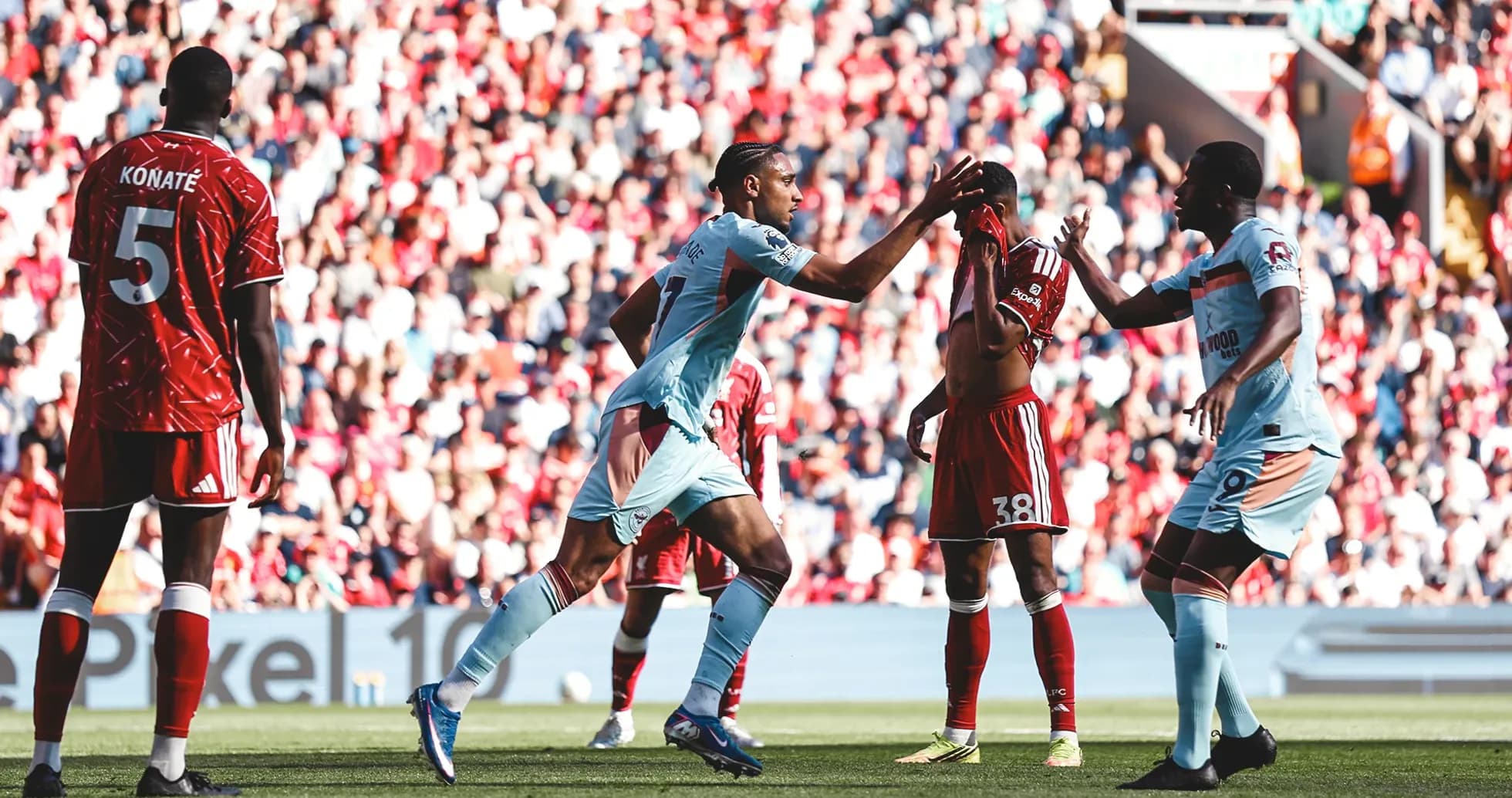
Brentford’s response, however, highlighted their transition threat and refusal to be overwhelmed. On 60 minutes, Andrews adjusted the structure: A. Hickey (IN) came on for J. Henderson (OUT), a substitution that freshened the right side and subtly rebalanced the defensive line. Four minutes later, Brentford struck. At 64', K. Schade scored for Brentford with no assist, a moment that came against the overall run of play but was consistent with their plan to spring quickly once possession was won. With 9 of their 11 shots coming from inside the box and an xG of 1.22, Brentford were selective but dangerous when they did break Liverpool’s lines.
From there, the game became a tactical arm wrestle of adjustments. At 73', F. Wirtz (IN) came on for R. Ngumoha (OUT), giving Liverpool a more creative presence between the lines. A minute later, J. Frimpong (IN) replaced M. Salah (OUT), adding direct running and width on the right to stretch Brentford’s increasingly compact block. The double change at 83' — M. Kerkez (IN) for A. Robertson (OUT) and T. Nyoni (IN) for R. Gravenberch (OUT) — suggested Slot was chasing fresh legs and slightly more verticality from full-back and midfield in the final phase. J. Gomez (IN) then replaced I. Konaté (OUT) at 89', a like-for-like change that maintained the high defensive line while adding energy.
Brentford’s bench moves were equally pragmatic. Alongside the earlier introduction of Hickey, M. Damsgaard (IN) replaced M. Jensen (OUT) at 83', offering more ball-carrying in transition, and R. Nelson (IN) came on for K. Lewis-Potter (OUT) at 89', providing pace for late counters. These changes helped Brentford survive the final waves of Liverpool pressure despite the home side’s 14 corners and constant crossing.
In goal, Alisson (Liverpool) and C. Kelleher (Brentford) both had clearly defined roles within their teams’ tactical identities. Alisson (Liverpool), despite facing only 2 shots on goal and making 1 save, functioned primarily as a high starting-position sweeper behind an aggressive line, enabling Liverpool to compress the pitch and keep Brentford penned in for long stretches. His goals prevented figure of 1.4 underlines the quality of the situations he did have to manage.
C. Kelleher (Brentford), by contrast, was under siege for much of the match. Brentford allowed 8 shots on goal and 24 total shots, yet Kelleher (Brentford) made 7 saves and also posted 1.4 goals prevented. Those numbers are consistent with the eye test of a goalkeeper repeatedly called upon to keep his side in the game, especially as Liverpool flooded the box with 17 shots inside it. His shot-stopping was central to Brentford turning a territorially lopsided contest into a point.
Discipline also played a subtle tactical role. Before kick-off, at -5', Jordan Henderson (Brentford) received a yellow card for "Argument", an early flashpoint that set an edge to Brentford’s midfield duels. Later, Liverpool’s high defensive aggression was reflected in bookings for Ibrahima Konaté (Liverpool) at 79' for "Foul" and Alexis Mac Allister (Liverpool) at 90+2' for "Foul", both indicative of counter-pressing tackles as Liverpool tried to prevent transitions. Brentford’s late-game emotional load showed in two more yellows for "Argument": Vitaly Janelt (Brentford) at 90+4' and Nathan Collins (Brentford) at 90+5', as they defended deep under sustained pressure.
Statistically, Liverpool’s attacking profile was clear: 24 total shots, 8 on goal, 8 blocked, and a heavy emphasis on central and box entries. Their 14 corners and 60% possession underscore how often they locked Brentford into their own third. Brentford’s 11 shots (2 on goal, 3 blocked) and 2 corners show a team content to attack in bursts rather than through long phases of build-up.
In the end, the numbers tell a story of a home side whose performance level, xG of 2.9 and volume of chances would usually yield more than a single goal, up against a visiting side whose defensive structure, goalkeeper excellence and efficiency (1.22 xG for 1 goal) allowed them to escape Anfield with a tactically hard-earned point.